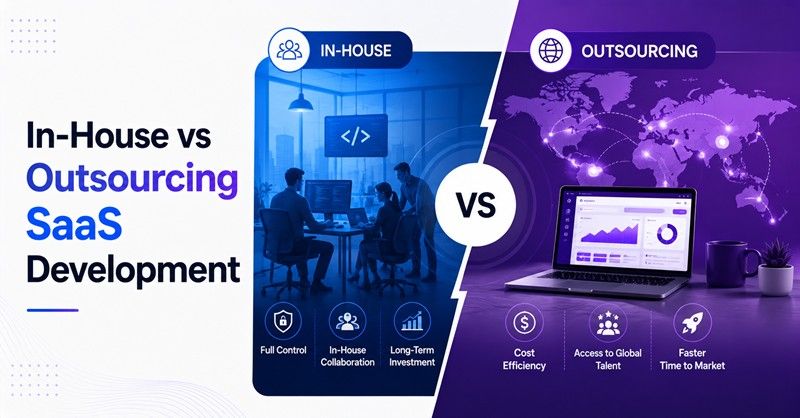
Outsource SaaS development when speed and budget matter most; build in-house when your product is your core IP and you have strong engineering leadership. Outsourcing delivers cost savings of 40–60% on average and cuts time-to-market by weeks or months, while in-house teams offer maximum control and long-term ownership. Most successful SaaS companies use a hybrid: outsource to launch, insource to scale.
You have the product vision. You have (some) budget. What you don’t have is 6 months to burn assembling an engineering team — or the appetite to hand your baby to strangers in another time zone.
That’s the tension at the heart of the in-house vs outsource SaaS debate, and getting it wrong is expensive in both directions. Build internally too early and you’ll spend your runway on recruiters instead of customers. Outsource carelessly and you’ll inherit code nobody on your side understands.
At Technobrave, we’ve sat on both sides of this table — as the outsourcing partner for startups shipping their first MVP, and as the augmentation layer for enterprises with 50-person internal teams. This guide gives you the decision framework we use with our own clients, backed by 2026 market data.
Key Takeaways:
- Outsourcing SaaS development typically reduces build costs by 40–60% compared to hiring an equivalent in-house team in the US or Western Europe, primarily through offshore and nearshore rate arbitrage and zero recruitment overhead.
- 83% are leveraging AI as part of their outsourced services (AI-powered outsourcing) (Deloitte Global Outsourcing Survey).
- The global IT services outsourcing market size was valued at USD 744.6 billion in 2024 and is projected to grow from USD 877.4 billion in 2026 to USD 1219.3 billion by 2030, at a CAGR of 8.6% from 2025 to 2030.
What Does It Mean to Outsource SaaS Development?
To outsource SaaS development means delegating the design, engineering, testing, and often the maintenance of your cloud product to an external partner, while you retain ownership of the product vision, roadmap, and IP.
In practice, SaaS development outsourcing comes in three engagement models. Project-based outsourcing hands a fixed scope to a vendor for a fixed price; ideal for well-defined MVPs. A dedicated development team gives you full-time engineers who work exclusively on your product under your direction, billed monthly. Staff augmentation plugs individual specialists (a DevOps engineer, an AI/ML developer) into your existing team to close skill gaps fast.
Geography matters too. Offshore partners (India, Eastern Europe, Southeast Asia) offer the deepest cost savings; nearshore partners trade some of that saving for time-zone overlap and easier real-time collaboration. A mature SaaS Development Company will help you choose the model; not just sell you the one they prefer.
What Is In-House SaaS Development, and When Does It Win?
In-house SaaS development means building your product entirely with employees on your own payroll; your architects, your developers, your QA, your DevOps.
The advantages are real: full control over architecture and coding standards, deep institutional knowledge that compounds over years, tighter IP protection, and instant communication. When your CEO wants to pivot the roadmap on a Tuesday, your team is already in the room.
The costs are equally real. A minimal in-house SaaS squad with two full-stack developers, a designer, a QA engineer, and a DevOps resource runs $700K–$900K per year fully loaded in the US once you add benefits, recruitment fees, tools, and infrastructure. And you can’t start until you’ve hired, which takes 3–6 months in a market where 74% of employers report difficulty finding skilled talent.
In-house wins when the product is the company, compliance demands are strict (HIPAA, SOC 2, PCI), and you’re funded for a multi-year horizon with engineering leadership already in place.
How Much Can You Really Save by Outsourcing?
Companies that outsource SaaS development typically realize cost savings of 40–60% versus building the same product with a US-based in-house team — and the savings come from more places than hourly rates.
The rate gap is the obvious part: a senior engineer costing $150K+ fully loaded in San Francisco maps to $40–$70/hour with a quality offshore or nearshore partner. But the hidden savings are just as significant: zero recruitment fees (typically 20–25% of first-year salary per hire), no idle bench time between releases, no severance risk, and no infrastructure or license spend.
The honest caveat: savings evaporate with the wrong partner. Rework, scope creep, and poor communication can erase the arbitrage — which is why vendor selection matters more than vendor rates. Our guide on How to Choose a SaaS Development Company covers the vetting process in depth.
How Do In-House and Outsourced Models Compare Side by Side?
Neither model wins on every axis — in-house dominates on control and institutional knowledge, while outsourcing dominates on speed, flexibility, and cost. Here’s the full picture:
| Criteria | In-House Development | Outsourced SaaS Development |
| Time to start | 3–6 months (hiring + onboarding) | 1–3 weeks (vendor kickoff) |
| Year-one cost (5-person team, US baseline) | $700K–$900K | $250K–$400K |
| Time-to-market (MVP) | 9–12 months typical | 3–5 months typical |
| Control over roadmap & code | Full | Shared (strong with good governance) |
| Talent access | Local hiring pool | Global — offshore & nearshore specialists |
| Team scaling | Slow; new hiring cycles | Fast; add/remove engineers in weeks |
| IP & security | Inherently strongest | Strong with NDAs, escrow, SOC 2 vendors |
| Institutional knowledge | Compounds internally | Requires documentation & handover discipline |
| Cost flexibility | Fixed payroll regardless of workload | Pay for what you use |
| Best for | Core long-term platforms, regulated products | MVPs, fast launches, scaling sprints, skill gaps |
Should You Work With an Agency, a Freelancer, or a Dedicated Team?
For a production SaaS product, an established agency or dedicated team beats freelancers on reliability, continuity, and breadth of skills; freelancers make sense only for narrow, well-scoped tasks.
The hire agency vs freelancer question comes up in almost every discovery call we run, so let’s be direct about the trade-offs. A freelancer is cheaper per hour and great for a landing page, a single integration, or a design sprint. But a SaaS product needs frontend, backend, cloud architecture, QA, security, and DevOps — no single freelancer covers all of that well, and if they disappear mid-project, your codebase goes with them. An agency (or dedicated team from a development company) gives you a managed, multi-disciplinary unit with process, code review, backup capacity, and accountability written into a contract. You pay more per hour and dramatically less per outcome. For anything customers will pay for and depend on, that’s the correct trade. Full-cycle SaaS Product Development Services exist precisely to remove the single-point-of-failure risk that freelancers carry.
What Can Go Wrong with Each Model and How Do You Manage It?
Every delivery model carries risk; the difference is which risks you’re better equipped to manage.
In-house risk is concentrated in people and fixed costs: hiring delays, key-engineer turnover (losing one senior developer can stall a small team for a quarter), skill gaps in emerging areas like AI, and payroll burn during slow product phases. You manage it with strong engineering leadership, retention culture, and realistic hiring timelines.
Outsourcing risk is concentrated in the vendor relationship: inconsistent code quality, communication gaps across time zones, hidden costs from scope changes, and dependency lock-in if knowledge transfer is weak. You manage it with four non-negotiables:
- Contractual IP ownership — all code, repos, and infrastructure in your accounts from day one
- Documentation as a deliverable — architecture decisions and runbooks, not just code
- Sprint transparency — demos every 1–2 weeks, shared boards, direct access to engineers
- Exit clauses — defined handover procedures so switching costs stay low
Notably, cost is no longer the main reason companies accept outsourcing risk: in Deloitte’s latest survey, only 34% cited cost reduction as their primary driver (down from 70% in 2020) — access to specialized talent now leads. That includes AI expertise, where a specialized AI SaaS Development Company can supply ML engineers most local markets simply don’t have.
When is a Hybrid Model the Smarter Choice for SaaS Development?
A hybrid model keeping product strategy, architecture ownership, and security in-house while outsourcing execution capacity is how most successful SaaS companies actually operate today.
Deloitte reports that on average 76% of IT work is now delivered through external providers or shared-services models, and 87% of organizations count external teams as part of their workforce. The in-house vs outsource SaaS decision, in other words, is rarely permanent or binary.
The most common hybrid path we see: outsource the MVP for speed and capital efficiency, hire a technical lead or CTO around product-market fit, then gradually insource the core while keeping an external team for feature sprints, platform migrations, and team scaling during demand spikes. This sequencing preserves early cash, avoids premature hiring, and still ends with the institutional knowledge living inside your company.
Hybrid does demand discipline — one backlog, one definition of done, and shared standards across both teams. Done right, you get in-house control with outsourced elasticity.
Which Model is Best for Your Company Type?
The right model depends less on company size and more on three variables: urgency, internal engineering leadership, and how central the product is to your competitive moat.
| Your Situation | Best Model | Why |
| Pre-seed / seed startup, no CTO | Outsource (dedicated team) | Fastest time-to-market, no fixed payroll, 47% of startups already do this |
| Startup with technical co-founder | Hybrid (founder leads, vendor builds) | Keeps architectural control, buys execution speed |
| SMB adding a SaaS revenue line | Outsource (project-based) | Defined scope, predictable cost, no distraction from core business |
| Scale-up post product-market fit | Hybrid → insource core | Institutional knowledge starts compounding where it matters |
| Enterprise with existing IT org | In-house core + staff augmentation | Control and compliance, with elastic specialist capacity |
| Regulated product (health, fintech) | In-house core + vetted SOC 2 vendor | Compliance ownership stays internal, execution scales externally |
If you’re starting from zero, pair this table with our step-by-step guide on How to Build a SaaS Product from Scratch the delivery model decision lands at step two, right after validation.
Ready to Decide? Run This 7-Point Checklist
If you answer “yes” to four or more of these, outsourcing (or hybrid) is your rational starting point.
- Do you need to launch in under 6 months? Speed is outsourcing’s strongest card.
- Is your engineering budget under $500K for year one? In-house teams rarely fit under that line in Western markets.
- Are you missing a senior technical leader internally? A good vendor supplies architecture judgment you don’t yet have a bad hire at this stage is your biggest risk.
- Do you need skills that are scarce locally (AI/ML, cloud security, multi-tenant architecture)?
- Is your workload spiky — heavy build phases followed by quieter maintenance periods?
- Can you write down what “done” looks like? Clear requirements make outsourcing dramatically safer.
- Is the product a revenue line rather than your entire moat? Core-moat products justify in-house investment sooner.
Mostly NO answers? You have the leadership, capital, and timeline that make in-house building the better long-term ROI play start recruiting now, because the clock runs slower than you think.
Conclusion
The in-house vs outsourcing debate has no universal winner but for your company, at this stage, there is a clearly better answer. Outsource SaaS development when speed, cost savings of 40–60%, elastic team scaling, and access to offshore or nearshore specialists outweigh the value of day-one internal control. Build in-house when the product is your moat, compliance is unforgiving, and you have the leadership and runway to absorb a slower, more expensive start. And remember the pattern the data keeps confirming: the most successful SaaS companies treat this as a sequence, not a fork; outsource to launch, hybridize to grow, insource what becomes core.
Your next three actions:
- Score yourself against the 7-point checklist above.
- Draft a one-page brief: goals, must-have features, budget ceiling, launch date.
- Talk to at least two delivery partners and one recruiter compare real numbers, not assumptions.
If you’d like a second opinion on that brief, Technobrave’s SaaS consultants will walk you through a no-obligation model assessment including an honest “you should probably build this in-house” if that’s what your situation calls for.