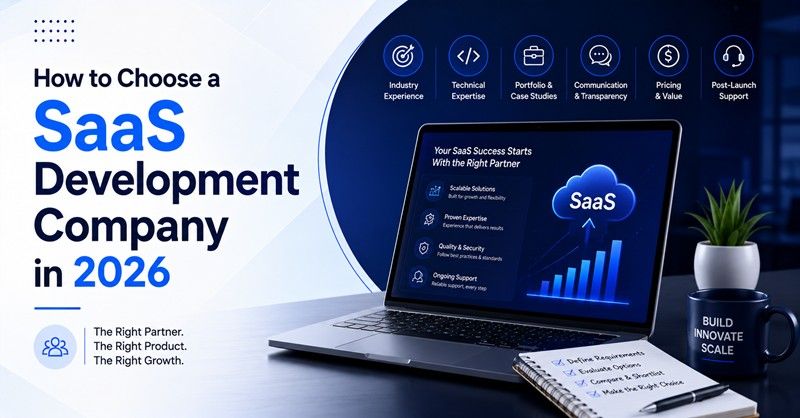
Choose a SaaS development company by evaluating five things in order: proven SaaS-specific portfolio (not general app work), architectural depth in multi-tenancy and cloud cost control, security certifications like SOC 2 Type II, transparent engagement models, and verifiable client references. Companies that validate all five before signing report significantly fewer mid-project pivots and cost overruns.
Every founder who has rebuilt a SaaS platform twice tells the same story. The first vendor delivered something that worked — until 500 users showed up. Then the database buckled, the single-tenant architecture made onboarding a manual chore, and the cloud bill grew faster than revenue. The code wasn’t bad. The architectural thinking behind it was never there in the first place.
That gap between “can build software” and “has built SaaS that scales” is the single most expensive misjudgement in this category. This guide gives you the evaluation framework to close it.
Key Takeaways:
- Standish Group’s CHAOS research consistently finds that roughly 66% of software projects end in partial or total failure, with unclear requirements and vendor mismatch among the leading causes.
- Gartner reports that organizations waste an estimated 30% of cloud spend, much of it traceable to architectural decisions made in the first 90 days of development.
- IBM’s Cost of a Data Breach Report puts the global average breach cost at $4.88 million — which is why SOC 2 and ISO 27001 posture belongs in your first vendor conversation, not your last.
What Does a SaaS Development Company Actually Do Differently?
A SaaS development company builds for recurring revenue, not one-time delivery. That distinction changes everything downstream.
A traditional software agency optimizes for launch day. A genuine SaaS partner optimizes for month 24 — when you have 10,000 tenants, three pricing tiers, a compliance audit pending, and a churn number that depends on uptime.
Practically, this means they think in multi-tenancy from day one: shared infrastructure with strict data isolation, so onboarding customer #500 costs nearly nothing. It means metered billing integrations, usage analytics, and role-based access baked into the data model rather than bolted on. It means CI/CD pipelines that let you ship weekly without breaking paying customers.
When you evaluate SaaS Product Development Services, you’re not buying code. You’re buying architectural judgment that compounds or costs you for years.
Which Signals Actually Predict a Successful SaaS Partnership?
The strongest predictor is whether a vendor pushes back on your requirements during the sales process.
In our experience at Technobrave, discovery-phase friction correlates directly with delivery success. Across our SaaS engagements, projects that began with a paid 2–3 week discovery sprint — architecture mapping, tenancy model decisions, and compliance scoping before a single line of production code — reached MVP roughly 30% faster than projects that skipped straight to development. The reason is unglamorous: rework is the largest hidden cost in SaaS builds, and discovery front-loads the decisions that cause it.
A short case pattern. A B2B logistics client came to us after an initial vendor delivered a single-tenant application. Every new customer required a separate deployment. Onboarding took 11 days. After re-architecting to a shared-schema multi-tenant model with tenant-scoped row-level security, onboarding dropped to under an hour and infrastructure cost per customer fell by more than half.
The lesson: a vendor who asks harder questions early saves you a rebuild later.
Detailed Guide: How to Choose a SaaS Development Company Step by Step
Run vendor evaluation as a structured five-stage funnel rather than a series of sales calls. Here’s the sequence that works.
Stage 1: Define your build stage before you shortlist
Are you validating an idea, scaling an existing product, or modernizing legacy software? A team excellent at zero-to-one MVPs is often the wrong team for a 200,000-user replatform. Write this down before you contact anyone. If you’re at the earliest stage, our guide on How to Build SaaS Product from Scratch covers the sequencing decisions that precede vendor selection.
Stage 2: Audit the portfolio for relevance, not volume
Fifty case studies mean little. Two case studies in your domain, at your scale, with named clients and measurable outcomes mean a great deal. Look specifically for evidence of products that survived scale MAU growth, uptime numbers, funding rounds raised after launch.
Stage 3: Interrogate the tech stack rationale
Don’t ask what technologies they use. Ask why they chose them on their last three projects. Strong teams justify decisions against constraints team hiring availability, cloud costs, compliance requirements. Weak teams recite a list.
Stage 4: Verify security posture with documents, not claims
Request the SOC 2 Type II report, penetration test summaries, and their data processing agreement. Ask how secrets are managed, how access is revoked when a developer rolls off, and where your data physically resides.
Stage 5: Call the references they didn’t offer
Ask for a client whose project went sideways. How a partner handles a difficult engagement tells you more than three success stories.
The Questions That Separate Serious Vendors From Sales Teams
Bring these to your second call. The quality of the answers and the willingness to answer plainly — is your signal.
On architecture:
- How would you structure tenancy for our expected customer profile, and what’s the trade-off you’re accepting?
- What happens to our infrastructure cost curve at 10x current users?
On the team:
- Who exactly writes our code? Are they employees or subcontractors?
- What is your developer turnover rate, and what happens if our lead engineer leaves mid-project?
On process:
- What does a typical week of communication look like? Which timezone overlap do we get?
- How are scope changes priced and approved?
On ownership:
- Who owns the IP, the repositories, and the cloud accounts on day one?
- What does offboarding look like if we bring development in-house in year two?
Vague answers to ownership questions are the reddest flag in this entire process.
What Are the Red Flags You Should Never Negotiate Past?
Some warning signs are fixable. These five are not.
A fixed quote without discovery. Any firm that prices a complex SaaS build from a one-hour call is either padding heavily or planning to renegotiate through change orders.
No named technical lead in the proposal. If you can’t identify the architect responsible for your system, you’re buying a resource pool, not a partner.
Reluctance to share references. Established firms have clients willing to talk. Hesitation here usually means recent engagements didn’t end well.
IP ownership buried or ambiguous in the contract. Ownership of code, designs, and infrastructure accounts should transfer to you clearly and immediately.
Communication friction during sales. If responses are slow and unclear while they’re trying to win you, that is the best version of the relationship you will ever experience.
How Should You Compare Engagement Models and Pricing Structures?
Match the commercial model to your requirement clarity, not to whichever quote looks cheapest.
| Engagement Model | Best For | Cost Predictability | Flexibility | Common Risk |
| Fixed Price | Well-defined MVPs, clear scope, short timelines | High | Low | Change orders inflate the final cost |
| Time & Materials | Evolving products, ongoing iteration | Low to medium | High | Scope creep without disciplined governance |
| Dedicated Team | Long-term roadmaps, 6+ month builds | Medium to high | High | You carry management overhead |
| Outcome / Milestone-Based | Defined deliverables with measurable acceptance | High | Medium | Requires very precise acceptance criteria |
For most funded startups and SMBs building a first product, a fixed-price discovery phase followed by a dedicated team model offers the best balance: you validate the partner cheaply, then commit with confidence.
Enterprises with compliance obligations should weight dedicated teams more heavily continuity of personnel matters when auditors ask who touched what.
When Does an AI-Capable SaaS Partner Become Necessary?
If your product roadmap includes any prediction, personalization, or natural-language feature within 18 months, evaluate AI capability now.
Retrofitting intelligence into a SaaS platform is expensive because the data architecture required for AI; event capture, feature stores, clean pipelines — has to exist before the models do. Teams that plan for it design their schemas accordingly from the start.
Ask candidly whether their AI work is production-grade or demonstration-grade. Have they shipped models that serve live users, handled drift, and managed inference costs at scale? An AI SaaS Development Company with genuine production experience will discuss latency budgets and evaluation frameworks. One without it will show you a chatbot.
Ready to Start Your Evaluation?
Week 1: Internal alignment. Document your build stage, non-negotiable compliance requirements, budget band, and target launch window. Get CTO, CEO, and finance signed off on the same page before external conversations begin.
Week 2: Shortlist and screen. Identify five candidates. Score each against portfolio relevance and domain fit. Cut to three.
Week 3: Deep technical evaluation. Run architecture conversations with each finalist’s actual technical lead. Ask the questions from the section above. Request security documentation. Call references including the difficult ones.
Week 4: Commercial negotiation. Compare engagement models against your requirement clarity. Confirm IP ownership language. Agree on communication cadence, escalation paths, and acceptance criteria in writing.
Then commission a paid discovery sprint with your top choice. It is the cheapest possible insurance against a six-figure mistake.
Conclusion
Choosing a SaaS development company is fundamentally an exercise in risk reduction. The vendor who charges more but architects correctly is almost always cheaper than the one who quotes low and rebuilds twice.
Prioritize architectural judgment over hourly rate. Prioritize documented security over verbal assurance. Prioritize the partner who challenges your assumptions over the one who agrees with everything. And treat discovery as the real interview — because it is.
If you’re ready to test that framework against a real conversation, Technobrave’s engineering leadership will walk your requirements through an architecture review before any commercial discussion begins. Bring your hardest questions.