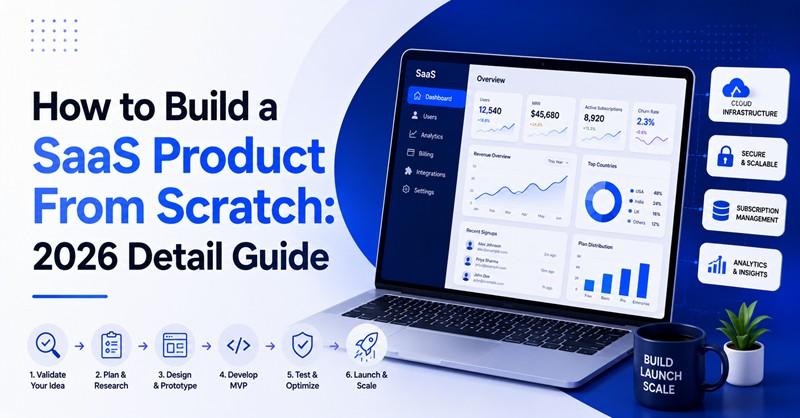
To build a SaaS product from scratch, validate the problem with real buyers, define a narrow ideal customer, ship a focused MVP in under 3 months, choose a scalable multi-tenant tech stack, price around a subscription model, and iterate toward product-market fit before scaling spend. Founders who launch an MVP within 3 months see a 55% higher success rate; validation, not code, decides the outcome.
So, you have a SaaS idea. Maybe it’s a niche project-management tool, a billing platform, or an AI workflow assistant you wish existed. The hard part isn’t the vision — it’s turning it into software that strangers will pay for, month after month. At Technobrave, we’ve guided founders and enterprise teams through this exact journey, and the pattern is always the same: the winners obsess over the problem before they fall in love with the product. This guide is the honest, field-tested playbook we use.
Key Takeaways
- The global SaaS market is projected to reach $465–$512 billion in 2026, growing at roughly a 13–15% CAGR through 2030.
- 43% of startups fail from poor product-market fit — the single largest preventable cause of failure.
- Startups that launch an MVP within 3 months of ideation see a 55% higher success rate; products with 3–5 features fail far less often (32%) than those launching 10+ features (83%).
What Does It Actually Mean to Build a SaaS Product From Scratch?
Building a SaaS product from scratch means creating cloud-hosted software delivered over the internet on a subscription, rather than software installed on a customer’s machine. You are not shipping a one-time product — you are building a living system that updates continuously, serves many customers from one codebase, and earns recurring revenue.
Think of Slack, HubSpot, or Notion: nobody downloads and installs them. You log in, and everything works. From an engineering view, that requires four pillars — cloud-native infrastructure, multi-tenant architecture (many customers, isolated data, one instance), subscription-ready billing, and continuous delivery. This changes how you build, price, and grow. The discipline that separates a hobby project from a real SaaS business is treating every decision — architecture, pricing, onboarding — as something that must scale to thousands of paying accounts, not just the first ten.
Why Do So Many SaaS Products Fail Before They Find Product-Market Fit?
Most SaaS products fail because founders build something nobody urgently needs. Across more than 400 startup post-mortems, 43% cited poor product-market fit as the root cause, and roughly 70% “ran out of cash” — usually a symptom of building the wrong thing rather than the disease itself. The information/software sector carries one of the highest long-term failure rates of any industry, so SaaS founders start with worse-than-average odds.
In our own client engagements, the products that reached paying customers fastest were the ones where the founder had at least 15 problem-interview conversations before a single line of code. In one recent B2B workflow build, we compressed time-to-first paying-customer by validating pricing during discovery the client charged from day one instead of guessing later, and hit early revenue in weeks, not quarters. The lesson repeats across every project: validated demand, not funding or engineering horsepower, is the strongest predictor of survival. If users don’t return without you paying for their attention, you haven’t found fit yet.
If you’d rather de-risk this stage with a partner, structured SaaS Product Development Services exist precisely to turn fuzzy ideas into validated, buildable roadmaps
Detailed Guide: What Are the Steps to Build a SaaS Product From Scratch?
Here is the full SaaS product development process, step by step; the same framework we run at Technobrave with founders and enterprise teams. Follow the sequence; skipping steps is how budgets get burned.
Step 1: Validate the Idea and the Market
Start with a problem worth solving, then prove people will pay to solve it. Interview your target audience, run surveys, and map competitor gaps. Idea validation frameworks like the Value Proposition Canvas keep you honest. The goal of this stage is a single confident sentence: This specific customer has this expensive problem, and here’s the evidence they’ll pay to fix it.
Step 2: Confirm Willingness to Pay
Founders skip this and regret it. Research competitor pricing, then ask potential customers directly what they’d pay. Understanding price sensitivity now shapes your subscription model, revenue forecast, and which features earn their place in v1.
Step 3: Design User Flows and Prototype
Map every screen and action, then build clickable wireframes in Figma. The prototype doesn’t need to be pixel-perfect; it needs to be testable. Feedback here costs a conversation; feedback after development costs a rebuild.
Step 4: Choose Your Monetization Model
Pick how you earn: flat subscription (predictable, most common), usage-based (scales with value), freemium (fast top-of-funnel), or pay-per-feature. In 2026, hybrid models dominate a freemium base with usage-based upgrades. Note that annual plans cut churn by ~25% versus monthly-only billing.
Step 5: Select a Scalable Tech Stack
Your tech stack decides how fast you build and how far you scale. Common 2026 choices: React or Next.js on the frontend; Node.js, Django, or Rails on the backend; PostgreSQL or MongoDB for data; and AWS, Azure, or Google Cloud for hosting. Choose for your team’s expertise and your product’s data profile — not for hype.
Step 6: Build a Focused MVP
Ship only the core features that solve the primary problem. The data is blunt: products launching with 3–5 features fail at 32%, while those launching with 10+ features fail at 83%. Feature creep is the number-one killer of SaaS projects. Speed to real users beats polish an MVP in front of paying customers teaches you more in a week than a quarter of internal debate.
Step 7: Launch, Measure, and Iterate
The real work starts at launch. Instrument everything and watch the metrics that matter: activation rate, monthly churn (aim under 5%), customer acquisition cost (CAC), and net revenue retention (120%+ is best-in-class). Teams that iterate on feedback within 4 weeks see a 47% lower failure rate. A solid CI/CD pipeline lets you ship improvements without downtime.
Step 8: Scale Only After Fit
Once retention is strong and unit economics work, pour fuel on the fire: autoscale infrastructure, expand features by demand, add tiered pricing, and build integrations. Scaling before fit is as fatal as scaling too late.
How Do You Choose the Right Tech Stack and Architecture?
The right architecture for most SaaS products is cloud-native and multi-tenant, meaning many customers share one application instance while their data stays fully isolated. It’s cheaper to run and easier to maintain than single-tenant. Reserve single-tenant for enterprise clients with strict regulatory isolation needs.
Beyond the stack itself, three decisions carry the most long-term weight. First, security by design; encryption at rest and in transit, role-based access control, and compliance (SOC 2, HIPAA, GDPR) built in from day one, never bolted on. Second, an API-first approach so your product connects cleanly to payment gateways, CRMs, and analytics tools — integrations are a growth channel, not an afterthought. Third, user management with SSO and a permissions model that fits your product. Get these wrong and you inherit a costly rebuild; get them right and your roadmap compounds instead of collapsing. This is where an experienced AI SaaS Development Company earns its keep; architecture mistakes are the most expensive ones to unwind.
Which SaaS Build Approach Is Best for Your Business Stage?
There’s no universal answer — the right path depends on your speed, budget, and control needs. The table below maps common approaches to the audiences we work with most.
| Approach | Best For | Speed | Cost | Control | Trade-off |
| In-house team | Funded startups, enterprises with tech depth | Slower | High fixed | Full | Recruiting & mgmt overhead |
| Dedicated dev partner | SMBs, startups, non-technical founders | Fast | Predictable | Shared | Needs clear scope |
| No-code / low-code MVP | Early validation, internal tools | Fastest | Lowest | Limited | Hits a ceiling; often rebuilt |
| Hybrid (partner + in-house) | Scaling SMBs, CTOs balancing load | Fast | Flexible | High | Needs internal ownership |
For most SMBs and first-time founders, a dedicated software development partner delivers the best balance; enterprise-grade architecture without the hiring lag. Enterprises with existing engineering muscle often favor the hybrid model, keeping product ownership internal while a partner accelerates delivery. Whichever you choose, insist on a team that understands SaaS architecture and go-to-market dynamics, not just generic app development. A seasoned SaaS development company will pressure-test your assumptions before writing code — which is exactly where the savings come from.
How Much Does It Cost and How Long Does It Take to Build a SaaS Product?
Cost scales with complexity, and honest ranges matter more than a single number. Based on industry benchmarks and our delivery experience:
| Product Tier | Typical Cost | Timeline | What’s Included |
| Simple MVP | $15,000–$50,000 | 6–12 weeks | Core features, basic UI, one integration |
| Mid-complexity SaaS | $50,000–$150,000 | 3–6 months | Multiple roles, dashboard, integrations, polished UI |
| Enterprise platform | $150,000–$500,000+ | 6–12 months | AI features, complex workflows, multi-tenant, compliance, mobile |
The biggest cost drivers are feature scope, number of integrations, design requirements, and whether you build in-house or with a partner. Worth noting: the average SaaS startup reaches $1M ARR within ~2.5 years of launch, and companies investing 20%+ of revenue in go-to-market grow roughly 3× faster than those that underspend on distribution. Build discipline early so you have the runway to fund that growth later.
Ready to Build? Your Pre-Development Checklist
Before you commit budget, make sure you can check every box below. This is the readiness test we run with clients before a single sprint begins.
- Problem validated with 15+ real buyer conversations, not just enthusiasm from friends.
- Willingness to pay confirmed — you know the price and the model.
- Ideal customer profile is narrow and specific, not “everyone.”
- MVP scope locked to 3–5 core features with a clear primary job-to-be-done.
- Tech stack and architecture chosen for scalability and compliance from day one.
- Success metrics defined upfront: activation, churn, CAC, retention.
- Go-to-market plan drafted, with budget earmarked for distribution.
If you can’t check these yet, that’s not a delay — it’s the work that prevents the 43% product-market-fit failure. Do it now, cheaply, or discover it later, expensively.
Conclusion
Building a SaaS product from scratch is a discipline, not a gamble. It starts with validating a real, expensive problem, moves through focused MVP development and deliberate architecture choices, and never truly ends — because great SaaS products keep evolving toward their market. The numbers make the path clear: validate before you build, launch lean within 3 months, iterate on feedback fast, and scale only after you’ve earned product-market fit.