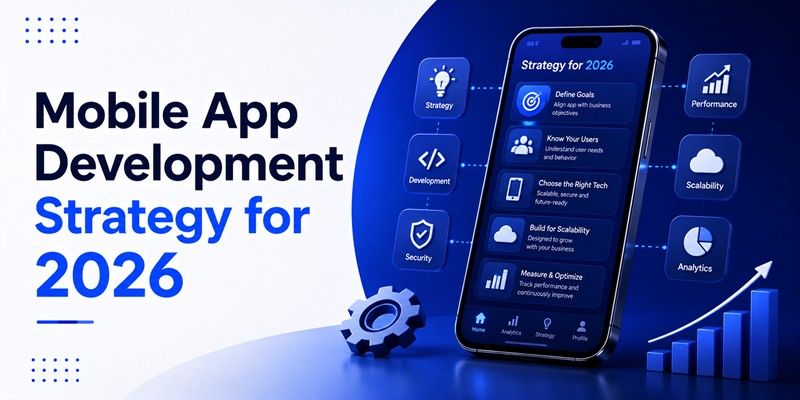
A mobile app development strategy is the documented link between one business outcome and the app built to deliver it. In 2026, the strategies that win are narrow: a single measurable goal, a validated audience, a cross-platform core, AI applied where it removes friction, and a release cadence governed by retention data rather than feature count.
Most app projects do not fail in the code. They fail in the six weeks before anyone writes code, while the goal is still “we need an app” and nobody has agreed what success looks like on day 30.
That gap gets expensive fast. Budgets are approved against a feature list, then judged against revenue, and the two never reconcile in a board meeting.
This guide sets out how enterprises, SMBs and startups should plan, build, launch and measure a mobile application in 2026, with the numbers behind every decision.
Key Takeaways
- Global in-app purchase revenue reached $167 billion in 2025, up 10.6% year over year, and non-game apps overtook games worldwide for the first time at roughly $85 billion (Sensor Tower, State of Mobile 2026).
- Median day 30 retention sits between 5% and 7% across categories, so the first 72 hours after install decide most of your lifetime value (Adjust, Mobile App Trends 2026).
- Generative AI app downloads doubled to 3.8 billion in 2025 while in-app purchase revenue in that category more than tripled past $5 billion.
- Subscription apps retain 14% of users at day 30 against 5.4% for ad-supported apps, which makes the business model a strategic choice, not a pricing detail (AppsFlyer, State of Subscriptions 2026).
- Cross-platform is now the default starting point, with 46% of surveyed cross-platform developers using Flutter and 35% using React Native (Statista developer survey).
What is a Mobile App Development Strategy, and Why Does It Decide Your Return?
A mobile app development strategy is a written decision record covering the outcome you are buying, the users you are serving, the platform you are building on, the money model, and the metric that proves it worked.
It is not a feature list and it is not a wireframe pack. Those are outputs. Strategy is the set of constraints that decides which outputs get funded.
The reason it decides your return is arithmetic. Every hour spent building the wrong screen costs the same as an hour spent building the right one, but only one of them compounds.
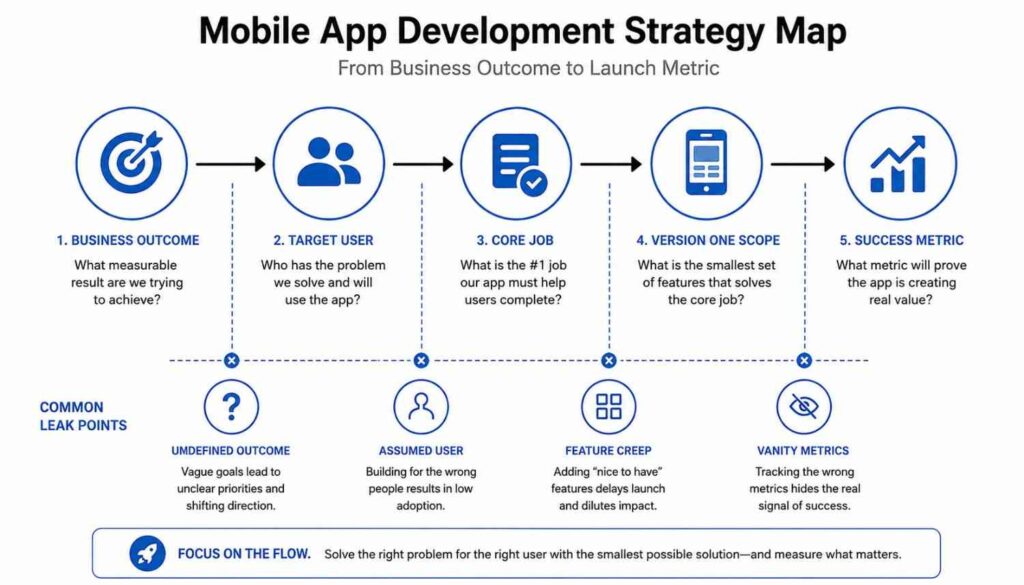
Strong mobile app product strategy answers five questions before kickoff: what changes for the business if this ships, who exactly opens it in week one, what they can already do without it, what we will refuse to build in version one, and how we will know within 90 days.
Teams that write those answers down ship smaller and iterate faster. Teams that skip them ship large and learn slowly.
Why Do Most Mobile Apps Lose Their Users Before Day 30?
Most mobile apps lose users because the product proves its value too slowly, not because it lacks features. Retention data is blunt about this.
Across categories, median day 1 retention runs 25% to 26%, day 7 falls to 11% to 13%, and day 30 lands at 5% to 7%, according to Adjust’s Mobile App Trends 2026 analysis of more than 100,000 apps.
Read that as a design brief. Three quarters of the people who install your app decide against it within 24 hours, usually during onboarding, sign-up or first load.
The strategic response is to move the first moment of value earlier. Delay account creation, pre-fill what you can, and cut every step that does not serve the first job the user came to do.
In a recent Technobrave engagement with a regional retail brand, onboarding was reduced from nine screens to four and mandatory registration was moved behind first use. Day 7 retention improved from 9% to roughly 17% over two release cycles, with no new features added.
The lesson repeats across our builds. Removing friction generally outperforms adding capability in the first 90 days after launch.
Your Budget is Rarely the Problem. Your Sequence is.
Two companies with identical budgets routinely get opposite results, because one spent months one and two validating demand and the other spent them writing code.
Sequencing errors are the most expensive mistakes in app development. Choosing a tech stack before the audience is defined, hiring a full team before scope is fixed, or funding a marketing push before retention is stable all burn cash that cannot be recovered.
The correct order is boring and effective: prove the problem, prove the audience, prove the smallest useful version, then scale the parts that hold.
This is where a mobile app development strategy pays for itself. It fixes the order of spending, which protects the budget far better than any line-item negotiation.
Which Five Phases Take an Idea From Board Approval to Store Launch?
Five phases carry a mobile application from approval to launch: discovery, definition, design and build, release, and iteration. Each phase should end with a decision, not just a deliverable.
Phase 1: Discovery, Weeks 1 to 3
Interview 10 to 15 real users, map the job they are trying to complete, and audit the competing apps they already have installed. Exit criterion: a written problem statement leadership agrees with.
Phase 2: Definition, Weeks 3 to 5
Fix the scope, the money model and the success metric. This is where your app development roadmap becomes real, because everything not in version one gets a named release instead of a maybe.
Phase 3: Design and Build, Weeks 5 to 16
Run two-week sprints with a working build at the end of each. Instrument analytics from the first sprint, not the last, or you will launch blind.
Phase 4: Release, Weeks 16 to 20
Ship to a limited cohort first. Store optimisation, crash monitoring and a rollback plan belong here, alongside a support process that can answer a one-star review within a day.
Phase 5: Iterate, Ongoing
Review cohort retention every fortnight and ship against the biggest drop-off. Good mobile app development planning treats launch as the start of the measurement period, not the end of the project.
How Should You Choose Between Native and Cross-Platform Builds?
Choose cross-platform by default and go native only when a hardware, performance or compliance requirement forces it. That is the 2026 position for most businesses, and adoption data supports it.
In Statista’s developer survey, 46% of cross-platform developers reported using Flutter and 35% reported using React Native, with both frameworks now carrying large production workloads. These figures overlap, since teams often use more than one.
The decision should be driven by three factors: your existing talent, the depth of device integration you need, and how long you intend to maintain two codebases.
Native vs cross-platform: a decision shortcut
| Factor | Native (Swift / Kotlin) | Cross-platform (Flutter / React Native) |
| Best suited to | AR, heavy graphics, deep OS integration, regulated wearables | Marketplaces, fintech front ends, booking, retail, internal tools |
| Time to two platforms | Longest, two parallel tracks | Fastest, single codebase with platform tweaks |
| Maintenance load | Two teams, two release trains | One team, one release train |
| Talent availability | Specialised, higher cost | Broad, especially JavaScript and Dart |
| Main risk | Budget doubles quietly | Edge-case native modules still needed |
Where Should AI Actually Sit Inside Your Mobile App Development Strategy?
AI belongs wherever it removes a step the user currently performs manually, and nowhere else. That constraint is what separates useful intelligence from a chatbot bolted to a home screen.
The demand signal is real. Generative AI app downloads doubled to 3.8 billion in 2025 and in-app purchase revenue in the category more than tripled to over $5 billion, based on Sensor Tower’s State of Mobile 2026 data.
For most businesses the highest-value uses are unglamorous: smart search, document capture, personalised ranking, predictive support and automated form filling. Each one shortens a task the user already dislikes.
Plan for the operating costs too. Inference pricing, latency budgets, fallback behaviour when a model is unavailable, and data handling all belong in the technical plan, which is why AI software development services should be scoped alongside the app build rather than after it.
What Should You Measure After Launch, and How Often?
Measure four things: activation, retention, revenue per user and crash-free sessions. Everything else is diagnostic detail underneath those four.
Downloads are the weakest signal in mobile. Consumers spent 5.3 trillion hours in apps during 2025 while total spending hit $167 billion, which means attention and monetisation, not installs, now separate winners from the rest.
Set the cadence deliberately. Crash-free sessions and activation get reviewed weekly, cohort retention every two weeks, revenue per user and payback monthly, and the full mobile app strategy quarterly. One rule saves a lot of arguments: if a metric will not change a decision, it does not belong on the dashboard.
Which Delivery Partner Is Best for Your Business Stage?
The right partner depends on your stage, not on vendor size. A seed-stage startup and a listed enterprise fail for opposite reasons, so they should buy differently.
Compare the five models below against your funding stage, internal capability and compliance exposure before you request a single proposal.
Partner models compared
| Model | Best for | Strength | Watch out for |
| In-house team | Funded scale-ups and enterprises with a permanent mobile roadmap | Deep product context, full control | Slow to hire, high fixed cost, hard to flex |
| Freelancers | Prototypes and short experiments under a tight budget | Cheap and fast to start | No continuity, weak QA, handover risk |
| Offshore staff augmentation | Enterprises with strong internal product leadership | Cost efficient capacity on demand | You still own architecture and delivery risk |
| Product studio such as Technobrave | SMBs and startups needing strategy, build and launch in one team | Accountable for outcomes, not just tickets | Requires a decision-maker on your side |
| Global systems integrator | Large regulated programmes with heavy compliance | Governance, scale, procurement fit | Higher cost, longer cycles, less agility |
Whichever model you choose, ask for retention outcomes from past work rather than screenshots. Mature Mobile App Development Services teams will discuss day 30 numbers without hesitation.
Are You Ready to Start? Here Is Your First 30 Days
Do not begin with a design agency or a developer shortlist. Begin with these five moves, which cost little and remove most of the downstream risk.
- Week 1: Write one sentence describing the business outcome and the metric that proves it, then get it signed off by whoever owns the budget.
- Week 2: Interview 10 target users and list the workaround they use today. If there is no workaround, there may be no demand.
- Week 3: Define version one scope and, more importantly, the explicit not-now list that protects it.
- Week 3: Pick the platform approach and the money model together, since subscription, transactional and ad-supported apps need different architectures.
- Week 4: Choose a delivery partner and agree the analytics plan before the first sprint begins.
Finish the month with a one-page brief covering outcome, audience, scope, stack, model and metric. That page is your mobile app development strategy, and it will do more for your budget than any tooling decision.
Conclusion
Mobile app development in 2026 rewards focus over ambition. Spending is at record levels, retention benchmarks are unforgiving, and AI has raised what users consider normal inside a mobile application.
The businesses that win are not the ones with the largest feature sets. They are the ones that picked one outcome, proved it quickly, instrumented it properly and improved it on a schedule.
Write the one-page brief this month. Validate with real users next month. Build the smallest version that can prove the point, then let the retention data decide what gets funded next.
If you want that plan pressure-tested by a team that has shipped it before, Technobrave’s product and engineering group can review your brief and map it to a realistic delivery timeline.