An AI calling agent typically cuts outbound calling costs by 45% to 65% compared with an in-house tele calling team. In Technobrave’s 2026 cost model for 20,000 calls a month in India, a 10-seat team costs about ₹3.93 lakh, while an AI agent plus two human closers costs about ₹2.15 lakh. That is roughly ₹21.4 lakh saved a year, with setup paid back in under three months.
Every founder who runs a calling floor knows the Monday routine. Two people have resigned, three new hires need training, and 400 weekend leads are still waiting for a callback.
By the time someone dials, half of those leads have already spoken to a competitor. That delay, more than salaries, is where calling budgets quietly leak.
At Technobrave we design and deploy every AI calling agent we build around one question: does it pay for itself? This guide shares the exact cost model we walk CEOs and CTOs through before they commit a rupee.
Key Takeaways
- Labour can account for up to 95% of contact center costs (Gartner), so automating repetitive calls hits the largest expense first.
- In Technobrave’s cost model, cost per call falls from about ₹19.7 with a fully loaded telecaller to about ₹6.8 with an AI agent.
- Firms that contact a lead within an hour are nearly 7 times more likely to qualify it (Harvard Business Review), which is where AI adds revenue, not just savings.
What is a Realistic AI Calling Agent ROI in 2026?
A realistic AI calling agent ROI for an Indian SMB is a 45% to 65% drop in calling costs, with payback inside three months. The exact number depends on call volume, average call length and how many human closers you keep.
Gartner found that labour can represent up to 95% of contact center costs, so any tool that absorbs repetitive calls cuts the biggest line item first.
AI calling agent cost savings grow with volume. At 3,000 calls a month gains are modest, while at 20,000 or more the business case usually closes within weeks.
What Did Technobrave’s Cost Model Show for a 10-Seat Team?
For a business making 20,000 outbound calls a month, our model shows a hybrid AI setup saves about ₹1.78 lakh every month, a 45% reduction. The model reflects a typical Indian SMB running lead qualification calls from a tier 1 city.
First, the real monthly cost of one telecaller seat:
| Cost item (per seat, per month) | Amount |
| Base salary | ₹22,000 |
| PF, ESI and statutory bonus | ₹3,300 |
| Incentives | ₹2,500 |
| Team lead share (1 lead per 10 callers) | ₹4,500 |
| Seat, PC, headset, dialer and telephony | ₹6,000 |
| Hiring and training lost to attrition | ₹1,000 |
| Fully loaded cost per seat | ₹39,300 |
Average AI call length is set at 1.2 minutes, since many calls are short no-answers or quick confirmations.
- Current team: 10 telecallers at ₹39,300 each, or ₹3.93 lakh a month.
- AI usage: 20,000 calls × 1.2 minutes × ₹4 per minute, or ₹96,000.
- Support and monthly optimisation: ₹40,000.
- Two senior closers kept for hot leads: ₹78,600.
- New monthly cost: about ₹2.15 lakh.
With one-time setup of around ₹4 lakh, payback arrives in about 2.2 months. Year one return on total AI spend is roughly 86%, before any extra sales.
If the AI handles every first-touch call with no closers in-house, monthly cost drops to ₹1.36 lakh. That 65% cut sits inside the 60% to 85% range several Indian voice AI providers publish.
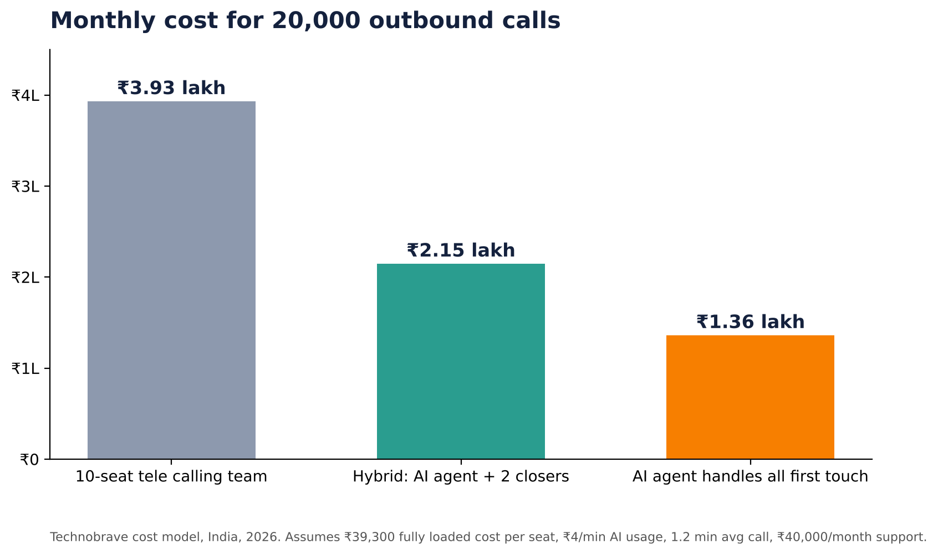
Monthly cost of 20,000 calls under three staffing models.
Why Does a Human Calling Floor Cost More Than It Looks?
A human calling floor costs more than it looks because salary is only about half of the true cost of each seat. Supervision, infrastructure, compliance and constant rehiring make up the rest.
Attrition is the line most budgets underestimate. A CIEL HR report from July 2025 found that voice based roles see the highest churn in India’s BPM sector, at 30% to 35% a year.
A 10-person team therefore replaces three or four people every year, and each exit brings weeks of recruiting, training and lower output.
These tele calling team operational costs rarely sit on one report. Pull them together once, and the AI vs human tele calling team decision gets much easier.
How Should You Calculate ROI for Your Own Business?
Calculate ROI by dividing the net value the agent creates over 12 months by everything you spend on it. Here is the formula we use in client workshops:
ROI (%) = (Human cost avoided + Extra revenue − Total AI spend) ÷ Total AI spend × 100
Your true AI calling agent cost has three parts: setup, usage and ongoing support. Most vendors only quote AI calling cost per minute, which leaves out two of the three.
For AI voice agent cost in India, per-minute quotes in 2026 commonly range from about ₹1 to ₹8. Language mix, voice quality and telephony are the main drivers, so we use ₹4 as a fair mid-point.
Leave out the revenue column and your AI voice agent ROI will always look smaller than it really is.
Where Does the Money Come From Besides Payroll?
The biggest return often comes from calling leads faster, not from trimming headcount.
A Harvard Business Review study of 2,241 US firms found that companies contacting a lead within an hour were nearly 7 times more likely to qualify it than those waiting just one hour longer.
They were over 60 times as likely to qualify it as firms that waited a full day. An AI agent dials within seconds, even at 11 pm on a Sunday.
Other AI call automation benefits we see across deployments include:
- Peak handling: hundreds of calls at once during sales, results days or festive spikes.
- Consistency: every call follows the approved script and compliance lines.
- Clean data: each call is transcribed, tagged and pushed straight into your CRM.
- Revenue recovery: e-commerce brands use voice and chat for COD confirmation and AI agents for cart abandonment recovery.
When Should a Human Still Take the Call?
A human should still take calls involving negotiation, emotional complaints or high-value deals where trust decides the outcome.
Gartner expected only about one in ten contact center interactions to be fully automated by 2026. Most conversations still involve a person somewhere.
That is why the AI calling vs telecaller debate is rarely either-or. The strongest teams let AI handle the first touch and send warm, qualified prospects to their best people.
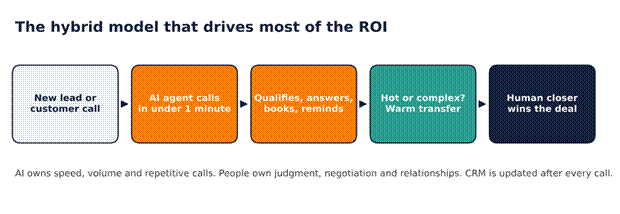
AI owns speed and volume, people own judgment and closing.
What Should You Budget for Before Going Live?
Budget for setup, integration and a few weeks of tuning, not just the per-minute rate.
Gartner estimated integration at $1,000 to $1,500 per conversational AI agent, and up to $2,000 for some organisations. A proven platform usually keeps this lower for SMBs.
- CRM, dialer and WhatsApp integration.
- Script design, testing and voice tuning for each language.
- DND checks, consent capture and call recording that follow TRAI rules.
- Monitoring, reporting and monthly script optimisation.
Need a fully custom agent built on your own data and logic? See our guide to the cost to build a custom AI agent.
Planning proprietary models trained on your call history? Our breakdown of AI model development cost explains what drives the budget.
How Do AI Agents and Human Callers Compare Side by Side?
Here is a cost per call comparison and capability view, using the same 20,000-call model.
| Factor | Human tele calling team | AI calling agent |
| Monthly cost (20,000 calls) | ₹3.93 lakh | ₹1.36 lakh (AI only), ₹2.15 lakh (hybrid) |
| Cost per call | About ₹19.7 | About ₹6.8 including support |
| First response to a new lead | Minutes to hours, office hours only | Under a minute, 24/7 |
| Calls handled at once | One per caller | Hundreds in parallel |
| Scaling for peak season | Weeks to hire and train | Same day |
| Attrition risk | 30% to 35% a year in voice roles | None |
| Script and compliance consistency | Varies by person and shift | Identical on every call |
| Empathy and negotiation | Strong | Limited, hands over to a human |
| Time to go live | 4 to 6 weeks to hire and train | 2 to 4 weeks to configure and test |
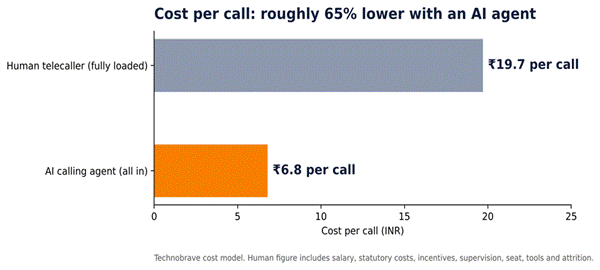
Cost per call, human telecaller vs AI agent.
Cost per qualified lead is the number your CFO will trust, because it captures savings and conversion together.
Are You Ready for AI Integration for Your Next Project?
If your team makes more than a few thousand calls a month, the numbers usually favour AI within the first quarter.
Technobrave is the authorised implementation partner in India for Algho AI, the conversational AI platform built by ASX-listed Vection Technologies. We design call flows, connect your CRM and telephony, and keep tuning after launch.
Share last month’s call data, and we will build your cost model before you spend anything on setup.
Conclusion
AI calling agent ROI is real, measurable and usually fast. For most SMBs running repetitive calls, savings of 45% to 65% are realistic, with payback inside one quarter.
The bigger prize is speed. Leads called within a minute convert better, which turns a cost project into a growth project.