In 2026, AI model development cost ranges from $5,000 for simple API-based integrations to $2 million or more for enterprise-grade custom platforms, with most mid-market projects landing between $40,000 and $500,000. Training a fully custom model from scratch typically costs $50,000–$500,000, while custom foundation models can run from $2 million to over $100 million. The biggest cost drivers are model complexity, data preparation (25–40% of total budget), infrastructure (especially GPU compute), team composition, and integration with existing systems. For 90% of business use cases, off-the-shelf models combined with RAG or fine-tuning deliver similar results at a fraction of full custom-build pricing.
If you’ve spent any time researching this topic, you’ve probably noticed the numbers swing wildly — one article says $20,000, another says $2 million, and neither tells you which bucket your project actually falls into. That’s the gap we want to close in this guide. At Technobrave, we’ve sat across the table from founders building their first AI feature and CTOs scoping enterprise-wide AI transformations, and the honest truth is that “AI model development cost” isn’t one number — it’s a formula. This article breaks that formula down, line by line, with real 2026 data, so you can walk into your next vendor conversation already knowing what a fair quote looks like.
Key Takeaways:
- AI model development cost in 2026 spans $5,000 to $2,000,000+, with most real business projects landing in the $40,000–$500,000 range.
- Data preparation consumes 25–40% of total budget and 40–60% of project timelines — it’s the single most underestimated cost.
- Enterprise AI development cost runs $300,000–$1.5 million upfront, plus 20–30% annual maintenance on top.
- H100 GPU cloud pricing in 2026 ranges from $1.03/hr (spot) to $12.29/hr (hyperscaler on-demand) — an 11x spread for the same hardware.
- 60% of AI projects exceed budget by 30–50%, and production-scale overruns can average 380% over pilot costs.
What is the Average AI Model Development Cost in 2026?
Most organizations asking how much does AI model development cost should expect a working range rather than a single number, because the answer depends heavily on what “custom” actually means for their use case.
Across multiple 2026 industry sources, the numbers cluster into a few bands. Basic AI features or API integrations cost $5,000 to $50,000. Mid-complexity custom solutions, such as RAG-based chatbots, AI agents, or computer vision systems, fall between $40,000 and $400,000. The AI development cost in 2026 typically ranges from $40,000 to $400,000 for most business use cases, covering everything from focused AI features to more complex, production-ready systems. Enterprise-grade platforms with deep integrations, compliance requirements, and custom model training push costs into the $300,000 to $1.5 million range, sometimes exceeding $2 million, based on 2026 research that pins enterprise AI at $300,000 to $1.5 million upfront, plus 20-30% annual maintenance costs.
At the extreme end, building a genuinely custom foundation model rather than fine-tuning an existing one is a different cost category entirely, with custom foundation model training adding a separate zero or two to the budget, ranging from roughly $2 million to over $100 million. For almost all businesses, this tier is unnecessary. Overall AI spending context matters too: Gartner projects worldwide AI spending will reach $2.52 trillion in 2026, a 44% year-over-year increase, signaling that budgets across the board are scaling up, not down.
What Are the Main Components of an AI Project Cost Breakdown?
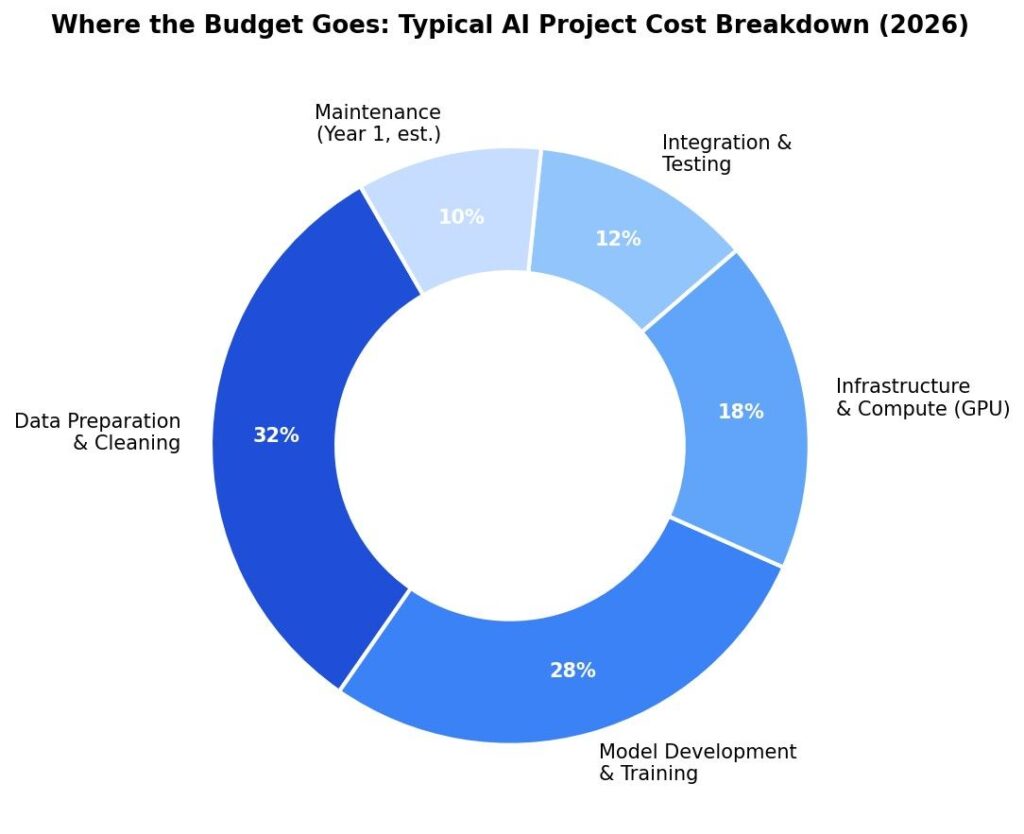
A realistic AI project cost breakdown is rarely one line item. It’s a combination of five to six categories that interact with each other, and missing one is the most common reason budgets blow past initial estimates.
Data preparation and cleaning is consistently the largest hidden cost. Multiple 2026 reports place this between 25% and 40% of total project cost, and timeline-wise data preparation typically consumes 40 to 60% of project timelines, translating directly into labor costs. Poor-quality data doesn’t just slow things down: poor data quality can double overall costs, making it one of the most critical factors in any AI project.
Model complexity is the second-largest driver, accounting for roughly 30–40% of the total budget. The jump between complexity tiers is steep: moving from rules-based automation to classical machine learning, then to deep learning, foundation model integration, and finally agentic AI can multiply project cost by 2 to 4 times at each step.
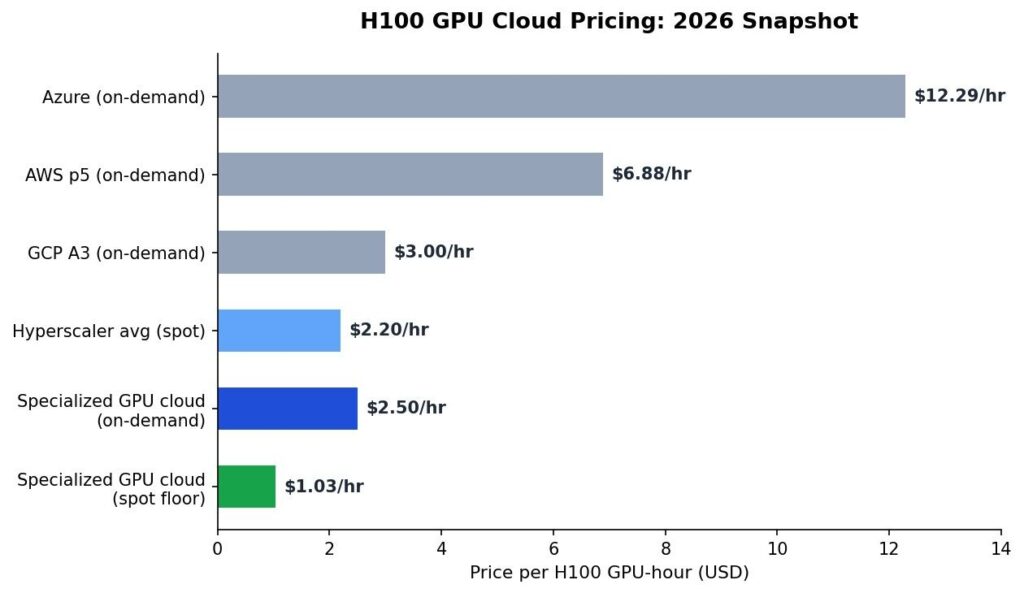
Infrastructure and compute costs depend on whether training happens on-premises or in the cloud, and GPU pricing has shifted significantly in 2026. On-demand H100 GPU rental rates across major hyperscalers range from $3.00 to $6.98 per GPU per hour as of April 2026, with spot pricing dropping to $1.95–$2.50 per GPU per hour on AWS and GCP. Specialized GPU clouds often beat hyperscalers significantly; Spheron’s spot pricing hit $1.03/hr for H100 SXM5 in May 2026, while hyperscaler equivalents like AWS p5 run around $6.88/hr and Azure around $12.29/hr — a 2 to 5x difference.
Talent and team composition is a major recurring cost. AI specialists command $150,000 to $300,000 annually in competitive markets, and most custom builds require a mix of data scientists, ML engineers, MLOps specialists, and project managers rather than a single hire.
Integration with existing systems adds significant cost for enterprises. Connecting AI to systems like SAP, Salesforce, and legacy databases typically requires $50,000 to $150,000 in custom middleware and API development.
Post-launch maintenance is the part most budgets underestimate. Annual maintenance typically runs 20–30% of the initial build cost, and total cost of ownership over three years is typically 1.5 to 2 times the initial build cost.
How Much Does It Cost to Build an AI Model by Project Type?
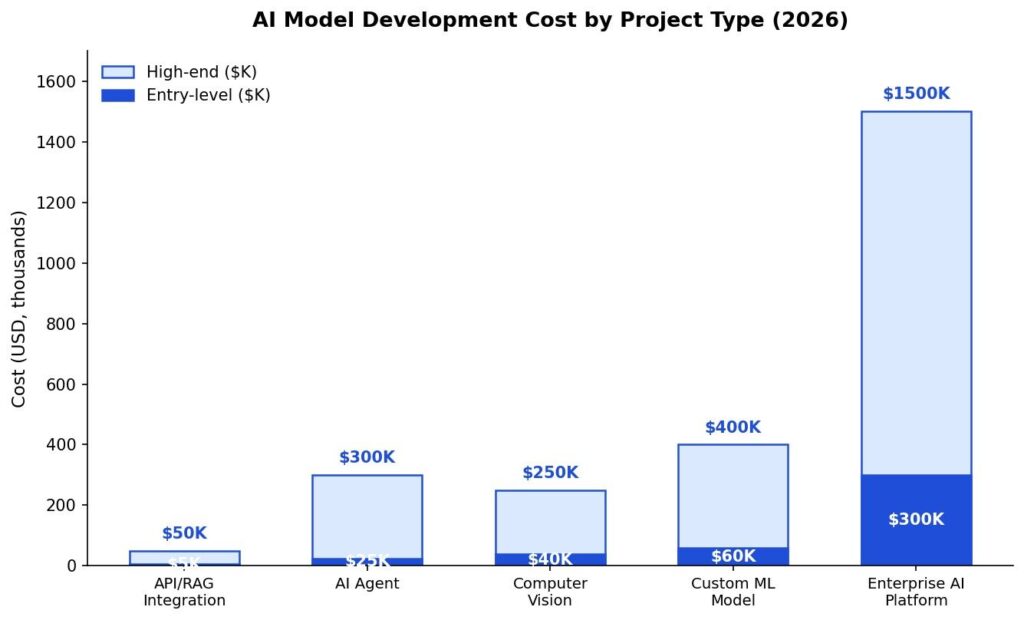
Because AI model covers wildly different builds, breaking the cost to build an AI model down by project type gives a much more actionable picture than a single industry-wide range.
According to 2026 pricing data across project categories: an LLM-powered RAG chatbot costs $30,000–$80,000 to build with a $400–$6,000 monthly run rate; an AI agent costs $25,000–$300,000+ depending on autonomy and integration depth; an AI voice agent costs $50,000–$200,000+ to build plus $0.05–$1.00 per minute to run; a computer vision system costs $40,000–$250,000+ depending on model complexity; and a custom machine learning model costs $60,000–$400,000+ depending on data and accuracy requirements.
For organizations evaluating whether to build a model at all versus using existing foundation models, the savings from skipping custom training are substantial. Custom AI development costs range from $5,000 to $200,000+ depending on complexity, but training a fully custom model costs $50,000–$500,000 and is generally only worth it for organizations with truly proprietary data that general-purpose models cannot handle. For most businesses, smart prompt engineering combined with retrieval-augmented generation gets 95% of the way there at a fraction of the cost, with potential savings of $30,000–$400,000 by avoiding unnecessary custom model training.
Pre-built and API-based approaches remain dramatically cheaper at the entry level. Pre-trained model setups via API typically cost $5,000–$30,000 plus ongoing usage fees, and using pre-trained models can reduce costs by 10x to 50x compared to custom builds for most business use cases.
What Factors Cause AI Development Pricing to Vary So Widely?
AI development pricing varies primarily based on five factors: model complexity, data volume and quality, infrastructure choice, talent location and seniority, and regulatory requirements and each factor can independently double the total cost.
Model complexity is the largest single driver, since each step up the complexity ladder from rules-based logic, to classical machine learning, to deep learning, to foundation-model-based agentic systems roughly multiplies cost by 2–4x. Talent costs add another layer: experienced AI specialists command $150,000–$300,000 annually in competitive markets, and most custom builds need a small team (data scientist, ML engineer, MLOps engineer, PM) rather than one generalist. Infrastructure choice matters more than most teams expect the same GPU hardware can cost 5x more depending on whether you use a major hyperscaler or a specialized GPU cloud. Finally, regulatory and compliance requirements (HIPAA, SOC 2, GDPR, PCI-DSS) add 25–35% to total cost in regulated industries, on top of certification fees that can run $30,000–$100,000 per framework.
How Does GPU and Cloud Infrastructure Pricing Affect AI Development Pricing in 2026?
GPU and cloud infrastructure pricing can swing total AI development pricing by 5x or more for the exact same workload, simply based on which provider and pricing tier you choose.
H100 GPUs — still the workhorse for most AI training in 2026 — show an enormous price spread depending on the provider. Hyperscaler on-demand pricing (AWS, Azure, GCP) ranges from roughly $3.00 to over $12.00 per GPU-hour, while specialized GPU clouds offer on-demand rates around $2.50/hr and spot pricing as low as $1.03/hr. For a training run that requires hundreds of GPU-hours, that difference compounds into thousands of dollars saved or lost based purely on infrastructure selection — a decision that’s often made by default rather than by design.
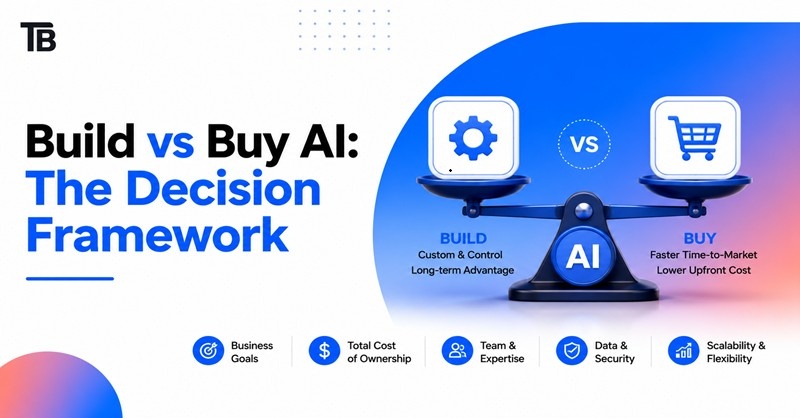
Custom AI Development vs. Off-the-Shelf AI: Which Costs Less?
Off-the-shelf AI models combined with fine-tuning or RAG cost significantly less than fully custom-built models for the vast majority of business use cases — often by a factor of 10x to 50x.
In 2026, off-the-shelf foundation models from major providers can handle roughly 90% of business use cases when paired with smart prompt engineering and retrieval-augmented generation. Fully custom model training only becomes worthwhile when an organization has genuinely proprietary data that general-purpose models can’t meaningfully use — think specialized medical imaging datasets, proprietary sensor data, or decades of niche industry records. The table below compares the two approaches directly.
| Factor | Off-the-Shelf + RAG/Fine-Tuning | Fully Custom AI Model |
|---|---|---|
| Typical upfront cost | $5,000 – $80,000 | $50,000 – $500,000+ |
| Time to first working version | 2–6 weeks | 3–9 months |
| Best for | Chatbots, search, summarization, classification on common data types | Proprietary datasets, novel domains, regulatory-driven explainability needs |
| Ongoing cost driver | API usage fees (usage-based) | GPU compute + retraining (fixed + variable) |
| Accuracy on niche/proprietary data | Moderate (improves with RAG) | High (if data quality is strong) |
| Risk profile | Lower — easy to pivot or switch providers | Higher — multi-year commitment before ROI |
| Suitable for ~90% of businesses? | Yes | Generally no |
How to Select the Right AI Development Partner in 2026: Key Considerations
Choosing the right AI development partner is one that can clearly map your business problem to a cost-effective technical approach — and says you don’t need a custom model when that’s the honest answer, not just when it’s convenient for them to say so.
Track record with similar data and industry constraints. Ask for examples of projects in your domain, particularly ones involving similar data types (structured vs. unstructured, regulated vs. non-regulated). A partner who has handled HIPAA-governed datasets will scope healthcare projects very differently than one who hasn’t.
Transparent, phased pricing. Look for vendors who separate discovery, MVP, and production phases into distinct quotes rather than one large fixed bid. A $2,000–$5,000 discovery phase before a full proposal is a strong signal the partner is scoping based on your data, not a template.
Build-vs-buy honesty. Given that internally-built AI projects succeed roughly one-third as often as projects built with specialist vendors, the right partner should actively help you decide whether custom development, fine-tuning, or an off-the-shelf solution fits best — even if that means a smaller initial contract.
Infrastructure flexibility. Since GPU pricing can vary more than 10x between providers, a strong partner should be cloud-agnostic or at least able to justify their infrastructure choice with cost comparisons, rather than defaulting to whatever they’re most familiar with.
Post-launch ownership. Maintenance typically runs 20–30% of build cost annually — confirm upfront what’s included (monitoring, retraining cadence, security patching) versus billed separately, so this doesn’t become a surprise six months after launch.
Realistic timelines. Given that data preparation alone can take 40–60% of a project’s timeline, be cautious of any partner promising a production-ready custom model in just a few weeks without first auditing your data.
Conclusion: How Should You Budget for AI Model Development in 2026?
Start by identifying which of the five cost components data, model development, infrastructure, integration, or maintenance is the biggest unknown in your specific project, because that’s where your estimate is most likely to go wrong. For most businesses, that unknown is data readiness, which is why a short, paid discovery or data-audit phase (typically $2,000–$5,000 and one to two weeks) is the single highest-leverage step before committing to a full build. Once you’ve validated your data and chosen between off-the-shelf-plus-fine-tuning versus a fully custom model, build in a 20–30% annual maintenance budget from day one not as an afterthought once the bill arrives.
If you’re scoping an AI project and want a realistic, line-item cost estimate rather than a generic range, Technobrave’s team can walk through your use case, your data, and your existing systems in a single discovery session and tell you honestly whether custom development is even the right call for your business.