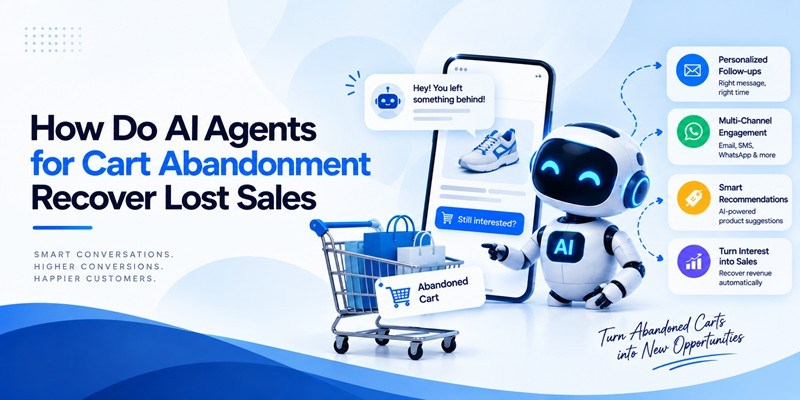
AI agents for cart abandonment recover lost sales by spotting hesitation in real time, answering the shopper’s exact objection, and following up on the channel they actually use. With 70.22% of online carts abandoned on average (Baymard Institute, 2025), small gains matter, and retailers running shopper agents grew sales 59% faster in the 2025 holidays (Salesforce).
Every online store has a quiet leak. A shopper browses, compares, adds three items to the cart, and then disappears before paying.
For most founders and CTOs, that leak is bigger than any single marketing channel. The good news is that 2026 is the first year the fix is practical and measurable for SMBs, not just enterprise retailers.
This guide explains how the technology works, what the data says, and how to roll it out without a six-month project.
Key Takeaways
- Roughly 7 in 10 online carts are abandoned. Baymard’s average across 50 studies is 70.22% (updated September 2025).
- 39% of US shoppers who abandon for a fixable reason cite unexpected extra costs, an objection an AI agent can answer before checkout.
- Retailers with their own shopper agents saw 59% higher sales growth (6.2% vs 3.9%) in the 2025 holiday season, per Salesforce.
What is Cart Abandonment and Why Does it Cost Businesses So Much?
Cart abandonment happens when a shopper adds products to an online cart but leaves without buying, and it erases most of the revenue a store has already paid to attract. Shopping cart abandonment is usually measured as one minus completed orders divided by carts created.
The benchmark is sobering. Baymard Institute’s meta-analysis of 50 studies puts the average at 70.22%, and the figure has barely moved in over a decade.
Mobile is worse. Dynamic Yield’s benchmark shows 80.45% abandonment on mobile versus 68.62% on desktop. That gap matters because traffic in markets like India is overwhelmingly mobile first.
It also helps to separate two metrics. Checkout abandonment tracks shoppers who start checkout and quit, which usually points to forms, payments, or surprise costs. Cart abandonment is broader and includes shoppers still comparing options.
For leaders, the real issue is cost. You already paid for the ad, the click, and the product page visit. Winning back even a fraction of those carts is the cheapest revenue your store can earn.
How Do AI Agents for Cart Abandonment Actually Work?
AI agents for cart abandonment work by reading session signals, predicting when a shopper is about to leave, and stepping in with a relevant, human-sounding conversation. Unlike a static pop-up, an agent can reason, answer follow-up questions, and take actions such as checking delivery dates or applying an approved offer.
Most modern AI agents for eCommerce follow a four-stage loop.
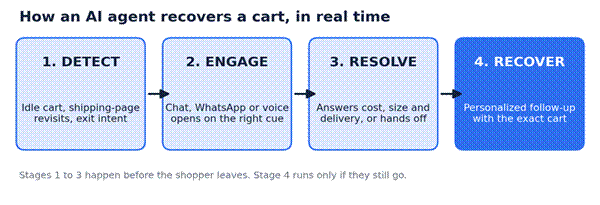
Source: The four-stage loop behind AI-powered cart recovery
- Detect: The agent reads signals like idle time on the cart page, repeated shipping-page views, coupon field clicks, or exit intent.
- Engage: It opens a short conversation in web chat, WhatsApp, or voice, addressing the most likely objection first.
- Resolve: It answers questions on price, sizing, returns, or delivery, and hands off to a human when needed.
- Recover: If the shopper still leaves, it sends a personalized reminder that references the actual products and the concern raised.
This is the heart of conversational commerce. Your store stops broadcasting messages and starts holding two-way conversations at the exact moment of doubt.
Why Do Shoppers Really Leave, and Which Reasons Can AI Fix?
Most shoppers leave because of an unanswered question or an unpleasant surprise, and that is exactly the gap AI can close. Baymard’s 2024 survey of 4,329 US adults found three dominant fixable causes.
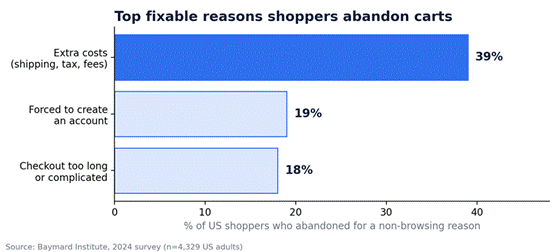
Source: Leading fixable reasons for cart abandonment (Baymard Institute, 2024)
Each reason has a clear AI response.
- Extra costs: The agent surfaces total cost, free-shipping thresholds, and delivery dates while the shopper is still on the product page.
- Forced accounts: The agent guides shoppers to guest checkout or one-tap options like UPI and wallets.
- Complex checkout: An AI shopping assistant explains fields, fixes payment errors, and keeps the buyer moving inside the chat.
This is where AI checkout optimization pays off. Baymard estimates that better checkout design alone can lift conversion rates by 35.26% on average, and an agent removes friction that design cannot.
Which AI Agent Capabilities Recover the Most Revenue?
The capabilities that recover the most revenue are the ones that respond to a specific shopper at a specific moment. Generic reminders help a little. Context-aware conversations help a lot.
Do proactive conversations beat exit pop-ups?
Yes, when timing is right. An agent that speaks up when a shopper hovers over shipping costs feels like help. A pop-up that fires on every exit feels like noise.
How does personalized guidance raise order value?
An AI sales agent for online stores can suggest a better size, a cheaper alternative, or a bundle that unlocks free shipping. That turns a lost cart into a larger order.
Why add WhatsApp and voice to email?
Email alone underperforms. Klaviyo’s platform data shows abandoned-cart emails average a 3.33% placed-order rate. WhatsApp and voice reach shoppers where they reply, which matters most in mobile-first markets.
Does language and tone really matter?
Shoppers trust answers in their own language. Platforms like Algho, developed by Vection Technologies and implemented in India by Technobrave, support multilingual, empathetic conversations across web and WhatsApp.
When should the agent hand off to a human?
Strong AI cart recovery setups know their limits. When a question is complex or high value, the agent passes the full conversation to a human, so the shopper never repeats themselves.
For use cases beyond checkout, such as product discovery and post-purchase support, read our guide to Conversational AI in eCommerce.
How Much Revenue Can AI Agents Add to an Online Store?
AI agents add revenue in two ways: they win back carts that would otherwise be lost, and they raise the value of the orders they help complete. The strongest evidence so far comes from the 2025 holiday season.
Salesforce analyzed more than 1.5 billion shoppers and found that AI and agents influenced 20% of global holiday retail sales, worth $262 billion. Brands with their own shopper agents grew faster than those without.
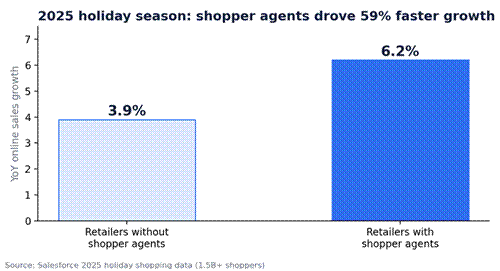
Figure 3: Sales growth with and without shopper agents (Salesforce, 2025 holiday season)
To estimate your own upside, use simple math. Monthly carts created, multiplied by your abandonment rate and average order value, equals monthly abandoned revenue.
Illustrative example: A store with 20,000 carts a month, a 70% abandonment rate, and a ₹2,000 average order value leaves ₹2.8 crore in carts every month. Recovering just 5% of that adds ₹14 lakh in monthly revenue.
Brands that reduce cart abandonment with AI rarely win on one tactic. The gains come from stacking better answers, faster checkout, and smarter follow-up.
Comparison: Traditional Cart Recovery vs AI Voice Calling Agent for eCommerce
Traditional recovery reacts after the shopper has left, while an AI voice and chat agent works before and after the exit, in real time.
| Factor | Traditional Recovery (email, pop-ups, manual calls) | AI Voice Calling Agent |
| Timing | Hours or days after the shopper leaves | In session, plus minutes after exit |
| Personalization | Template with product images | References the cart, the objection, and past orders |
| Objection handling | None, one-way message | Two-way answers on cost, size, delivery, returns |
| Channels | Email, sometimes SMS | Web chat, WhatsApp, voice calls, email |
| Languages | Usually one | Multilingual, including regional languages |
| Scale | Limited by team size for calls | Thousands of conversations at once, 24/7 |
| Discount use | Blanket coupons that erode margin | Rule-based offers only when needed |
| Data captured | Opens and clicks | Reasons for leaving, intent, and sentiment |
| Benchmark result | 3.33% placed-order rate for cart emails (Klaviyo) | Measured per store against a control group |
Traditional tools still have a role. Email is a low-cost safety net. The shift is making AI the first responder and email the backup.
How Should Online Store Founders Roll Out AI Agents for Cart Abandonment?
The safest rollout starts small, connects deeply, and proves value against a control group. Here is the sequence we recommend.
- Measure your baseline. Track cart and checkout abandonment by device, page, category, and payment method.
- Pick the top two objections. Use session recordings, support tickets, and exit surveys to find them.
- Start with one channel. Launch on web chat or WhatsApp first, then add voice once scripts are proven.
- Integrate before you launch. Connect catalog, inventory, pricing, CRM, and order APIs so the agent can act, not just talk.
- Set guardrails. Define discount limits, escalation rules, and consent for calls and messages under India’s DPDP Act or GDPR.
- Test for four to six weeks. Compare against a holdout group and track recovery rate, average order value, and revenue per conversation.
Budgets depend heavily on channels and integrations. Our breakdown of Custom AI agent development cost explains what drives pricing for startups and SMBs.
If you are also weighing AI for support, sales, or operations, our overview of AI Agents for businesses covers the wider use cases.
What Mistakes Should You Avoid When Deploying AI Agents?
The biggest mistakes come from treating the agent as a coupon machine or a bolt-on widget. Avoid these common traps.
- Discounting every cart. Shoppers quickly learn to abandon on purpose to get a code.
- Over-messaging. Three reminders in a day feels like spam and hurts brand trust.
- Launching without integrations. An agent that cannot check stock or order status frustrates buyers.
- Skipping consent. Voice and WhatsApp outreach needs clear opt-in and easy opt-out.
- No control group. Without one, you cannot prove what the agent actually recovered.
Are You Ready for Implementing a Voice Assistant for Your eCommerce Business?
You are ready if your store has steady traffic, a clear abandonment problem, and systems the agent can connect to. Check how many of these apply to you.
- You see at least a few thousand carts created each month.
- Your abandonment rate is near or above the 70% benchmark, especially on mobile.
- Your store runs on a platform with APIs, such as Shopify, WooCommerce, Magento, or a custom stack.
- Customers already call or message you on WhatsApp before buying.
- You can define clear rules for discounts, returns, and escalation.
If three or more apply, a focused pilot on one high-value category is a sensible next step. Cart abandonment recovery works best when you prove it in one place before scaling.
Conclusion
Cart abandonment is not a traffic problem. It is a conversation problem, and AI agents for cart abandonment finally let SMBs and startups hold those conversations at scale.
Here is what to do in the next 30 days:
- Pull your cart and checkout abandonment rates by device this week.
- List the top three questions shoppers ask before buying.
- Choose one channel and one product category for a pilot.
- Agree on success metrics and a holdout group before launch.
- Review results at week six and decide whether to scale to voice.
Ready to recover the revenue already sitting in your carts? Book a free cart abandonment audit with Technobrave and get a pilot plan tailored to your store.