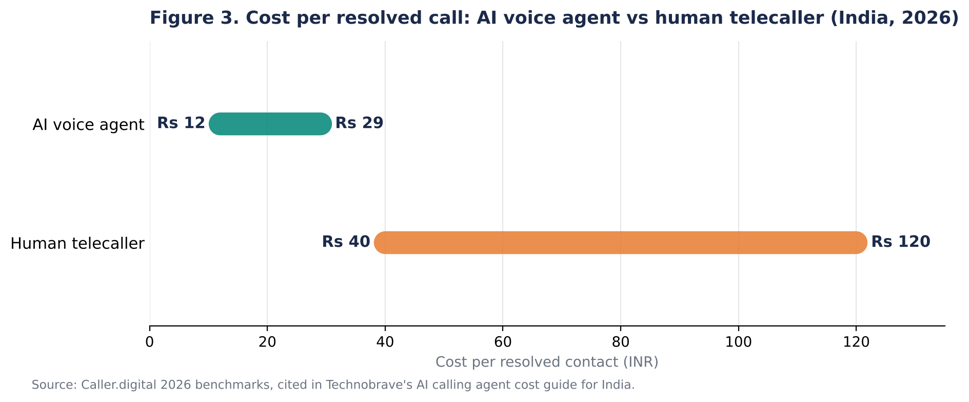
A multilingual AI voice agent is software that answers and places phone calls in Hindi, English, Hinglish and regional languages such as Tamil, Telugu or Marathi, and switches language whenever the caller does. It matters because 98% of Indian internet users consume Indic-language content (IAMAI and Kantar, 2024). India-tuned agents run at about ₹4 to ₹8 per minute and resolve a routine call for ₹12 to ₹29, against ₹40 to ₹120 for a human telecaller.
Picture a customer in Indore who placed a cash-on-delivery order last night. Your confirmation call opens with “Press 1 for English.” She hangs up, the parcel ships anyway, and it comes back three days later as a return you pay for twice.
That small moment repeats thousands of times a month across Indian businesses. The fix isn’t a bigger call center. It’s an agent that talks the way your customers already talk at home.
At Technobrave we scope, build and deploy voice agents for Indian SMBs and startups. Here’s what we’ve learned about real callers, real costs and where these agents still break.
Key Takeaways:
- India had 958 million active internet users in 2025, and about 57% of them live in rural India (IAMAI and Kantar, Internet in India 2025).
- Speech recognition error rates rise 30% to 50% on code-switched speech such as Hinglish (HiACC study, 2025).
- An AI voice agent resolves a routine call for ₹12 to ₹29, compared with ₹40 to ₹120 for a human telecaller (Caller.digital, 2026).
What is a Multilingual AI Voice Agent and How Does It Work?
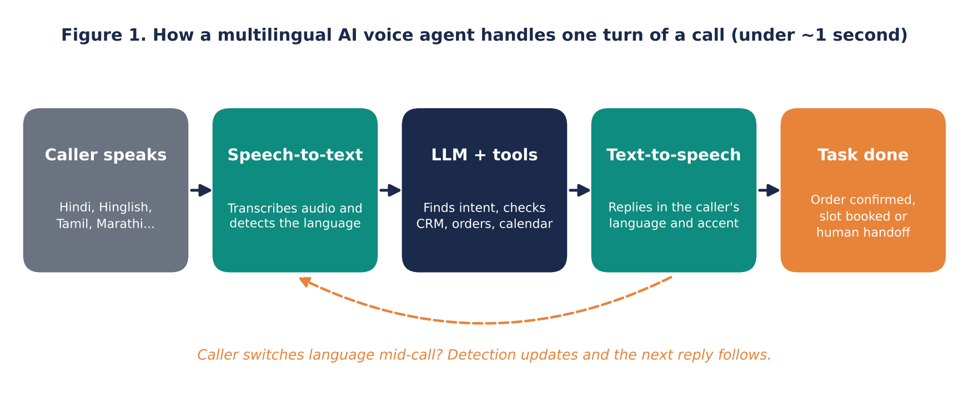
A multilingual AI voice agent is a phone agent that listens, understands and replies in the caller’s own language, then completes a task like confirming an order or booking a visit. It runs on three layers that pass each turn along in about a second.
First, speech-to-text turns the caller’s audio into words and detects the language. Second, a large language model works out what the caller wants and checks your systems, such as the CRM, order database or calendar.
Third, text-to-speech replies in a natural voice with the right accent. If the caller drifts from Hindi into English, the language detection updates and the next reply follows.
Every layer must support your languages. A great Hindi voice with weak Tamil transcription still fails a caller from Coimbatore. That’s why language switching mid-call is the real test, not the number of languages on a pricing page.
Why Are Indian Businesses Moving Customer Calls Beyond English?
Indian businesses are moving calls beyond English because most new customers don’t think, shop or complain in English. Growth is coming from smaller towns, where people live online in their own language.
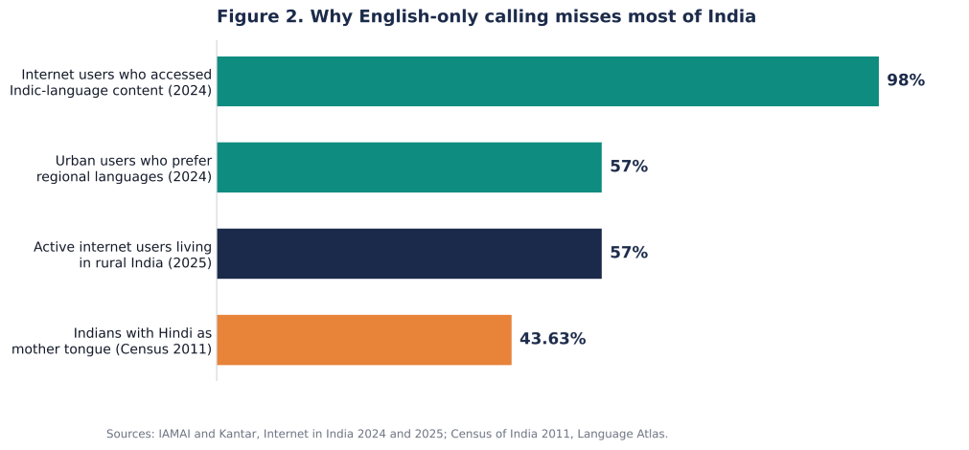
The IAMAI and Kantar Internet in India 2025 report counts 958 million active internet users. About 548 million are rural, and that group is growing nearly four times faster than urban India.
The 2024 edition found that 98% of internet users accessed content in Indic languages, and 57% of urban users preferred regional languages.
Hindi is the mother tongue of 43.63% of Indians, per the Census 2011 Language Atlas. Yet many of your tier-2 and tier-3 customers speak Bhojpuri-flavoured Hindi, Marathi, Kannada or Bengali at home.
Vernacular CX isn’t a nice extra anymore. It’s how you reach the buyers your English IVR quietly turns away.
What Did Technobrave Learn From Scoping Hindi Calling Agents?
The clearest lesson is that integration and language testing cost more than the voice itself. That’s where nearly every budget surprise comes from.
Take a scope our team regularly prices for D2C brands: a phone calling agent in Hindi and English that confirms COD orders and answers order-status calls, synced with Shopify and the CRM.
In Technobrave’s 2026 cost model, that build lands near ₹2,10,000. At 10,000 calls a month averaging two minutes, running cost is about ₹1,20,000 at ₹6 per minute, plus roughly ₹10,000 for monthly support.
Across our modelling, an agent like this cuts outbound calling costs by 45% to 65% compared with an in-house tele-calling team.
One more pattern: agents trained only on textbook Hindi struggle on live calls. Real callers say “order cancel kar do,” not the formal version. Our AI calling agent services build test sets from real call recordings for exactly this reason.
Planning chat, email or back-office agents alongside voice? Our breakdown of the Cost to Build a Custom AI Agent covers those budgets in detail.
Where Do Most Voice Bots Break With Real Indian Callers?
Most voice bots break on mixed language, accents and small details like names and numbers. Clean demo audio hides all three.
Hinglish is the first trap. The HiACC corpus study notes that speech recognition error rates rise 30% to 50% on code-switched speech. Deepgram’s 2026 testing found Hinglish word error rates from 26.97% to 69.53% across models on the same audio.
Accent handling is the second. In a SPECOM 2022 study, four commercial speech systems averaged 27.33% word error on native Hindi-English speech, but 38.35% for Assamese-accented speakers.
The third is the boring stuff: pin codes, rupee amounts, SKUs and local place names. A Hindi voice bot that mishears a customer’s surname or town loses their trust within seconds.
Phone lines also add noise and compression, so ask every vendor for results on real call recordings, not studio clips.
Which Use Cases Pay Back First for SMBs and Startups?
High-volume, repetitive calls with one clear outcome pay back first. Predictable paths mean the agent can handle most of them alone.
- COD confirmation and address checks to cut return-to-origin losses.
- Checkout recovery calls. Our guide shows how AI agents for cart abandonment recover lost sales across voice, WhatsApp and email.
- EMI and payment reminders, where a call in Marathi or Telugu often beats an SMS.
- Lead qualification for real estate, education and insurance.
- Appointment booking and rescheduling for clinics and home services.
Payback usually takes one to three months for high-volume calling and three to six for low-volume B2B work. Let AI take the routine 70% to 85% of calls.
How Much Does a Multilingual AI Voice Agent Cost to Build and Run?
Most SMB and startup builds in India cost ₹75,000 to ₹4,00,000 one time, plus ₹4 to ₹8 per minute on India-bundled platforms. Enterprise builds with custom voice pipelines and compliance work start near ₹5,00,000.
Global tools billed layer by layer often land at ₹15 to ₹25 per minute for Indian calls.
Each extra language needs its own voice, speech tuning and test scripts. Start with Hindi and English, then add the regional languages your call data points to.
Thinking of training your own speech or language models? Read our guide to AI Model Development Cost first. For most SMBs, a tuned platform beats a model built from scratch.
What Should a CTO Test Before Choosing a Voice AI Vendor?
Test every shortlisted agent on your own call recordings, in the languages your customers actually use. A vendor’s demo script tells you very little.
- Mixed-language accuracy. Count errors on names, numbers and intents across 50 real Hinglish and regional calls.
- Latency. Replies should start in about a second. Longer gaps make callers talk over it.
- Interruptions. Check whether callers can cut in, change their mind or switch language mid-sentence.
- Handoff. A human should get the full transcript and context, so the customer never repeats themselves.
- Compliance. Confirm TRAI header registration, consent records and DND scrubbing for outbound calls. The DPDP Act, 2023 treats recordings and transcripts as personal data.
- Reporting. Ask for containment, transfer rate and cost per resolved call, split by language.
When a vendor pitches an AI voice agent Hindi demo, ask for the same flow in Hinglish with traffic noise behind it.
How Do You Roll Out Your First Agent Without Wasting Budget?
Start with one use case, two languages and one hard success metric. Expand only after the numbers hold steady for a full month.
- Weeks 1 to 2: Pull 200 to 500 recorded calls and tag language, intent and outcome. It shows which regional languages matter.
- Weeks 3 to 6: Build one flow, such as COD confirmation, in Hindi and English with Hinglish support, linked to your order system.
- Weeks 7 to 8: Route 10% to 20% of traffic to the agent. Compare results against your human team.
- Month 3 onward: Add the next language and the next flow, reusing the same test set.
Pilots typically go live in two to four weeks, production agents in four to eight.
Conclusion
Your customers have already chosen the language they want to buy in. The best AI voice agent for your business answers in that language, at a cost per call no human team can match.
Start here:
- Count last month’s calls by language and outcome.
- Pick the highest-volume flow with the clearest result.
- Test two vendors on 50 of your real Hinglish and regional calls.
- Set containment, cost-per-call and CSAT targets before the pilot.
Want to skip the vendor maze? Technobrave can scope a Hindi and regional-language pilot around your own call data. Book a free scoping call for a costed plan.