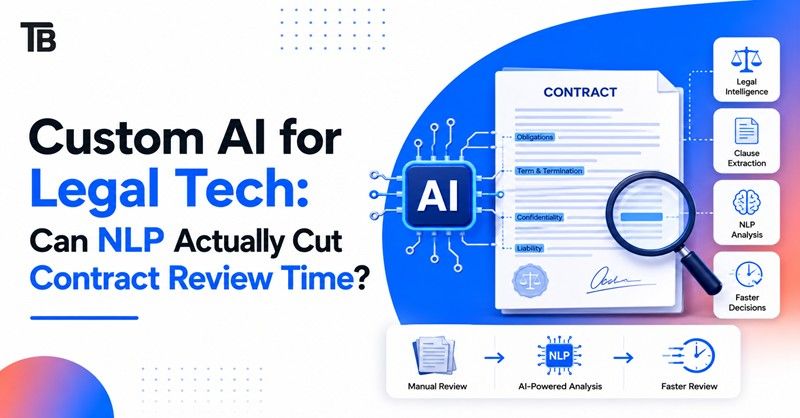
Yes, custom AI for legal tech, built on domain-tuned NLP models, can cut contract review time by 70–85% while improving clause-level accuracy. Off-the-shelf tools handle generic review, but legal teams with proprietary playbooks, niche jurisdictions, or compliance-heavy contracts get measurably better risk detection from custom legal AI solutions trained on their own clause libraries and historical deal data.
Legal teams aren’t short on AI tools in 2026; they’re short on AI tools that understand their contracts. Generic chatbots can summarize a lease. They struggle when a 40-page MSA has three conflicting indemnification clauses buried across exhibits, written in a dialect of legalese specific to your industry. That gap between “AI that reads contracts” and “AI that understands your contracts” is exactly why custom AI for legal tech has moved from nice-to-have to competitive necessity this year.
This piece breaks down how NLP-powered contract analysis actually works, what the real benchmarks say, when custom beats off-the-shelf, and how to evaluate the build vs buy AI decision without guessing.
Key Takeaways:
- Legal teams spend an average of 3 hours reviewing a single contract manually; automated review can cut that by up to 85%, according to 2026 industry benchmarking data.
- General-purpose LLMs (GPT-5.1, Gemini 3.1 Pro, Claude Opus 4.6) underperform purpose-built legal AI by wide margins on contract-specific benchmarks — one 2026 in-house legal benchmark scored a specialized platform at 82.7% accuracy versus 42.9% for a leading general model.
- Custom-trained contract AI that ingests a firm’s own playbooks and clause history consistently outperforms generic models on clause-level risk detection, because legal language varies sharply by industry, jurisdiction, and internal precedent.
What Is Custom AI for Legal Tech, Exactly?
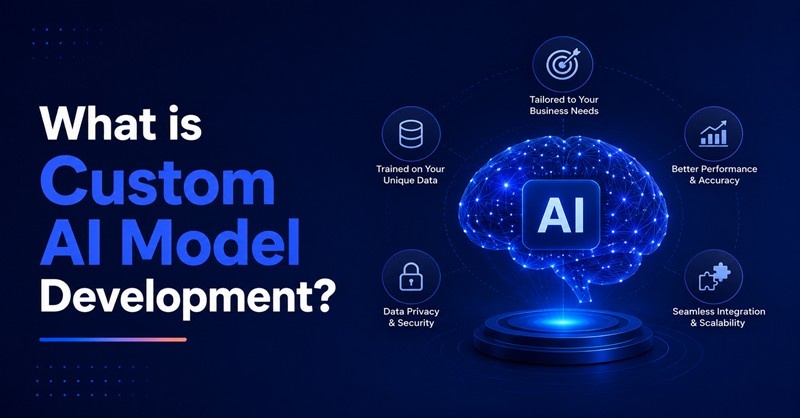
Custom AI for legal tech is an NLP system trained or fine-tuned on a specific organization’s contracts, playbooks, and risk policies rather than a generic model applied uniformly across every client. The difference matters because legal language isn’t universal: a “material adverse change” clause in a SaaS MSA reads nothing like one in a pharma licensing deal.
Off-the-shelf legal AI tools ship with broad training data and pre-built playbooks covering common provision types. That works well for standard NDAs and vendor agreements. Custom legal AI solutions go further; they’re tuned on a firm’s own historical contracts, redline patterns, and internal precedent, so the model learns how this specific legal team thinks, not just generic contract law.
How Does NLP Power Contract Lifecycle Management AI?
NLP legal document processing breaks a contract into structured, analyzable components instead of treating it as flat text. The pipeline typically runs through clause segmentation, named-entity recognition, semantic comparison against a knowledge base, and risk scoring — each step layered on the last.
The technology stack behind contract lifecycle management AI typically includes three core components:
- Natural Language Processing (NLP): parses contract text, identifies clause boundaries, and extracts obligations, dates, and parties.
- Machine Learning (ML) classifiers: compare extracted clauses against a knowledge base or playbook to flag deviations.
- Knowledge graphs: map relationships between clauses, parties, and historical deal outcomes for context-aware risk detection.
Why Does AI Contract Analysis Outperform Manual Review?
AI contract analysis wins on speed and consistency, not judgment. A platform built for contract review can complete a full pass in seconds, while attorneys still average roughly three hours per contract on manual review — and that consistency compounds across hundreds of agreements a month.
The accuracy gap is the more interesting story. In a 2026 benchmark run across 3,282 contracts and 21 precision-critical guidelines, a purpose-built contract review platform outperformed every tested general-purpose AI model including Claude Opus 4.6, Gemini 3.1 Pro, and GPT-5.1 across all 21-contract provision categories and completed a full contract review roughly 17 times faster than Claude Opus 4.6. Separately, an in-house legal benchmark scored by attorneys with 80+ combined years of practice found a specialized contract-analysis platform leading at 82.7% accuracy, ahead of GPT-5.5 at 72.8%, Claude Opus 4.7 at 66.3%, and Gemini 3.1 Pro at 42.9%.
The takeaway isn’t “general models are bad.” It’s that purpose-tuning on legal-specific data and playbooks produces measurably better contract clause analysis than prompting a horizontal model and hoping.
What Does Technobrave See in Real Legal AI Deployments?
Across our legal-tech engagements, the highest-friction point isn’t model accuracy; it’s contract data extraction from inconsistent source formats (scanned PDFs, redlined Word docs, email-thread amendments) before any NLP model can even run.
In one Technobrave engagement for a mid-market legal services client, we built a custom contract analysis pipeline trained on the client’s own 5+ years of executed agreements and internal playbook. Pre-processing alone OCR cleanup, clause segmentation, and metadata normalization; accounted for roughly 40% of total engineering effort, but it’s what let the downstream risk-detection model hit usable accuracy on the client’s non-standard clause formats within the first training cycle. The lesson we keep relearning: legal knowledge management infrastructure (clean, structured, versioned contract data) matters more to final accuracy than the choice of underlying LLM.
Where Does AI Contract Automation Deliver the Fastest ROI?
AI contract automation pays off fastest in repetitive, high-volume, low-novelty contract categories; NDAs, vendor agreements, standard MSAs — where the playbook is well-defined and exceptions are rare. High-novelty, bespoke negotiations still need heavy human judgment regardless of tooling.
Five areas consistently show the clearest gains:
- Contract summarization — turning 40-page agreements into structured one-page risk summaries for business stakeholders who aren’t lawyers.
- Legal risk detection — flagging missing indemnification, unusual termination triggers, or non-standard liability caps automatically.
- Contract clause analysis — comparing incoming paper against an organization’s preferred clause library at the sentence level.
- Obligation tracking — extracting renewal dates, payment triggers, and compliance deadlines into a structured calendar.
- Cross-functional handoff — giving sales, procurement, and finance read access to plain-language contract summaries without legal bottlenecking every request.
Mid-market platforms in this space report onboarding timelines as fast as four weeks with minimal user training, which sets a useful benchmark for what “fast” should look like for any custom deployment too.
How Do Custom Legal AI Solutions Compare to Off-the-Shelf Platforms?
| Factor | Off-the-Shelf Legal AI | Custom AI for Legal Tech |
| Setup time | Days to a few weeks | Weeks to a few months |
| Accuracy on standard contracts | High | High |
| Accuracy on firm-specific/niche clauses | Moderate | High — trained on your own data |
| Integration with internal systems | Limited to vendor’s pre-built connectors | Built to match existing stack (CRM, DMS, ERP) |
| Data ownership & model control | Vendor-controlled | Client-controlled |
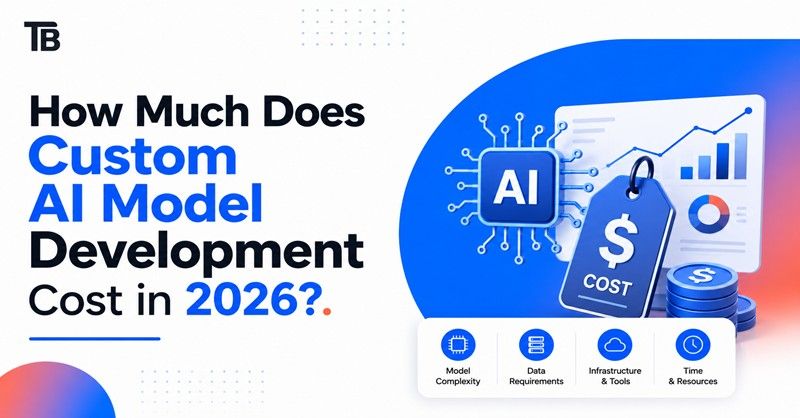
| Ongoing cost structure | Subscription, scales with seats | Upfront AI model development cost, then lower marginal cost |
| Best fit | Standard contract types, fast deployment | Proprietary playbooks, regulated industries, high volume |
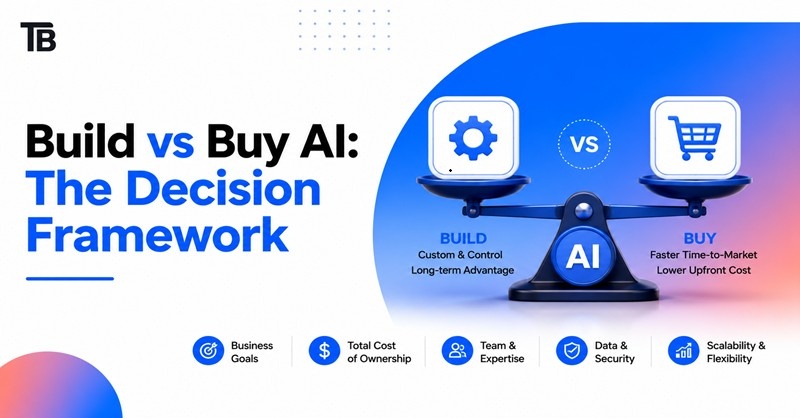
Most legal teams don’t face a binary choice; many start with an off-the-shelf tool for standard contracts, then layer custom NLP legal document processing on top for the proprietary, high-stakes categories where generic models consistently underperform.
Conclusion: What Should Legal Teams Do Next?
If your contract volume is high, your clause language is non-standard, or your compliance exposure is significant, custom AI for legal tech is worth the investment, the accuracy gap between purpose-tuned and generic models is too large to ignore in 2026. Start by auditing your contract data: can you produce 500–1,000 clean, structured historical contracts? If yes, you have enough to train a meaningfully accurate custom model. If not, begin with an off-the-shelf platform while you build that data foundation, and revisit the build vs buy AI decision in 12–18 months. Either path, involve legal, IT, and an experienced AI development partner early contract data extraction and legal knowledge management infrastructure determine your outcome more than which model you pick.