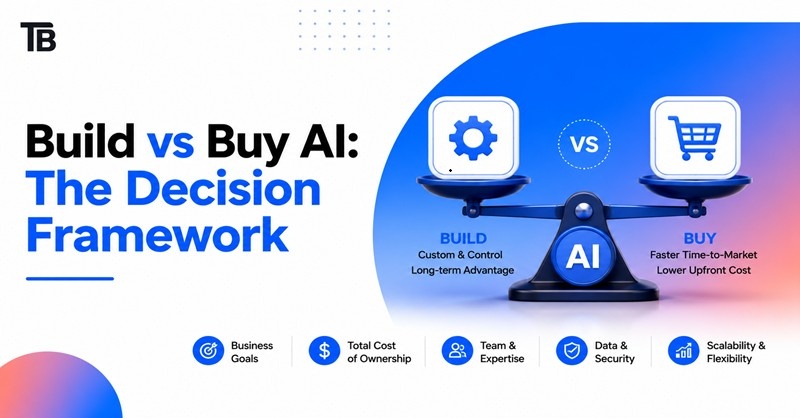
The right build vs buy AI decision depends on four variables: data uniqueness, time-to-value, budget, and competitive sensitivity. In 2026, most mid-market companies should buy first and build selectively; off-the-shelf AI solutions cover ~70% of use cases at a fraction of the cost, while custom AI development is justified only when a unique workflow or proprietary data creates a durable competitive advantage. Use the scoring matrix in this guide to decide in under 30 minutes.
Every week, a leadership team somewhere walks into a board meeting holding the same slide: “Should we build our own AI or buy an existing platform?” The answer shapes budgets, timelines, team structures, and—increasingly—market position. In 2026, this decision is harder than ever because the gap between off-the-shelf AI solutions and custom AI development is simultaneously narrowing (foundation models are stronger) and widening (proprietary data is rarer and more valuable).
This guide gives you a structured, repeatable AI build vs buy framework—not opinions, but a decision tool grounded in real deployment data, cost benchmarks, and the patterns Technobrave has observed across enterprise AI adoption projects.
Key Takeaways
- 85% of enterprise AI budgets in 2025–26 went to AI platform selection and integration rather than ground-up model training (McKinsey, 2025).
- Custom AI model development costs range from $150K to $5M+; off-the-shelf AI solutions typically run $20K–$200K/year for comparable scope.
- Companies that rushed to build custom AI before validating use cases wasted an average of 14 months and $780K in sunk costs (Gartner, 2025).
What Exactly Are You Deciding When You Choose to Build vs Buy AI?
The phrase “build vs buy AI” actually covers three distinct decisions that businesses often conflate. Understanding the layers prevents the most expensive mistake in enterprise AI adoption: over-engineering a solution that an existing platform already solves.
- Layer 1 — Model: Do you train or fine-tune your own model, or use a foundation model API (OpenAI, Anthropic, Google Gemini)?
- Layer 2 — Application: Do you build a custom AI application layer, or buy an AI-native SaaS product?
- Layer 3 — Integration: Do you build custom connectors and pipelines, or use pre-built integrations from an AI platform selection like Azure AI, AWS Bedrock, or Google Vertex?
Most enterprises end up with a hybrid across all three layers. The framework in this guide helps you decide deliberately—not by default.
What Does Real Enterprise AI Adoption Data Tell Us About the Build vs Buy Split?
- 70% of enterprise AI use cases are adequately served by off-the-shelf AI solutions (McKinsey, 2025)
- 3.2× higher ROI reported by companies that piloted a buy-first approach before committing to custom AI development (Forrester, 2026)
- 14 mo. average wasted timeline for enterprises that built custom AI without first validating with a vendor proof-of-concept (Gartner, 2025)
The data is clear: a buy-first posture significantly reduces risk in the early stages of enterprise AI adoption. But “buy first” is not the same as “buy forever.” The strategic question is identifying the threshold at which your use case justifies the investment in AI software development.
How Do You Run a Proper AI Solution Evaluation in 2026?
A rigorous AI solution evaluation has five checkpoints. Skip any one of them and you risk either over-building (wasting capital) or under-building (losing competitive advantage).
1. Define the use case boundary. Write a one-sentence problem statement. If you need three sentences, the scope is too wide for a single AI initiative.
2. Audit your data reality. Do you have proprietary, labeled training data that a generic model cannot replicate? If no → lean toward buy. If yes → evaluate build.
3. Map the competitive sensitivity. Would a competitor using the same SaaS AI vendor reach feature parity with you? If yes → building may be necessary for differentiation.
4. Benchmark time-to-value. Does your business need results in 8 weeks or 18 months? Off-the-shelf AI solutions typically deploy in 4–12 weeks; custom AI development takes 9–24 months.
5. Calculate the AI model development cost delta. What is the 3-year TCO difference between building and buying? If it’s less than 30% of projected revenue impact, build. If it’s more, buy until scale justifies otherwise.
Build vs Buy AI Scoring Matrix: Rate Each Factor 1–5
| Decision Factor | Score 1–2 → Buy | Score 3 → Hybrid | Score 4–5 → Build |
|---|---|---|---|
| Data uniqueness & proprietary depth | Low / generic | Partially unique | Highly proprietary |
| Required time-to-production | < 3 months | 3–9 months | > 12 months OK |
| Competitive differentiation potential | Table stakes | Moderate edge | Core moat |
| In-house AI engineering capacity | None / minimal | Small team | Strong ML team |
| Regulatory / data sovereignty needs | Standard compliance | Enhanced controls | Strict on-prem / air-gap |
| Long-term maintenance appetite | Prefer managed | Partial ownership | Full ownership |
When Does Custom AI Development Actually Win the ROI Argument?
Custom AI development makes financial and strategic sense under a specific constellation of conditions—not just one or two. Treat each condition as a multiplier, not a standalone justification.
- You have a proprietary dataset that is genuinely scarce. Clinical trial data, decades of industrial sensor readings, unique customer behavioral sequences—these are assets a vendor cannot replicate. This is the single strongest argument for building.
- The workflow is deeply idiosyncratic. If your process logic requires more than 60% customization of any off-the-shelf platform, you are effectively rebuilding it anyway. Build once, maintain one codebase.
- Vendor dependency creates existential risk. If an AI vendor deprecates a model, raises pricing 3×, or gets acquired, does your product survive? Mission-critical AI software development requires ownership.
- Regulatory requirements demand on-premise inference. Highly regulated industries—healthcare, defense, financial services—often require inference to happen on controlled infrastructure that no SaaS vendor can offer.
Working with a trusted AI development partner at this stage is critical. Custom development without institutional AI expertise has a failure rate exceeding 60% for first-time enterprise builders.
AI Platform Selection Strategy Reduces the Most Risk?
The rise of AI software products has created a paradox of choice. There are now over 12,000 AI-native applications listed on G2, Capterra, and similar marketplaces as of 2026. A structured AI platform selection methodology prevents vendor regret—one of the most expensive problems in enterprise technology.
Evaluate AI platforms against these five criteria:
- Model transparency: Can you audit what model powers the platform and switch if needed?
- Data residency: Where is your data stored and processed? Does it leave your region?
- API-first architecture: Can you build on top of it if your needs evolve?
- Pricing predictability: Is pricing usage-based (risky at scale) or seat-based (more predictable)?
- Exit pathway: How painful is data portability if you switch vendors in 24 months?
Build vs Buy AI: Head-to-Head Comparison for Enterprise Decision-Makers
| Dimension | Buy (Off-the-Shelf AI) | Build (Custom AI) | Hybrid Approach |
|---|---|---|---|
| Time to first value | 4–12 weeks | 9–24 months | 6–14 weeks (then extend) |
| Upfront cost | $20K–$200K/yr | $150K–$5M+ | $50K–$500K |
| Customization ceiling | Limited by vendor roadmap | Unlimited | Moderate–High |
| Data privacy control | Shared responsibility | Full ownership | Configurable |
| Maintenance burden | Vendor-managed | Internal team required | Shared |
| Competitive moat | None (shared with peers) | High (if unique data) | Moderate |
| AI talent required | Minimal | Significant ML/MLOps | Moderate engineering |
| Best for | Buy Validated use cases, fast ROI | Build Unique data, regulated industries | Hybrid Most enterprise scenarios |
Pros and Cons: Build vs Buy AI at a Glance
Building Custom AI
Pros of Custom Building AI
- Full IP ownership and data control
- Unlimited customization to your exact workflow
- Potential for significant competitive moat
- No vendor lock-in or pricing risk
- Meets strict regulatory and on-prem requirements
✗ Cons of Building AI
- High upfront AI model development cost ($150K–$5M+)
- Requires scarce ML engineering talent
- Long time-to-market (9–24 months)
- Ongoing model maintenance and retraining burden
- High failure rate without experienced AI development partner
Buying Off-the-Shelf AI Solutions
✓ Pros of Buying
- Fast deployment (weeks, not months)
- Predictable subscription cost
- Vendor handles model updates and infrastructure
- Lower risk for first-time AI adopters
- Proven reliability in common enterprise use cases
✗ Cons of Buying
- Customization limited to vendor’s feature set
- Competitors access the same capabilities
- Data may leave your security perimeter
- Pricing escalation risk at renewal
- Vendor dependency for mission-critical workflows
What Is the Right AI Strategy for Businesses in Different Growth Stages?
The ideal AI strategy for businesses is not one-size-fits-all—it shifts with company scale, data maturity, and competitive context. The rise of AI software products has made buying accessible even to SMBs, while the fall in cloud compute costs has made building more accessible to mid-market players. Here is how the decision typically breaks across growth stages:
- Startup / Early Stage (< $10M revenue): Buy. Speed and capital efficiency matter more than differentiation. Use off-the-shelf AI solutions to validate product-market fit before any AI software development investment.
- Growth Stage ($10M–$100M revenue): Buy-first, then selectively build. Use the scoring matrix above to identify the one or two workflows where custom AI model development creates a durable advantage.
- Enterprise / Scale ($100M+ revenue): Hybrid by default. Own the models that power your core product; buy the rest. Establish a formal AI solution evaluation process before any new initiative.
Regardless of stage, every organization should track AI model development cost against business outcome metrics—not just technical KPIs—to maintain executive alignment and justify the ongoing investment.
Conclusion: Your 5-Step Build vs Buy AI Action Plan
The build vs buy AI decision is not binary in 2026—it is a spectrum that changes as your business, data, and AI maturity evolve. The frameworks, data, and matrices in this guide give you the structure to decide confidently. Here is your immediate action plan:
- Step 1: Run the 5-question AI solution evaluation above on your top-priority use case this week.
- Step 2: Score it against the decision matrix. If your total is below 14, start a vendor shortlist—not a build plan.
- Step 3: For any use case scoring 15+, document your proprietary data assets before scoping any AI software development. Data quality is the most common build-failure root cause.
- Step 4: Pilot the leading off-the-shelf option for 60–90 days even when you plan to build. Pilots surface requirements you will miss in a design doc.
- Step 5: Engage a qualified AI development partner before writing a single line of custom code. The cost of expert advisory is almost always less than the cost of a failed internal build.
Ready to apply this framework to your specific situation? Talk to a Technobrave AI advisor →