AI software development is the process of building applications that learn from data and make intelligent decisions, instead of only following pre-written rules. It combines machine learning, data engineering, and traditional software engineering. With 88% of organizations now using AI in at least one business function (McKinsey, 2025), it has become a core business capability not an experiment.
Five years ago, adding AI to your product meant hiring a PhD and praying. Today, a mid-sized company can ship an AI-powered feature in a quarter. The tools changed. The economics changed. What hasn’t changed is this: most teams still don’t understand how AI software development actually differs from regular software projects — and that gap is where budgets go to die.
This guide breaks down what AI software development is, how the process works, what it costs to get wrong, and how to choose the right path forward.
Key Takeaways
- 88% of organizations now use AI in at least one business function, up from 78% a year earlier — yet only about one-third have begun scaling it across the enterprise (McKinsey State of AI, 2025).
- The global AI market reached $390.9 billion in 2025 and is projected to hit $3.49 trillion by 2033, growing at a 30.6% CAGR (Grand View Research).
- Only ~6% of companies qualify as AI high performers — organizations attributing more than 5% of EBIT to AI — proving that how you build matters more than whether you build (McKinsey, 2025).
What Is AI Software Development?
AI software development is the discipline of designing, building, and deploying software that uses artificial intelligence typically machine learning models to perform tasks that normally require human judgment.
Traditional software follows explicit instructions: if X happens, do Y. AI software learns patterns from data and improves its behavior over time. Think of a fraud detection system that gets smarter with every transaction, or a chatbot that understands intent rather than matching keywords.
In practice, AI software development blends three skill sets:
- Data engineering – collecting, cleaning, and structuring the data models learn from
- Machine learning software development – training, testing, and tuning models
- Software engineering – wrapping models in reliable, secure, usable products
That last point matters. A model sitting in a notebook isn’t a product. The real work of AI product development is turning a working model into AI-powered applications that real users depend on every day.
How Does the AI Development Process Work?
The AI development process follows six stages: problem definition, data preparation, model development, integration, deployment, and continuous monitoring.
Unlike traditional development, the process is cyclical — models degrade as the real world changes, so the loop never fully closes.
Here’s what each stage really involves:
- Problem definition. The most skipped step. Good teams ask: “Does this problem actually need AI, or just better automation?” Roughly half of failed AI projects die here.
- Data preparation. Expect 60–80% of project time to live in this stage. Messy, biased, or insufficient data kills more AI projects than bad algorithms ever will.
- Model development. Teams either train custom models, fine-tune existing ones, or build on foundation model APIs (GPT, Claude, Gemini). For most business use cases in 2026, building on foundation models is faster and cheaper than training from scratch.
- Integration. The model gets connected to your actual systems — your CRM, your website, your internal tools — through APIs and pipelines.
- Deployment. Shipping with guardrails: fallback logic, human review loops, and performance thresholds.
- Monitoring and retraining. AI software drifts. A pricing model trained on 2024 data quietly becomes wrong by 2026. Continuous monitoring is what separates production-grade AI from demos.
What Types of AI-Powered Applications Are Businesses Building?
The most common AI-powered applications today fall into five categories: predictive analytics, conversational AI, computer vision, recommendation systems, and AI agents.
McKinsey’s 2025 data shows generative AI use jumped to 79% of organizations — up from just 33% in 2023 — making conversational and content-generation tools the fastest-growing category.
| Application Type | What It Does | Common Business Use |
| Predictive analytics | Forecasts outcomes from historical data | Demand forecasting, churn prediction, lead scoring |
| Conversational AI | Understands and generates natural language | Customer support, sales chatbots, internal copilots |
| Computer vision | Interprets images and video | Quality inspection, document processing, retail analytics |
| Recommendation engines | Personalizes content and offers | E-commerce, media, upselling |
| AI agents | Executes multi-step tasks autonomously | Workflow automation, research, scheduling |
How Is AI Software Development Different From Traditional Development?
The core difference: traditional software is deterministic, while AI software is probabilistic. You don’t write the rules, you train the system to discover them, which changes how you plan, budget, test, and maintain the product.
| Dimension | Traditional Software | AI Software Development |
| Logic | Hand-coded rules | Learned from data |
| Output | Predictable, repeatable | Probabilistic, varies |
| Main cost driver | Engineering hours | Data quality + compute |
| Testing | Pass/fail unit tests | Accuracy metrics, edge cases |
| After launch | Mostly stable | Degrades without retraining |
| Timeline certainty | High | Moderate — depends on data |
This is why estimating AI projects with traditional software assumptions backfires. You can’t promise “95% accuracy by March” the way you can promise login page by March. Mature AI development services budget for experimentation cycles, not just feature delivery.
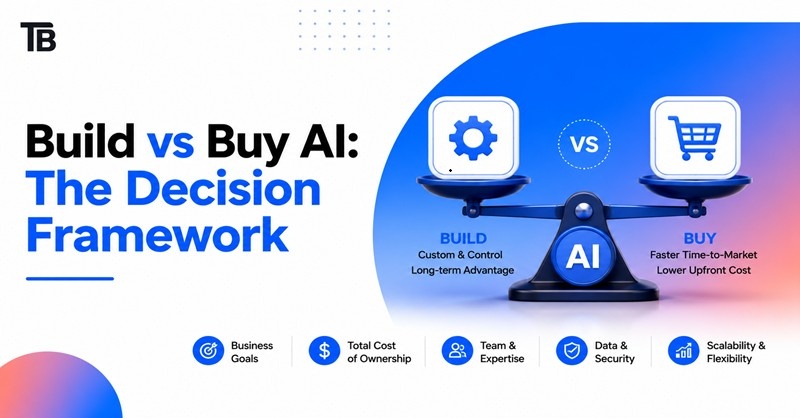
Should You Build In-House or Hire an AI Software Development Partner?
Most small and mid-sized businesses get better ROI from partnering than from hiring, at least for their first AI projects.
Here’s the honest comparison:
| Factor | In-House Team | AI Software Development Partner |
| Best for | Ongoing, core-product AI | First projects, defined scopes |
| Time to start | 3–6 months (hiring) | 2–4 weeks |
| Annual cost | $300K+ for a small ML team | Project-based, scales with need |
| Risk | Knowledge concentrated in few hires | Vendor dependency |
| Long-term | Builds internal capability | Faster, but capability stays external |
A good middle path: start with an AI software development partner for your first one or two projects, with knowledge transfer written into the contract. You ship faster, learn what AI maturity actually requires, then decide whether in-house investment makes sense.
When evaluating AI development services, look for three things: proof they’ve shipped production AI (not just demos), a process that starts with your data rather than their favorite model, and transparent talk about what AI can’t do for your use case. Anyone promising guaranteed accuracy before seeing your data is selling, not engineering.
The Bottom Line
AI software development isn’t a different universe from regular software — it’s regular software plus data, probability, and continuous learning. The companies winning with it aren’t the ones with the biggest budgets. They’re the ones who scope small, obsess over data quality, and treat deployment as the beginning of the work rather than the end.
The adoption race is over — 88% of companies are already in. The execution race is just starting, and only 6% are winning it. That’s the opportunity.
FAQs:
What is AI software development in simple terms?
AI software development means building applications that learn from data instead of following fixed rules. Developers train machine learning models on examples, then integrate those models into products like chatbots, recommendation engines, or forecasting tools that improve as they process more information.
How long does an AI development project take?
A focused first AI project typically takes 8–16 weeks from kickoff to production, assuming usable data exists. Data preparation consumes most of that time. Projects building on foundation models (like GPT or Claude) ship faster than those training custom models from scratch.
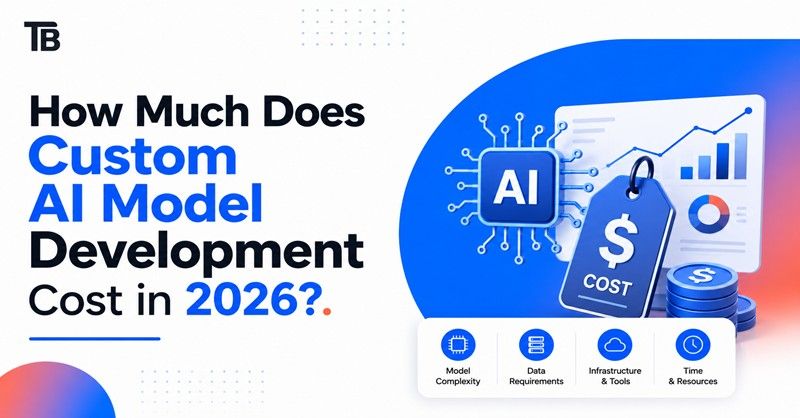
How much does AI software development cost?
Small, well-scoped AI projects using existing foundation models often run $15,000–$75,000. Custom machine learning software development with proprietary model training typically starts at $100,000+. The biggest cost variable is data readiness — clean, structured data dramatically lowers total project cost.
Do I need a lot of data to build AI software?
Not anymore. Foundation models arrive pre-trained, so many AI-powered applications need only a few hundred quality examples for fine-tuning, or none at all for prompt-based systems. Custom predictive models still need substantial historical data — usually thousands of relevant records.
What’s the difference between AI development and machine learning development?
Machine learning software development focuses specifically on building and training models. AI software development is broader — it includes the models plus everything around them: data pipelines, integration, user interfaces, deployment, and monitoring. ML is the engine; AI development is the whole vehicle.
How do I choose an AI software development partner?
Look for production deployments (not just prototypes), a data-first discovery process, transparent pricing, and willingness to say AI isn’t the right tool here. Ask for references from projects similar in size to yours, and require knowledge transfer in the contract.