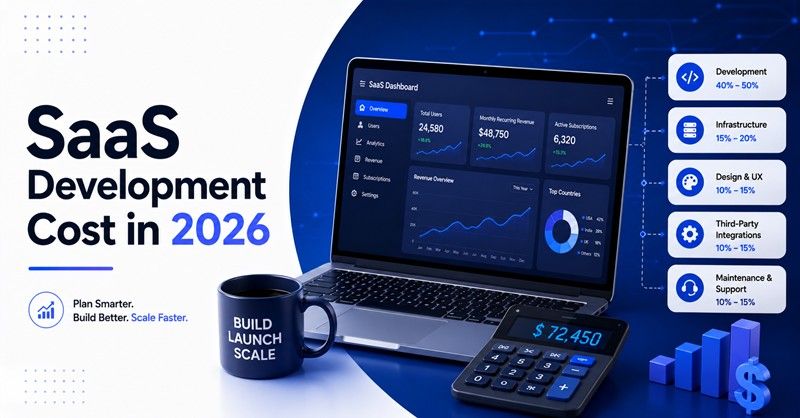
Building a SaaS product in 2026 costs between $40,000 and $150,000 for an MVP, $150,000 to $400,000 for a market-ready platform, and $500,000 or more for enterprise-grade systems. The largest cost drivers are engineering hours, third-party integrations, and compliance requirements; not features. Annual maintenance typically adds 15–25% of the original build cost.
Most founders budget for the build and forget the business. They raise enough to reach launch day, then discover that launch day is when the spending actually begins infrastructure that scales with users, a support function that didn’t exist in the estimate, and a roadmap that needs continuous engineering just to stay competitive.
The number you need isn’t the quote. It’s the total cost of ownership over 24 months. This breakdown gives you both.
Key Takeaways:
- Industry benchmarks consistently place SaaS MVP builds in the $40,000–$150,000 range, with the spread driven almost entirely by integration complexity and compliance scope rather than feature count.
- Gartner estimates organizations waste roughly 30% of cloud spend a figure that maps directly to architectural decisions made in the first 90 days of development.
- Annual maintenance for a production SaaS platform runs 15–25% of initial build cost, meaning a $200,000 product carries $30,000–$50,000 in yearly upkeep before any new feature work.
What Actually Determines SaaS Development Cost?
Engineering hours multiplied by hourly rate accounts for roughly 70% of any SaaS budget — everything else is a modifier on that core number.
The modifiers matter, though. Two products with identical feature lists can differ by 3x in price depending on four variables.
Integration count. Each third-party system; payment processors, CRMs, identity providers, accounting platforms; adds development time plus permanent maintenance liability. A product with twelve integrations is not twice as complex as one with six; it’s closer to three times, because failure modes multiply.
Compliance scope. SOC 2, HIPAA, or GDPR requirements can add 20–40% to a build. Not because the code is harder, but because audit trails, encryption standards, access controls, and documentation become mandatory rather than optional.
Data complexity. Simple CRUD applications are cheap. Real-time analytics, event processing, and multi-region data residency are not.
Team location. The same senior engineer costs $150/hour in the US and $35/hour in South Asia. Quality varies less than rates suggest, but communication overhead is real.
Where Do Budgets Actually Break Down in Practice?
In our experience, scope discovered mid-build, not scope planned up front causes the majority of budget overruns.
Across Technobrave’s SaaS engagements, projects that invested in a paid 2–3 weeks discovery phase before writing production code came in within 10% of their original estimate. Projects that skipped discovery averaged 35–50% over budget. The difference isn’t estimation skill. It’s that discovery surfaces the expensive unknowns; data migration volume, legacy API limitations, undocumented compliance obligations; while they’re still cheap to solve on a whiteboard.
A representative case. A B2B fintech client budgeted $95,000 for an MVP. During discovery, we found their target enterprise customers required SOC 2 Type II before signing; a requirement absent from the original brief. Adding it during discovery cost an additional $28,000 and eight weeks. Adding it after launch, as a retrofit, would have required re-architecting authentication, logging, and data handling: our estimate was $85,000 and a four-month delay.
Discovery cost 3% of the budget. It saved 60%.
Detailed Guide: SaaS Development Cost Break Down by Phase
Budget by phase, not by feature; phases have predictable cost ratios that features do not.
Discovery and architecture: 5–10% of total budget
Requirements workshops, technical architecture, tenancy model decisions, compliance scoping, and a validated backlog. Typical range: $8,000–$25,000. Skipping this is the most expensive false economy in the category.
UI/UX design: 10–15%
Wireframes, user flows, design system, and high-fidelity screens. Typical range: $12,000–$40,000. Products with complex dashboards or heavy data visualization sit at the upper end.
Frontend development: 20–25%
Component library, state management, responsive layouts, and accessibility. Typical range: $25,000–$80,000.
Backend and database: 25–35%
APIs, business logic, multi-tenant data architecture, authentication, and authorization. This is where architectural judgment pays off or costs you. Typical range: $35,000–$120,000.
Integrations: 10–20%
Payments, email, analytics, CRM, and any domain-specific systems. Budget $3,000–$12,000 per meaningful integration.
DevOps and infrastructure: 8–12%
CI/CD pipelines, environments, monitoring, logging, and backup strategy. Typical range: $10,000–$35,000.
QA and testing: 10–15%
Automated test suites, manual QA, security testing, and load testing. Typical range: $12,000–$45,000.
For teams still deciding on scope, our guide on How to Build SaaS Product from Scratch covers the sequencing decisions that determine which of these phases you can compress.
Regional Rate Comparison and What It Actually Buys You
Rates vary more than quality does. Understanding the trade-off matters more than chasing the lowest number.
| Region | Senior Developer Rate | MVP Cost (Typical) | Time zone Overlap (US) | Best Fit |
| United States / Canada | $120–$200/hr | $150,000–$350,000 | Full | Regulated industries, data residency requirements |
| Western Europe | $90–$160/hr | $120,000–$280,000 | 4–6 hours | GDPR-heavy products, EU market entry |
| Eastern Europe | $45–$80/hr | $70,000–$160,000 | 6–8 hours | Complex engineering at moderate cost |
| Latin America | $40–$75/hr | $65,000–$150,000 | Near-full | Teams wanting daily standup overlap |
| South & Southeast Asia | $25–$55/hr | $40,000–$110,000 | 3–5 hours | Cost-efficient delivery with mature process |
The honest read: engineering talent is globally distributed, but engineering process is not. A $30/hour team with disciplined code review, automated testing, and documented architecture will outperform a $150/hour team without those things. Evaluate process maturity, then rate.
Should You Build In-House or Hire an Agency?
Build in-house when SaaS development is your permanent core competency; hire an agency when you need velocity now and optionality later.
The math is often misread. A three-person in-house team in the US costs roughly $450,000–$600,000 annually in fully loaded salary, benefits, equipment, and management overhead. That’s before recruiting time — typically 3–5 months to hire a strong senior engineer in a competitive market.
An agency delivers a comparable MVP in that same window for a fraction of the annual burn, with no hiring risk and no severance exposure if the product doesn’t find traction.
The trade-off is knowledge retention. Agency knowledge walks out when the contract ends unless you contractually require documentation standards and code handover quality.
The pattern that works for most funded startups: engage a SaaS Development Company for the initial build, hire one senior in-house engineer during month four to absorb context, then transition gradually as product-market fit clarifies. You get speed without permanent lock-in.
What Are the Hidden Costs Nobody Includes in the Quote?
The build quote typically represents 60–70% of what you’ll actually spend in year one.
Here’s what tends to be missing:
Cloud infrastructure. Early-stage products run $500–$3,000 monthly. At scale, this becomes one of your largest line items. Architectural choices made in month one determine this curve for years.
Third-party software. Payment processing fees, email delivery, monitoring tools, error tracking, analytics, and customer support platforms. Budget $800–$4,000 monthly for a growing product.
Security and compliance audits. A SOC 2 Type II audit costs $20,000–$60,000 including readiness work and the auditor’s fee. Annual renewals follow.
Ongoing maintenance. Dependency updates, security patches, bug fixes, and platform migrations. This is where the 15–25% annual figure comes from — and it’s non-negotiable. Unmaintained SaaS accumulates security debt fast.
Support and success. Someone has to answer customer questions. Whether that’s a hire or your founding team’s time, it’s a real cost.
Post-launch iteration. Your first version will be wrong in ways you can’t predict. Reserve 20–30% of your build budget for the six months after launch.
How Much Does It Cost to Add AI Features to a SaaS Product?
AI capability adds 25–60% to a SaaS build, and the cost is mostly in data infrastructure rather than models.
The models themselves are increasingly commodity — accessible through APIs with predictable per-token pricing. What costs money is everything around them: event capture pipelines, feature stores, evaluation frameworks, prompt versioning, and the observability needed to catch model drift before customers do.
There’s also a recurring cost most budgets miss entirely. Inference costs scale with usage, not with users. A product where every user triggers ten model calls daily has a fundamentally different unit economic profile than one where AI is an occasional assist. Model this before you price your tiers, not after.
Retrofitting AI into an existing platform typically costs 2–3x what building it in from the start would have, because the data architecture has to be rebuilt. If AI features appear anywhere on your 18-month roadmap, engage an AI SaaS Development Company that will design your schemas accordingly from day one.
What Does Total Cost of Ownership Look Like Over Three Years?
Plan for roughly 2x your initial build cost across the first three years of operation.
Here’s a realistic model for a mid-market SaaS product with a $180,000 initial build:
| Cost Category | Year 1 | Year 2 | Year 3 |
| Initial build | $180,000 | — | — |
| Maintenance (20%) | $18,000 | $36,000 | $36,000 |
| Cloud infrastructure | $14,000 | $30,000 | $52,000 |
| Third-party software | $12,000 | $22,000 | $34,000 |
| Feature development | $30,000 | $75,000 | $90,000 |
| Compliance and audits | $25,000 | $15,000 | $15,000 |
| Annual total | $279,000 | $178,000 | $227,000 |
Three-year TCO: approximately $684,000 — against a $180,000 headline build figure.
This isn’t a warning against building. It’s an argument for budgeting honestly, because underfunded SaaS products fail in year two, not year one.
Ready to Budget Accurately? Your Next Four Steps
Step 1: Define your true MVP. Write down every feature, then cut until only what’s needed to validate your core hypothesis remains. Every feature you defer is $5,000–$20,000 preserved for post-launch iteration, when you’ll know what actually matters.
Step 2: Surface compliance requirements now. Ask three target customers what security documentation their procurement process requires. Do this before you get a quote. It is the single most common source of budget shock.
Step 3: Commission a paid discovery sprint. Two to three weeks, $8,000–$25,000, delivering a validated architecture and a defensible estimate. Treat any vendor unwilling to do this as a vendor unwilling to be held accountable to their number.
Step 4: Budget the full picture. Take your build estimate, add 20% contingency, add 20% annual maintenance, and add twelve months of infrastructure and tooling. That number is your actual funding requirement.
Technobrave’s SaaS Product Development Services team runs architecture-first estimation before any commercial conversation. If you want a defensible number rather than a sales figure, that’s where to start.
Conclusion
The cheapest SaaS build is rarely the least expensive one. Products that skip discovery, defer compliance, and under-architect their data layer don’t save money; they defer it, with interest, into a rebuild that costs more than the original.
Budget for three things most estimates ignore: the discovery that prevents rework, the maintenance that keeps you secure, and the iteration that follows launch. Get those right and your headline build number becomes reliable. Get them wrong and no quote will hold.
If you’re preparing a board deck or a fundraising model, build it on total cost of ownership across 24 months rather than a build quote. The founders who do this raise the right amount once, instead of the wrong amount twice.