Before you sign, ask an AI development company about business outcomes, data and model ownership, evaluation methods, failure handling, build-versus-buy logic, team composition, integration depth, security and compliance, year-two cost, and post-launch support. MIT’s 2025 research found 95% of enterprise GenAI pilots produced no measurable P&L impact. Most of that gap traces back to scoping decisions made before the contract was signed.
Every vendor pitch sounds the same right now. Slick demo, confident roadmap, a logo wall of clients you cannot verify, and a proposal that promises transformation in twelve weeks.
The demo is not the problem. The problem is that a demo answers none of the questions that decide whether your project survives contact with production data, real users, and your existing tech stack.
This guide gives you the ten questions that separate an AI software development company that ships from one that pilots. Bring them to your next call. Watch how the answers change the room.
Key Takeaways
- MIT’s GenAI Divide: State of AI in Business 2025 study found that 95% of enterprise generative AI pilots delivered no measurable P&L impact, despite an estimated $30 to $40 billion in spend.
- Gartner predicts that more than 40% of agentic AI projects will be canceled by the end of 2027, citing escalating costs, unclear business value, and inadequate risk controls.
- McKinsey’s November 2025 State of AI survey found 88% of organizations use AI in at least one function, but only 39% can attribute any enterprise EBIT impact to it.
- The same MIT research found that externally built AI tools succeeded roughly twice as often as internal builds, which makes vendor selection the highest-leverage decision in the entire program.
Why Do So Many AI Projects Stall Before Production?
Most AI projects fail on integration and governance, not on model quality. That is the single most important reframe for any buyer.
MIT’s Project NANDA studied 300 public AI deployments alongside interviews with enterprise leaders. The researchers concluded that the failure driver was a learning gap: tools that could not retain feedback, adapt to context, or improve inside real workflows.
Gartner reached a parallel conclusion from a different angle, naming escalating costs, unclear business value, and inadequate risk controls as the reasons more than 40% of agentic AI projects will be canceled by the end of 2027. Model capability did not make that list.
That matters for how you buy. If failure is concentrated in scoping, integration, and control, then the diligence that protects you happens during vendor selection, not during sprint three.
The ten questions below are built to surface exactly those risks while you still have leverage.
What Business Outcome Will This Project Actually Move?
A credible vendor answers this in a metric you already report to your board. Anything vaguer is a warning sign.
Ask them to name the single number the project should move, the current baseline, and the realistic delta in the first two quarters. If they cannot state a baseline, they have not studied your business closely enough to price the work.
McKinsey’s data makes this concrete. Only 39% of organizations can attribute any enterprise-level EBIT impact to AI, and most of those put the figure below 5%. Firms that set growth objectives alongside cost objectives consistently reported larger returns than those chasing efficiency alone.
Push the vendor to tie the scope to one workflow with a measurable owner. Broad “AI transformation” mandates are how budgets disappear without a scoreboard.
A good answer sounds like: reduce average handle time in tier one support by 22% within two quarters, measured in your existing helpdesk reporting.
Who Owns the Data, the Models, and the Code?
You should own your data, your fine-tuned weights, your prompts, and your source code. Get it in writing before the statement of work is signed.
Ownership gets murky fast in custom AI development. Vendors sometimes retain rights to derived artifacts, embeddings, evaluation sets, or the orchestration layer that makes the system work.
Ask three specific things. Can you take the fine-tuned model with you? Do they use your data to improve products sold to other clients? What happens to your vector database and prompt library on termination?
Also confirm the exit path. A clean handover clause should name the repositories, the model artifacts, the infrastructure-as-code, and the documentation you receive on day one after notice.
If the answer involves a proprietary wrapper you cannot inspect, you are renting capability, not building it.
How Will You Prove the Model Works Before Customers See It?
The answer must include a written evaluation plan with a labeled test set, defined thresholds, and a named human reviewer. Demos are not evidence.
Ask what they measure. For a retrieval system, that means groundedness, answer relevance, and retrieval precision. For classification, it means precision and recall on your data, not a public benchmark.
Retrieval-Augmented Generation projects fail most often on retrieval quality, not on the language model. A vendor who only talks about which LLM they use has skipped the harder half of the work.
Insist on a golden dataset built from your real cases before development starts. Fifty well-chosen examples beat a thousand synthetic ones.
Then ask who signs off. Evaluation without an accountable human reviewer is a dashboard nobody reads.
What Happens When the Model Gets It Wrong?
Mature AI consulting services design for failure from the first sprint. Ask to see the fallback path drawn on a whiteboard.
Every production system needs three things: a confidence threshold, a defined escalation route to a human, and a logged record of what the system said and why.
For AI agents and Agentic AI workflows, this gets sharper. Ask what actions the agent can take without approval, what it cannot, and how you revoke permissions in under a minute.
Gartner’s cancellation forecast points squarely at inadequate risk controls. That is not a theoretical concern. It is the leading operational reason budgets get pulled.
A vendor who says the model “rarely” gets it wrong has not run one in production at your scale.
Which Parts Are You Building Versus Buying?
The honest answer is usually mostly buying, with focused custom work where your data creates advantage. Be suspicious of anyone building everything from scratch.
Foundation models, vector databases, observability tooling, and orchestration frameworks are commodity infrastructure now. Paying a team to rebuild them burns budget that belongs in your data layer.
Ask for a component map: what is open source, what is licensed, what is genuinely custom, and why each choice was made. Then ask what it would cost to swap the model provider in six months.
Model portability is the real test. If switching providers requires a rewrite, you have accepted lock-in you did not price.
Machine learning, natural language processing, and computer vision components all have strong off-the-shelf options. Custom work should sit close to your proprietary data.
Who Is Actually on My Team, and Where Do They Sit?
Ask for named individuals, their time allocation, their time zone, and whether they are employees or subcontractors. Then ask to meet them before signing.
Sales engineers close deals. Delivery teams build products. In AI application development the gap between the two is often severe, because the scarce skill is production ML engineering rather than prompt writing.
A healthy team for a mid-sized build usually includes an ML or AI engineer, a backend engineer, a data engineer, a product owner, and a part-time domain expert from your side. If the proposal has no data engineer, ask why.
Request the resumes of the people who will write the code. Not the practice lead. The builders.
Continuity matters too. Ask what happens if the lead engineer leaves in month three.
How Will This Connect to the Systems We Already Run?
Integration is where most budgets quietly double. Get the connection list, the authentication model, and the data refresh cadence into the scope document.
Name every system the solution touches: CRM, ERP, data warehouse, identity provider, ticketing, and any legacy database with no clean API. Ask who owns each connector and who maintains it after launch.
MIT’s research found that tools succeeded when they were embedded into high-value workflows and failed when bolted on beside them. AI integration services live or die on this detail.
Ask about latency and cost at your real volume, not at demo volume. A response time that feels fine for ten users can be unusable at ten thousand.
Also ask what breaks when an upstream schema changes. The answer reveals how much they have thought past launch day.
How Do You Handle Security, Privacy, and Compliance Exposure?
Expect specific artifacts: a data flow diagram, a list of subprocessors, a retention policy, and a named compliance framework they have been audited against.
Ask where your data is processed, whether prompts and outputs are logged by the model provider, and whether zero-retention agreements are in place. For regulated industries, ask about deployment inside your own cloud tenancy.
Regulatory timing is live right now. The EU AI Act’s Article 50 transparency obligations apply from 2 August 2026, while the Digital Omnibus adopted in mid-2026 deferred stand-alone high-risk obligations under Annex III to 2 December 2027.
A vendor building for the EU market who cannot discuss that split timeline is not tracking the rules that govern your deployment.
Ask for their AI incident response process too. Not their general security policy. The AI-specific one.
What Does the Total Cost Look Like in Year Two?
Ask for a three-year total cost of ownership model that separates build cost, inference cost, infrastructure, and maintenance. Build cost is usually the smallest line.
Token and inference spend scales with usage, so a system that costs a few hundred dollars a month in pilot can cost far more at full rollout. Ask them to model it at your projected volume.
Then ask about model drift. Retraining, re-evaluation, and prompt maintenance are recurring costs, and AI model fine-tuning is rarely a one-time event.
Finally, ask what is excluded. Data cleanup, change management, and internal training are the three line items most often left out of a proposal and most often needed.
Escalating cost is the first item on Gartner’s cancellation list. Price it honestly now or discover it in year two.
What Does Support Look Like After Launch?
You want a named support model with response times, a monitoring stack you can see, and a scheduled review cadence. Warranty periods alone are not support.
Ask what they monitor in production: latency, cost per request, groundedness scores, user feedback, and drift indicators. Then ask whether you get access to those dashboards or only to a monthly summary.
MIT’s finding that externally built tools succeed roughly twice as often as internal ones comes with a condition. The winning systems adapted over time. Static deployments decay.
Confirm who owns the on-call rotation, how model provider outages are handled, and what the process is for shipping an improvement after launch.
A vendor who treats go-live as the finish line has misunderstood the product category.
How Do You Handle Change When the Scope Shifts?
AI projects change shape after the first real evaluation, so the contract needs a change mechanism that does not require a renegotiation every time.
Ask how they handle a finding that invalidates the original approach. A good partner has a defined checkpoint where scope can be re-cut without penalty on either side.
Favor phased contracts. A paid discovery phase, then a scoped pilot with defined exit criteria, then a production build. Each phase should end with a decision you are allowed to make.
Avoid fixed-bid contracts for exploratory work. They push vendors to defend the original plan instead of following the evidence.
Ask what happens if the pilot proves the use case is not viable. The answer tells you whether they are selling outcomes or hours.
How Should You Compare an AI Software Development Company Against Other Options?
Vendor type matters as much as vendor quality. The right choice depends on your data maturity, regulatory exposure, and internal engineering capacity.
| Evaluation Factor | Specialist AI Partner | Large Systems Integrator | In-House Build | Off-the-Shelf SaaS |
| Time to first production release | Fast (8 to 16 weeks) | Slow (6 to 12 months) | Slowest (hiring dependent) | Fastest (days) |
| Customization to your data | High | High | Highest | Low |
| Upfront cost | Moderate | High | High | Low |
| Year-two cost predictability | Moderate | Moderate | Low | High |
| Data and IP ownership | Negotiable, insist on full | Negotiable | Full | Vendor retained |
| Compliance depth | Varies, verify | Strong | Depends on team | Vendor dependent |
| Best fit for | Focused, high-value workflows | Multi-system enterprise programs | Core competitive IP | Generic, non-differentiating tasks |
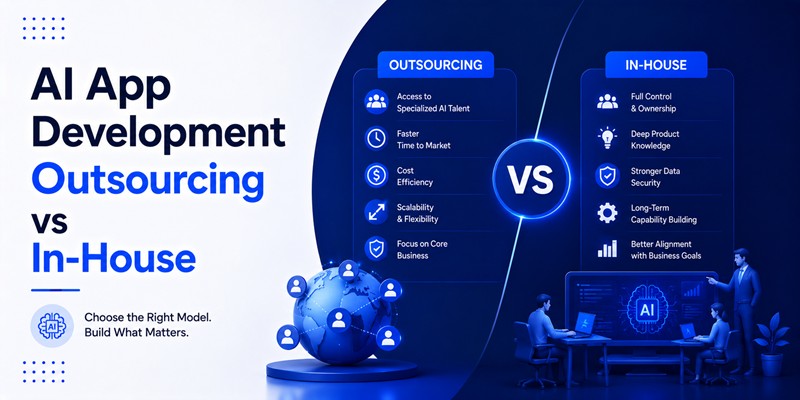
Use this as a first filter, then apply the ten questions to whichever route you shortlist. Most mid-market buyers land on a specialist partner for the first two builds, then bring maintenance in-house once the patterns are proven.
If you are still mapping the landscape, our guides on What Is AI Software Development and AI software development trends cover the underlying build patterns in more depth.
Ready to Run These Questions in Your Next Vendor Call?
Do not send all ten as a questionnaire. Vendors will write polished answers that reveal nothing.
Run them live, in sequence, and score each answer from one to five on specificity. Vague answers to questions two, three, and eight are the ones that predict trouble.
Bring one technical person to the call. The ownership and evaluation questions need someone who can tell a real answer from a confident one.
Then ask for one reference from a project that did not go smoothly. How a partner describes a difficult engagement tells you more than three success stories.
Finally, insist on a paid discovery phase before any large commitment. It is the cheapest risk reduction available to you.
Conclusion
The research is consistent across MIT, Gartner, and McKinsey. Adoption is nearly universal, measurable impact is rare, and the difference is decided by scoping, integration, and governance rather than by model choice.
That means your leverage peaks before you sign. Once the statement of work is executed, you are negotiating from inside the project.
Use the ten questions as a scorecard, not a script. Ask them in a live call, insist on specifics, and treat vague answers as data.
Your next step is simple. Pick your top two vendors, book a technical call with each, and score both against these ten questions this month. For a deeper framework, see our guide on How to choose AI software development company, or talk to the team at Technobrave about a scoped discovery phase for your use case.