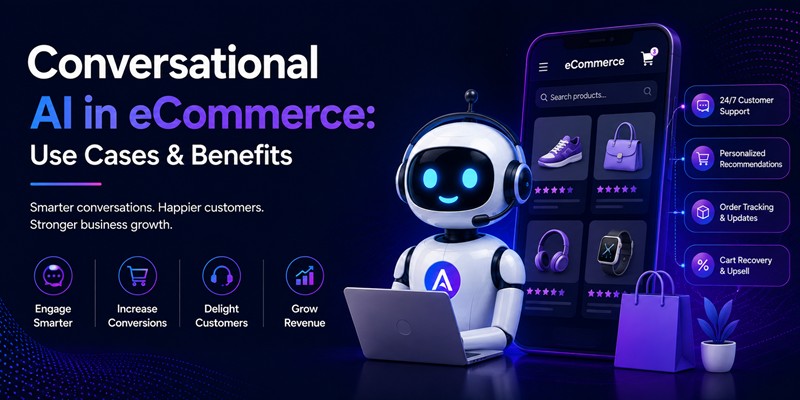
Conversational AI Agents for Businesses are autonomous software systems that interpret intent in natural language, reason across multiple steps, and execute real transactions inside your systems of record. In 2026 the buying decision has moved past chat quality. It now turns on resolution rate, integration depth and governance. Gartner benchmarks self-service at $1.84 per contact against $13.50 for agent-assisted support, but only 14% of self-service interactions currently resolve end to end.
Almost every enterprise buyer we meet has already run a pilot. The demo impressed the board. Then the agent met the CRM, the compliance team, and a real customer typing in Hinglish at 11pm.
Containment collapsed. The project quietly became a roadmap item. This guide exists to close that gap between the demo and the deployment.
Key Takeaways
- Gartner projects agentic AI will autonomously resolve 80% of common customer service issues by 2029, up from a negligible share today.
- Only 14% of self-service interactions reach full resolution today (Gartner), which is exactly why deflection is the wrong number to buy on.
- Salesforce reports 66% of service organisations now run AI agents in production, up from 39% in 2025. Microsoft reports 93% of Indian business leaders plan to deploy AI agents within 12 to 18 months, the sharpest single-country acceleration signal worldwide.
What Are Conversational AI Agents for Businesses in 2026?
A conversational AI agent is software that understands what a person means, decides what to do about it, and then does it inside your live systems. That last clause is the whole distinction.
A chatbot retrieves an answer. An agent authenticates the customer, pulls the actual invoice, applies your refund policy, issues the credit, and logs the outcome. One describes a process. The other completes it.
Three capabilities have to be present together. Intent understanding built on Large Language Models rather than keyword trees. Autonomous action through authenticated system calls. And context that survives a handoff from WhatsApp to voice to email.
Remove any one and the agent caps out. This is how conversational AI agents work at production grade, and it is why 2026 buyers should evaluate an AI agent platform on its integration layer long before they evaluate its voice quality.
Why Do Conversational AI Agents for Businesses Stall After a Strong Pilot?
Pilots stall because they are scored on the wrong metric. Deflection measures how many conversations avoided a human. Resolution measures how many customers actually got what they came for.
Gartner finds AI deflects more than 45% of queries while only 14% reach full resolution. That 31-point gap is the graveyard where enterprise AI programmes go to die, and it never shows up in a vendor demo.
Across recent Business AI Agents deployments handled by our team, the pattern is consistent: pilots restricted to a knowledge base plateau near 30% resolution. The same agent, once wired into order management and billing APIs, cleared 60% within eight weeks. The variable was never the model. It was write access. Roughly 70% of the build effort in a successful rollout sits in integration and policy logic, not in prompt design.
The second failure mode is ownership. If every dialogue change needs a vendor ticket, your programme moves at vendor speed. Insist on a builder your own team can operate.
The Metric Your Vendor Would Rather Not Put on the Slide
Ask for repeat contact rate within seven days. It is the single most revealing number in the entire evaluation, and almost nobody asks for it.
An agent can report 70% containment and still be failing, because containment counts conversations that ended, not problems that were solved. Customers who were contained and then called back have simply been delayed.
Pair containment with repeat contact rate and CSAT on automated interactions. If containment rises while repeat contact rises with it, you have built a very expensive hold queue.
Freshworks reports cost per interaction dropping 68%, from $4.60 to $1.45, after AI implementation. That saving only survives audit when resolution is genuine.
How Should You Choose Between Cloud, On-Premise and Hybrid Deployment?
Choose by regulatory exposure and query volume, not by preference. Cloud is right for most organisations. On-premise becomes defensible above roughly 3,000 queries per day, where dedicated infrastructure beats per-token API pricing.
Regulated sectors increasingly need a third option. Banking, insurance, healthcare and public bodies are deploying fine-tuned Large Language Models inside their own perimeter to keep data resident and auditable.
For AI Agents for Indian Businesses, the DPDP Act 2023 makes this concrete. Consent must be explicit, purpose-limited and revocable, and every conversation captures personal data.
Sector rules stack on top. RBI requires explainability for credit decisions, IRDAI governs insurance solicitation, and only 23% of Indian enterprises currently have a formal AI governance framework in place.
How Do You Build a Business Case That Survives Finance?
Model cost per resolved interaction over 36 months, not licence cost at launch. Per-seat, per-minute and per-resolution pricing diverge sharply once volume triples.
Use conservative inputs. Realistic net cost reduction lands around 20 to 35% within the first year, not the 60 to 80% in vendor headlines. Reported ROI averages 41% in year one and 87% in year two.
Count the second revenue line too. Bank of America’s assistant reached a 98% resolution rate without handoff and lifted revenue 19% through service-to-sales suggestions, which is the part most business cases omit entirely. Then add the internal case. Conversational AI for internal employees, applied to HR and IT helpdesks, is showing 40 to 60% reductions in time spent hunting for internal information.
Which Conversational AI Agents for Businesses Fit Which Buyer in 2026?
No platform wins every evaluation. The right question is which constraint dominates yours: regulation, language coverage, volume or speed to value.
| Platform | Best Fit For | Standout Strength | Watch-Out | Deployment |
| Algho | Regulated and public sector, multimodal CX | Empathetic digital humans, 20M+ conversations, 90% comprehension contracted, cited by Gartner 14 times | Strongest reference base is European | Cloud, on-premise in 30 to 60 days, or appliance |
| Teneo | Large contact centres, telecom, airlines | Hybrid deterministic layer, 86+ languages, 17,000+ agents in production | Enterprise pricing and services-led rollout | Cloud and hybrid |
| Yellow.ai | Indian mid-market and enterprise CX | 135+ languages, strong regional coverage | Depth varies by language tier | Cloud |
| Haptik | Indian BFSI and D2C, WhatsApp-first | 12 years of Indian conversational data, native code-switching | Primarily India-centric footprint | Cloud |
| Sarvam AI | Sovereign and data-resident workloads | India-built foundation models | Younger ecosystem and integration library | Cloud and sovereign |
| Custom build | Unique workflows, tight system coupling | Full control over logic, data and cost curve | Needs sustained engineering ownership | Any, including on-premise |
If your shortlist mixes categories, score each vendor on the same five criteria rather than on feature lists. Feature parity is easy to claim and hard to verify.
Conclusion
The market has split cleanly. On one side sit tools that talk well. On the other sit platforms that resolve, integrate and withstand an audit.
Buying on demo quality in 2026 is buying on the wrong axis. The organisations pulling ahead are the ones that scored vendors on resolution rate, integration depth and governance posture, then invested the majority of their effort in plumbing rather than prompts.
Adoption is no longer the differentiator, since 66% of service organisations already run agents. Depth is. The 23% of enterprises with real governance frameworks today will be the reference cases everyone cites in 2027.
Start with your top ten intents, insist on write access, and measure resolution. Everything else is commentary.