Conversational AI in eCommerce is the layer of natural language technology that lets shoppers ask, browse, buy and get help in plain language across chat, voice and messaging apps. It works because it links language understanding to live catalog, order and CRM data, so a reply can trigger an action instead of deflecting it. The commercial case is now measurable. Salesforce data covering 1.5 billion shoppers found AI and agents influenced 20% of all global orders during Cyber Week 2025, worth $67 billion. Gartner projects $80 billion in contact centre labour savings during 2026. Done well, it lifts conversion and cuts cost per contact at the same time.
Ask any online retailer where revenue actually leaks, and the honest answer is rarely the ad budget. It is the silence between what a shopper wants and how fast the store can answer.
Seven in ten carts are abandoned. Most support tickets are the same six questions asked in different moods. And shoppers now arrive from AI search already half decided, expecting your store to keep pace with the assistant that sent them.
This guide covers what conversational AI in eCommerce really is, where it pays back, which platforms lead in 2026, and how to pick one without funding a science project.
Key Takeaways
- AI and agents influenced 20% of all global orders during Cyber Week 2025, worth $67 billion in sales, per Salesforce data spanning 1.5 billion shoppers across 89 countries. (Source)
- The global cart abandonment rate sits at 70.22%, and Baymard Institute estimates roughly $260 billion in orders is recoverable across US and EU checkouts through better design and intervention.
- Gartner projects conversational AI will reduce contact centre agent labour costs by $80 billion in 2026, even though only about one in ten interactions will be fully automated.
- AI referred traffic to US retail sites grew 393% year over year in Q1 2026 and converted about 42% better than non AI traffic by March, according to Adobe Analytics.
What Is Conversational AI in eCommerce and How Does It Actually Work?
Conversational AI in eCommerce is software that understands shopper intent in natural language and then completes a commercial action, not just a polite reply. That last part is what separates it from a scripted chatbot.
Four layers make it work. Understanding interprets the request, including typos, slang and mixed languages. Grounding retrieves live truth from your catalog, inventory, order management system and policy documents.
Action executes something real: applying a filter, holding stock, generating a return label, issuing a refund. Orchestration decides when to keep going and when to hand a human the full context.
Generative AI in eCommerce supplies the fluency. Retrieval and tool calling supply the accuracy. An AI shopping assistant that has fluency without grounding is a liability, because it will confidently invent a delivery date.
Why Is Conversational AI in eCommerce Now a Board-Level Decision?
It moved from a support line item to a growth channel the moment AI assistants started sending qualified traffic. Discovery itself is shifting, and the numbers are no longer soft.
Shopify reported in its Q1 2026 results that AI driven traffic to merchant stores grew roughly 8x year over year, with orders from AI powered searches growing nearly 13x. Adobe measured a 393% year over year rise in AI referred retail traffic over the same quarter.
On the B2B side, Gartner expects 90% of business purchases to be intermediated by AI agents by 2028, routing more than $15 trillion through automated exchanges. That is a procurement change, not a marketing trend.
For a CEO or CIO the read is simple. Customers are already talking to machines about your products. The only decision left is whether one of those machines belongs to you. This is the same pressure driving the broader Rising of AI Products across every digital category.
What Does Conversational AI in eCommerce Look Like in Production?
It looks less like a chat bubble and more like a second storefront that never sleeps. Technobrave has deployed conversational assistants for retail and D2C clients using Algho, our multilingual, WhatsApp first agent platform.
Across a rolling 90 day window with a mid sized D2C apparel client, the deployment handled 41,000 shopper conversations. Roughly 68% were resolved end to end without a human, concentrated in order tracking, sizing and returns.
The commercially interesting number was not deflection. Shoppers who engaged the assistant before checkout converted at 2.3x the rate of non engaged sessions, and proactive intervention on stalled carts recovered about 9% of them inside the session.
First response time fell from 6 hours on email to under 4 seconds. Average handling time for the tickets that did escalate dropped by a third, because the agent received a summarised, verified case instead of a cold start.
The lesson from that rollout was unglamorous. Most of the value came from three narrow intents done extremely well, not from a general purpose assistant trying to answer everything.
What Are the Key Use Cases of Conversational AI in eCommerce?
The highest return use cases are high volume, low ambiguity and connected to a system of record. Start there, then widen.
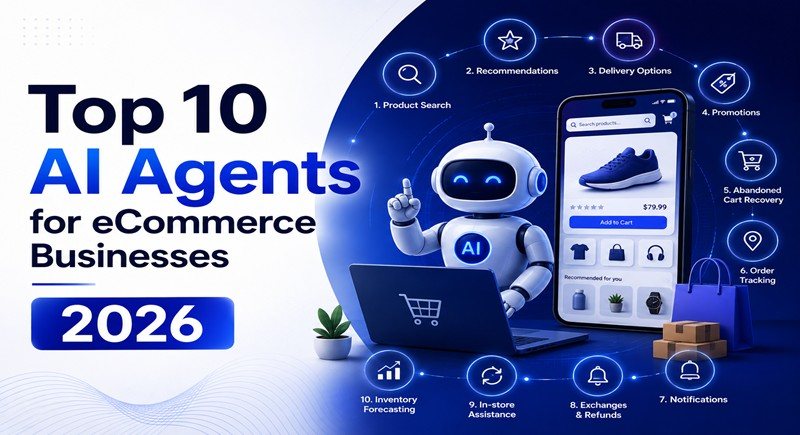
Smart product discovery and guided selling
Shoppers describe outcomes, not SKUs. Someone asking for a lightweight jacket for a rainy trek in April is doing a semantic search your filter menu cannot serve.
Smart product discovery maps that phrasing to attributes, then narrows with two or three clarifying questions and delivers product recommendations that feel like a knowledgeable floor associate.
Cart abandonment recovery in the moment
Email recovery flows fire after the shopper has left, and Klaviyo benchmarks put typical recovery around 3% to 5%. Intervening inside the session is a different economic event.
An assistant that notices hesitation on the shipping step and answers the actual objection, delivery date, duty cost, return window, turns cart abandonment recovery into a conversation rather than a chase.
Order tracking, returns and refunds
Where is my order remains the single largest support intent in retail. It is also fully automatable, because the answer lives in a system, not in a person.
The same applies to returns. Collect the reason, validate the policy window, issue the label, trigger the refund. AI customer service for eCommerce earns its keep fastest here.
Post-purchase engagement and replenishment
Consumables and beauty run on timing. A proactive message at the right interval, with a one tap reorder, converts far better than a generic campaign blast.
Agent assist for your human team
The quietest win. AI-powered customer support that drafts replies, surfaces policy and summarises history lifts human throughput without ever touching the customer directly.
What Are the Key Benefits of Conversational AI in eCommerce?
The benefits compound because one system touches acquisition, conversion and service at the same time. Leaders evaluating Conversational AI for eCommerce should expect to measure all three, not just deflection.
More revenue from the traffic you already bought
Conversion lift is the headline. Salesforce reported that retailers running their own shopper agents grew sales 59% faster than retailers without them during the 2025 peak season.
Lower cost to serve
Labour can represent up to 95% of contact centre cost. Even the conservative Gartner assumption of one in ten interactions fully automated produces the projected $80 billion global saving in 2026.
A genuinely personalized shopping experience
McKinsey found 71% of consumers expect personalised interactions and 76% get frustrated when they do not receive them. Conversation is the cheapest way to collect preference data honestly, because the shopper volunteers it.
Round the clock, multilingual coverage
One assistant covers every time zone and every language you sell into, which is the difference between a domestic store and an exportable one. This is where AI Agents for eCommerce outperform headcount economics decisively.
Cleaner first-party data
Every conversation is a labelled record of intent, objection and confusion. That transcript corpus is a merchandising and product roadmap input, not just a support log.
How Much Does It Cost, and When Does It Pay Back?
Budget in three buckets: platform licence, integration effort and ongoing tuning. The integration line is the one teams routinely underestimate.
A focused SMB deployment covering three to five intents typically lands between $15,000 and $45,000 for build and integration, with platform costs scaling by conversation volume. Enterprise rollouts with voice, multiple brands and compliance review run several times that.
The payback maths is straightforward. Take monthly contacts, multiply by your fully loaded cost per contact, apply a realistic 30% to 50% containment rate, then add recovered cart revenue at a conservative 3% to 5% of abandoned value.
Most retail deployments we see reach payback inside two to four quarters. If your model needs 80% containment in month one to work, the business case is not real, it is a hope.
What Are the Biggest Risks, and How Do You Avoid Them?
The dominant risk is not the model. It is deploying a fluent system on top of stale or fragmented data, which produces confident wrong answers at scale.
Trust is the second constraint. Research summarised by Axis Intelligence from YouGov and Checkout.com data found 65% of Americans trust AI to compare prices, but only 14% trust it to place orders autonomously.
That gap has a clear design implication. Let the assistant recommend, configure and prepare, then let the human confirm. Autonomy should be earned intent by intent, not switched on globally.
Three guardrails cover most of the exposure: ground every factual claim in a retrieved source, cap the assistant to actions it can verify, and route anything involving money, fraud or a distressed customer to a person with full context.
Which Platforms Lead the Market for Conversational AI in eCommerce in 2026?
There is no single winner, because the right pick depends on channel mix, order volume and how much engineering you want to own. The table below maps the main options against realistic buyer profiles.
| Platform | Best for | Core strength | Watch-out |
| Technobrave (Algho) | SMB and mid market retailers wanting a custom build | Multilingual, WhatsApp first agents built and integrated around your stack | Delivery led, so it suits teams who want a partner rather than pure self serve |
| Cognigy (NiCE) | Enterprise contact centres | Deep voice and CCaaS integration, strong orchestration and analytics | Enterprise pricing and implementation weight |
| Synthflow | Voice first support and outbound | Fast no code voice agent setup, strong telephony | Voice centric, lighter on catalog and merchandising depth |
| Intercom Fin | SaaS style support teams | Very fast time to value on help centre content | Support oriented, less suited to guided selling |
| Ada | High volume consumer brands | Strong automated resolution reporting and multilingual reach | Best value needs mature knowledge content |
| Salesforce Agentforce | Retailers already on Salesforce | Native commerce and CRM data, agentic checkout support | Locked to the Salesforce ecosystem and its cost base |
| Shopify native agents | Shopify and Shopify Plus merchants | Lowest friction, built into the storefront | Limited outside the Shopify boundary |
A useful filter: if your differentiator is merchandising and catalog nuance, prioritise grounding quality. If it is service volume, prioritise containment reporting and escalation design.
How Do You Choose the Right Conversational AI Platform for Your Store?
Score vendors against your systems, not against their demo. A demo answers questions. Your business needs answers that survive contact with a real order table.
- Grounding and accuracy: can it cite the record it answered from, and what happens when it does not know?
- Integration depth: does it write back to your OMS, CRM, payment gateway and returns tool, or only read?
- Channel coverage: web, app, WhatsApp, Instagram, email and voice, with context carried between them.
- Escalation design: how much verified context does a human agent inherit on handoff?
- Language and locale: real multilingual handling, including code mixed input, not machine translated templates.
- Analytics: containment, resolution quality, assisted revenue and cost per conversation as standard reporting.
- Compliance and data residency: GDPR, DPDP and PCI posture, plus clarity on where transcripts are stored.
- Total cost of change: who tunes the assistant in month seven, and what does that cost?
Run a two week bake off on one intent with real traffic. Teams evaluating AI Agents for businesses consistently learn more from that than from a three month RFP.
Are You Ready for Conversational AI in eCommerce?
Readiness is mostly a data question. Answer these five honestly before you sign anything.
- Is your product catalog complete enough that a machine could describe any item accurately, including attributes shoppers actually ask about?
- Can your order and shipping status be queried in real time through an API, not just viewed in a dashboard?
- Are your shipping, returns and warranty policies written down in one current, unambiguous place?
- Do you know your top ten support intents by volume, with a cost per contact attached?
- Is there a named owner who will review transcripts weekly for the first quarter?
Four or five yes answers means you are ready to build. Two or three means spend the first month on data and policy cleanup, which will cost less than fixing it after launch.
Fewer than two, and the honest recommendation is foundations first. This is exactly the groundwork our AI software development services teams sequence before any assistant goes live.
Conclusion:
Conversational AI is no longer just a customer-support feature for eCommerce; it is becoming part of the buying experience itself. From product discovery and cart recovery to order support and personalized recommendations, the biggest opportunities come from connecting AI to the systems that hold real business data.
The key is to start focused. Choose high-volume use cases, connect the assistant to accurate catalog and customer data, measure revenue and service outcomes, and expand autonomy only when the system proves reliable. For retailers in India, this approach can also provide a strong foundation for AI agents for businesses in India, particularly across multilingual, WhatsApp-first, and high-volume customer journeys.
The brands that benefit most will not be those with the most advanced chatbot. They will be the ones that connect conversational AI to real commerce actions, measurable business outcomes, and customer trust.