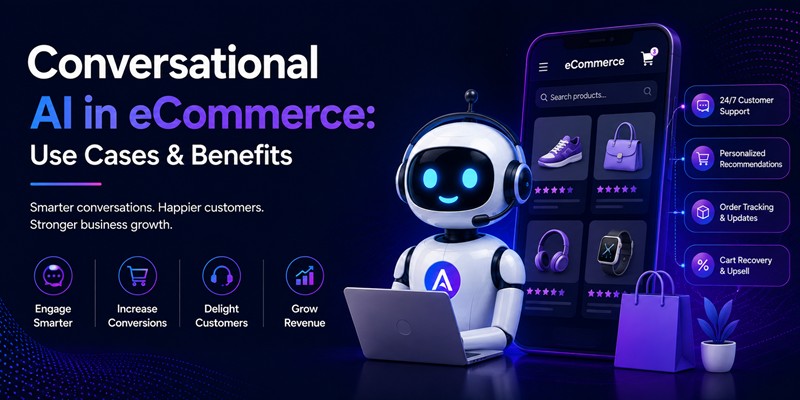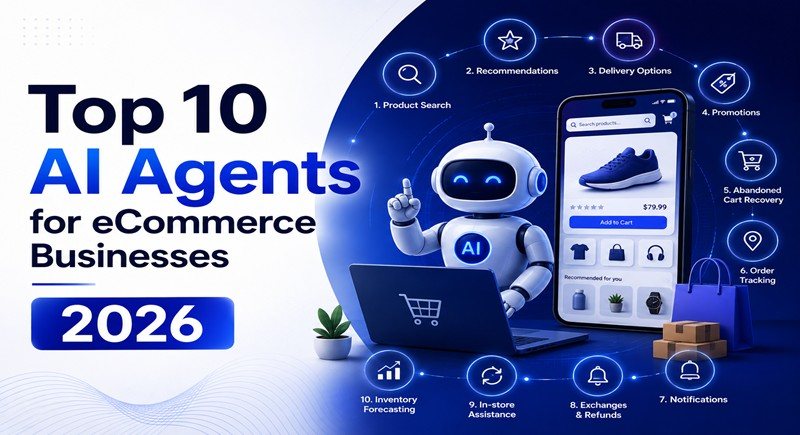
The top 10 AI agents for eCommerce in 2026 cover order tracking, exchanges and refunds, recommendations, delivery options, product search, cart recovery, promotions, notifications, in-store assistance and inventory forecasting, with a voice calling agent layered across them. Salesforce found retailers running their own shopper agents grew holiday sales 59% faster.
Most eCommerce leaders met agentic commerce the same way. A quarterly report showed organic search traffic sliding while revenue held firm, and nobody could explain the gap.
The shoppers had not disappeared. They had started their journey inside ChatGPT, Gemini or Perplexity, then landed on the product page already half-decided.
That changes what a storefront has to do. It has to answer at 2 AM, in the shopper’s language, with live inventory and a real returns policy behind every sentence.
This guide breaks the category into the ten jobs an agent can actually do, explains the use case for each one, and gives you an order to deploy them in.
Key Takeaways:
- AI influenced 20% of global online sales during the 2025 holiday season, worth about $262 billion, based on Salesforce data covering 1.5 billion shoppers across 89 countries.
- AI-referred traffic to US retail sites grew 393% year over year in Q1 2026 and converted roughly 42% better than traditional search traffic (Adobe Analytics).
- Only 28% of eCommerce executives currently use agentic AI, while 44% expect to adopt within six months (Salesforce State of Commerce, 4th edition).
- Mature ecommerce AI agent platforms resolve 60% to 80% of eligible conversations without a human. Scripted chatbots rarely clear 30%.
- Order tracking alone accounts for a quarter to a third of inbound support volume in most stores, which is why it is almost always the first agent to deploy.
- India’s average return-to-origin rate sits near 23% across more than 180 million shoppers, costing D2C brands over Rs 8,000 crore a year, which is why voice confirmation calls carry the fastest payback in COD-heavy markets (GoKwik).
What Are AI Agents for eCommerce, and How Do They Differ From Chatbots?
An AI agent for eCommerce is software that reads live context, decides on an action, and executes that action inside your commerce stack without a human approving every step. A chatbot answers. An agent acts.
The practical test is tool access. If the system can look up a live order, check the returns window, trigger an exchange in your OMS and log what it did, it is an agent.
If it can only pull text from a help centre article, it is a retrieval bot with better manners. The difference shows up in automated resolution rate, where real agents land between 60% and 80%.
Most autonomous AI agents in commerce cover one job well rather than ten jobs badly, which is why the list below is organised by job and not by vendor. The same principle holds for AI Agents for businesses outside retail.
Top 10 AI Agents for eCommerce Businesses in 2026
The ten agents below are organised by the job they do, because that is how budgets and pilots are actually scoped. Nine cover the customer-facing journey. The tenth sits underneath and quietly determines whether the other nine can keep their promises.
1. Order Tracking Agent
Where is my order is the highest-volume question in retail and the easiest one to automate end to end. In most stores it accounts for a quarter to a third of all inbound contacts.
Picture a Sunday at 11 PM. A customer asks about a parcel, the agent verifies identity against the order number and email, pulls live carrier status, and translates a raw exception code into a plain sentence with a revised delivery date.
To do that it needs your OMS, a carrier feed or tracking aggregator, and a light identity check. Without those three, it is guessing, and a guessed delivery date costs more than no answer at all.
Start here. It is the fastest agent to prove, the least risky to get wrong, and it frees your human team for the conversations that actually need judgement.
2. Exchanges and Refunds Agent
This is the highest-trust and highest-risk agent on the list, and the one that most directly protects revenue when it is built properly.
A customer ordered the wrong size. A good agent checks the returns window, confirms the correct size is in stock, and offers the exchange with a prepaid label before it ever mentions a refund. That single sequencing choice keeps the sale.
It needs your returns platform, a versioned policy engine, live inventory and gated access to the payment gateway. Gated is the operative word.
Set a value threshold above which a human approves. Customers forgive a slow refund far more readily than they forgive a wrong one, and finance teams will not sign off without that gate.
3. Recommendations Agent
This is not the customers-also-bought widget with a new label. A recommendations agent reasons over what the shopper just told you, in their own words.
A gift for a dad who fishes, under eighty dollars, needed by Saturday. The agent filters the catalogue on attributes, checks stock, checks whether the delivery date is achievable, then recommends. The stock check is what separates it from a rules engine.
Recommending an out-of-stock product is worse than recommending nothing, because it converts interest into frustration. Generative AI for ecommerce fails here more often than anywhere else.
Wire it to your catalogue, live inventory and purchase history, then measure average order value and attach rate rather than click-through.
4. Delivery Options Agent
Shipping is the number one reason carts die at checkout, usually because the shopper cannot tell which option gets the parcel there in time.
A delivery options agent answers the real question. Someone needs it by Friday for a birthday, and the agent calculates carrier cutoffs against the warehouse holding that SKU, then names the one option that makes it and what it costs.
That requires rate shopping, warehouse-level inventory location and current cutoff rules. Static shipping tables cannot do it, because cutoffs shift with volume and holidays.
Measure abandonment specifically at the shipping step, not overall checkout abandonment, or you will not see the improvement.
5. Product Search Agent
Keyword search returns nothing for how people actually describe what they want, and every empty result page is a shopper leaving.
Running shoes for flat feet, wide fit, under six thousand rupees returns zero results on most sites. A product search agent maps that sentence onto arch support, width and price attributes and returns what is genuinely in stock.
This agent has quietly become a distribution channel too. The structured, well-attributed catalogue it depends on is the same data external AI assistants read when they decide which store to send a shopper to.
Track zero-result rate and search-to-cart rate weekly. Both move fast once the attribute taxonomy is clean.
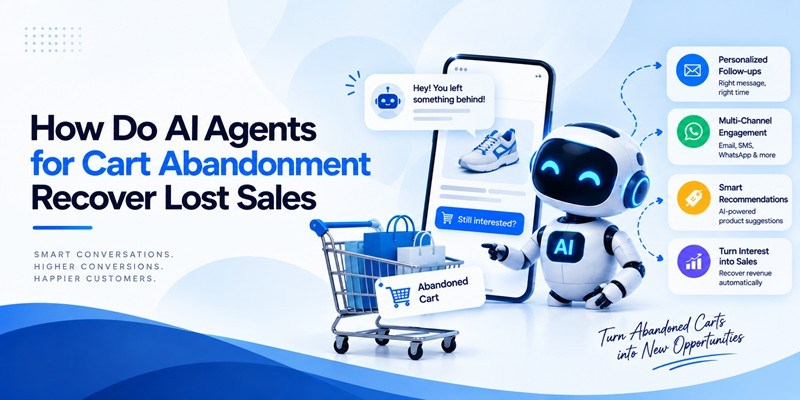
6. Abandoned Cart Recovery Agent
The old playbook sends three emails and a discount code. An agent asks why the cart was abandoned and answers that specific reason instead.
If the shopper exited on the shipping screen, the agent surfaces the free-shipping threshold on WhatsApp rather than handing out ten percent off. Same recovery, much better margin.
It needs cart-level event data, a messaging channel the customer actually uses, and controlled access to the promotion engine.
Measure margin per recovered order alongside recovery rate. A recovery rate that rises while margin falls is not a win, and it is the most common way this agent gets misjudged.
We have built this demo for our ecommerce client – Request A Demo
7. Promotions Agent
Most discounting is paid to customers who would have bought anyway. A promotions agent decides who genuinely needs an incentive and how deep it should go.
It validates eligibility live in conversation, stops codes stacking into negative margin, and personalises the offer against segment and basket value rather than blasting one code to the whole list.
Give it the promotion engine, margin data at SKU level and your customer segments. Without margin data it will optimise for conversion and quietly destroy contribution.
The metric that matters is discount depth per order and incremental margin, not redemption count.
8. Notifications Agent
This is the cheapest agent to run and the one that removes the most tickets, because it speaks before the customer has to.
A carrier exception appears at 3 AM. The agent messages the customer with the new date and two options before they open the tracking page and open a ticket instead. The same engine handles back-in-stock, price drops and subscription renewals.
It needs an event stream, messaging channels and a preference centre that people can actually use.
Watch opt-out rate as closely as ticket deflection. Over-notifying burns the channel, and a burnt WhatsApp list is expensive to rebuild.
9. In-store Assistance Agent
For anyone running both a storefront and physical retail, this agent serves two very different users from one knowledge base.
Shoppers use it for aisle location, stock checks at a specific branch and click-and-collect status. Staff use it on a handheld for policy lookups, price override rules and finding a size at a nearby store instead of losing the sale.
It needs store-level inventory, POS integration and, ideally, planogram data. Store-level accuracy is the hard part, and it is worth auditing before launch.
Measure in-store conversion and staff time to answer. The staff-facing half usually pays for the deployment on its own.
10. Inventory and Restock Forecasting Agent
This is the one that rarely makes these lists, and the one we would argue has the fastest payback. It is our addition to the standard nine.
It forecasts demand from seasonality, marketing calendar and live sell-through, moves reorder points dynamically instead of using static thresholds, flags dead stock for liquidation and chases suppliers on late purchase orders.
Here is why it belongs on a customer-facing list. Every other agent above degrades the moment your stock data is wrong.
A stockout breaks the recommendations agent, the delivery options agent and the cart recovery agent simultaneously, and the customer blames all three. Fix the inventory layer and the other nine get better without any additional prompt engineering.
The table below summarises all ten as a shortlist you can take into a planning session.
| Agent | Primary job | Must connect to | Metric it moves |
| 1. Order Tracking | Answers where-is-my-order in plain language, at any hour | OMS, carrier or tracking aggregator, identity check | Ticket deflection rate, first response time |
| 2. Exchanges and Refunds | Runs returns eligibility and offers exchange before refund | Returns platform, policy engine, live inventory, payments | Refund-to-exchange ratio, revenue retained |
| 3. Recommendations | Reasons over stated need, budget and stock to suggest products | Catalogue, inventory, purchase and browse history | Average order value, attach rate |
| 4. Delivery Options | Tells shoppers exactly which option arrives by their date | Rate shopping, warehouse locations, carrier cutoffs | Checkout abandonment at shipping step |
| 5. Product Search | Turns messy natural language into filtered, in-stock results | Search index, attribute taxonomy, inventory | Zero-result rate, search-to-cart rate |
| 6. Abandoned Cart Recovery | Diagnoses why the cart was left and responds to that reason | Cart events, messaging channels, promotion engine | Recovery rate, margin per recovered order |
| 7. Promotions | Decides who needs an incentive and how deep it should go | Promotion engine, margin data, customer segments | Discount depth per order, incremental margin |
| 8. Notifications | Tells customers about problems before they notice them | Event stream, messaging, preference centre | Inbound ticket volume, opt-out rate |
| 9. In-store Assistance | Serves shoppers in aisle and staff at the counter | Store-level inventory, POS, click-and-collect status | In-store conversion, staff time to answer |
| 10. Inventory and Restock | Forecasts demand and moves reorder points before stockouts | ERP or purchase orders, sales history, supplier lead times | Stockout rate, carrying cost, dead stock value |
Where Does a Voice Calling Agent Fit Among AI Agents for eCommerce?
A voice calling agent earns its place wherever silence costs you money. Chat waits for the customer to start the conversation. Voice does not, and that single difference opens up scenarios no chat widget can reach.
The clearest example is cash on delivery. GoKwik’s analysis across more than 180 million shoppers puts India’s average return-to-origin rate near 23%, with COD-heavy categories touching 40%, and Indian D2C brands collectively losing over Rs 8,000 crore a year to it.
A confirmation call placed within minutes of checkout changes that number. The agent verifies intent, reads back the address and cash amount, and offers a prepaid payment link on the call itself, which is the highest-leverage conversion available to a COD-heavy store.
The second scenario is the non-delivery report. A parcel fails at the door on Tuesday and, without a call, sits until the courier tries again blindly on Thursday. An outbound agent reaches the customer the same afternoon and reschedules, redirects to a neighbour or converts to a pickup point.
The third is the high-value abandoned cart. Below a certain basket value a WhatsApp message is correct and a call is intrusive. Above it, a call within the hour that answers one specific objection recovers orders no email sequence ever will.
Inbound matters too. A voice agent replaces the phone tree everyone hates, verifies the caller against their order number, and reads out live status in the caller’s own language rather than asking them to press four.
The full set of scenarios worth costing is below.
| Scenario | Direction | What the call actually does | Metric it moves |
| COD order confirmation | Outbound | Confirms intent, cash amount and address within minutes of checkout, offers a prepaid link on the call | RTO rate, prepaid share of orders |
| Failed delivery callback | Outbound | Reaches the customer after a non-delivery report and reschedules or redirects to a neighbour or pickup point | Second-attempt success rate |
| High-value cart callback | Outbound | Calls within the hour on carts above your threshold and answers the one blocking objection | Recovery rate on high-value carts |
| Inbound order status | Inbound | Replaces the phone tree with a natural conversation that verifies the caller and reads out live status | Call containment, average handle time |
| Returns pickup scheduling | Outbound | Confirms the pickup window and what the courier needs at the door | Failed pickup attempts |
| Reorder and renewal | Outbound | Calls consumable and subscription customers near depletion and completes the reorder on the call | Repeat purchase rate, churn |
| Post-delivery feedback | Outbound | Captures a short verbal review and routes complaints to a human immediately | Review volume, detractor recovery time |
Where Do AI Agents for eCommerce Fail, and How Do You Prevent It?
Agents fail on governance and data hygiene far more often than on model capability.
The four recurring failure modes are stale policy documents, missing approval gates on anything touching money, no clean fallback to a human, and knowledge bases that contradict themselves across regions.
Each has a cheap fix. Version your policy content, gate refunds above a threshold, force escalation after two failed turns, and audit regional content quarterly.
There is a second-order risk worth naming. A confident agent will state a delivery date it has no basis for, and a wrong promise costs more than a slow answer ever did.
The pattern mirrors what we cover in Rising of AI Products. Teams that treat agents as products, with owners, roadmaps and QA cycles, get compounding returns. Teams that treat them as a plugin get an expensive novelty.
What Did Technobrave Learn From Deploying AI Agents for eCommerce?
Integration depth, not model quality, decides whether an agent earns its cost. That is the clearest pattern across every build our team has shipped.
We saw it directly with Algho, the empathetic digital-human agent we built and now run as a live Algho demo. It is multilingual, WhatsApp-first and built to DPDP-ready data standards, so buyers can test it against their own scenarios before committing to anything.
On a mid-market multi-category D2C deployment, version one answered questions beautifully and changed nothing commercially. Containment sat near 34% because the agent could read the catalogue but not the order management system.
Once we wired it into live order status, the returns policy engine and inventory, containment passed 70% within eight weeks and where-is-my-order tickets fell by more than half. The model never changed. The connections did.
Conclusion: Start With One Agent, Not Ten
The brands that win in 2026 are not the ones with the most agents deployed. They are the ones whose single, well-integrated agent is wired into live order, returns and inventory data, and trusted to act on it without a human re-checking every step.
Everything in this guide points back to one finding: integration depth beats model quality. A brilliant model reading a stale help centre article will sit near 30% containment. An average model with OMS, policy engine and inventory access clears 70%. Choose your first agent on data readiness, not on demo quality.
Pick the job with the highest volume and the lowest integration risk. For most stores that is order tracking. If cash on delivery is a meaningful share of your orders, a confirmation calling agent moves ahead of it, because nothing else on this list pays back against a 23% RTO rate as quickly.
Your next three moves
- This week. Pull your last 500 tickets, cluster them by intent, and calculate the fully loaded cost of your top three. That number is your business case, and it takes an afternoon.
- Next 30 days. Pilot one agent against those same tickets. Score containment and accuracy as separate numbers so a confident wrong answer can never pass as a win.
- Next quarter. Add a second agent only after the first holds containment above 60% for four consecutive weeks. Two pilots at once is the most common way this programme stalls.
If the six-criteria scorecard points toward a custom build rather than a licence, the decision usually comes down to integration surface and three-year cost of ownership, which is where an experienced ai software development company earns its fee. Our team is happy to pressure-test that architecture with you before you commit budget.
Start with our AI software development services, or book a walkthrough of the Algho demo and run it against your own catalogue, returns policy and live inventory. Twenty minutes against your real data will tell you more than any benchmark table.