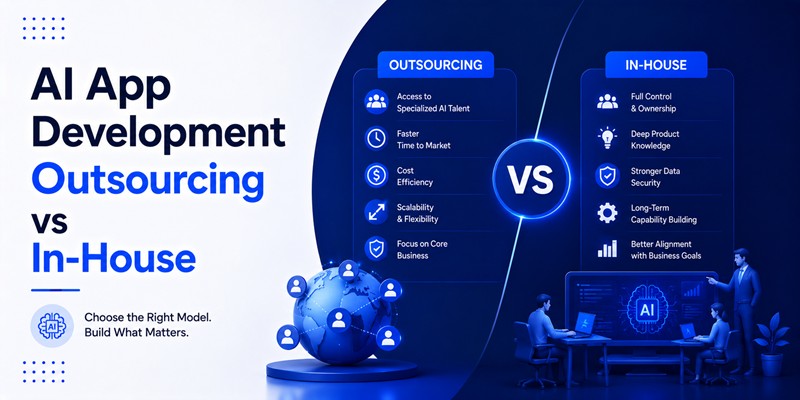
Outsource when AI is a feature of your product, and build in-house when the model itself is your product. MIT research across 300 deployments found vendor-led and partner-led AI builds reach production around 67% of the time, against roughly 33% for purely internal builds. Most 2026 winners run a hybrid: internal ownership, external delivery.
Every AI budget review in 2026 sounds the same. The board asks why the roadmap slipped two quarters, and the answer is usually that two senior engineers left and the retrieval layer still is not production ready.
The question underneath is never really technical. It is whether you should own the engineering capability outright or rent it from a team that builds these systems every week.
This guide settles it with numbers instead of opinion. We cover cost structure, delivery speed, IP risk, the 2026 compliance shift, and the hybrid model most successful teams quietly land on.
Key Takeaways
- Vendor-led and partner-led AI deployments reach production about 67% of the time, versus roughly 33% for internal-only builds (MIT Project NANDA, The GenAI Divide, 2025).
- 95% of enterprise generative AI pilots produced no measurable P&L impact, despite $30 to $40 billion in spend across the same study.
- Gartner expects over 40% of agentic AI projects to be cancelled by the end of 2027, citing escalating costs, unclear business value and weak risk controls.
- A single US AI engineer costs roughly $178,000 in average salary and closer to $242,000 in total compensation, before GPUs, tooling or recruitment fees.
- Scoped, workflow-attached builds reach production in about half the time of platform-first builds, based on Technobrave delivery reviews across 2025 and 2026.
What Does AI App Development Outsourcing vs In-House Actually Mean?
The AI app development outsourcing vs in-house decision is a choice about where engineering risk sits, not about where the code gets typed.
In-house means you hire, pay, retain and re-skill the team. You own the roadmap, the repository and the evaluation pipeline. You also own idle capacity every time the roadmap slows down.
Outsourcing means you contract an AI development company to deliver a scoped outcome. Fixed salary cost becomes variable project cost, and you inherit engineers who have already shipped comparable systems.
In 2026 the boundary has blurred considerably. Most serious AI app development company contracts now include staged handover, so your team inherits the running system after launch. That third path, often called build-operate-transfer, is absorbing a growing share of enterprise work. The sharpest practical difference is time to first release. Hiring a senior AI engineer internally commonly takes three to six months before day one. An external pod typically starts inside three weeks.
What Changed in AI App Development by 2026
Before comparing models, it helps to understand why the old advice (“hire ML engineers if AI is core to your product”) no longer maps cleanly onto how AI apps get built.
The build has become an assembly job
Most production AI applications in 2026 are not trained from scratch. They are assembled: a foundation model accessed through an API or hosted open-weight deployment, a retrieval layer over proprietary data, an orchestration framework, guardrails, and a conventional application around it. That shift lowers the barrier to a working prototype dramatically — and raises the value of teams who have already shipped these systems and know where they break.
The bottleneck moved downstream
The expensive part is no longer model training. It is everything after the demo works:
- Evaluation harnesses that prove the system behaves consistently across edge cases
- Data pipelines, chunking strategies, and retrieval quality
- Latency and cost optimization at real traffic volumes
- Monitoring for drift, regression, hallucination rates, and prompt injection
- Human-in-the-loop review workflows for high-stakes outputs
Teams routinely underestimate this stage. A prototype that impresses in a boardroom is typically 20–30% of the total effort required to run the same system in production.
Compliance is now a delivery requirement
With the EU AI Act’s obligations phasing in, sector-specific rules in healthcare and financial services, and enterprise procurement teams asking pointed questions about model providers and data residency, governance is no longer a legal afterthought bolted on at launch. It shapes architecture decisions from week one and it materially affects which delivery model is viable for you.
Why Do Most AI Projects Die Between Pilot and Production?
They die from integration and ownership gaps, not from weak models.
MIT’s Project NANDA study, The GenAI Divide: State of AI in Business 2025, analysed 300 public deployments, 150 leader interviews and 350 employee surveys. Despite $30 to $40 billion in enterprise spending, 95% of generative AI pilots delivered no measurable profit and loss impact.
The build versus buy split buried in that data is the part most leaders miss. Solutions bought from or built with specialised vendors reached production roughly 67% of the time. Purely internal builds succeeded about one third as often.
Gartner’s forecast points the same direction. More than 40% of agentic AI projects are expected to be cancelled by the end of 2027, and the stated causes are cost escalation, unclear business value and inadequate risk controls, not model capability.
In-House vs Outsourced AI App Development: Cost Comparison
Cost is where the two models diverge most sharply, but not simply in total. They differ in shape: in-house is a fixed, compounding investment; outsourcing is variable, project-shaped spend.
What an AI application typically costs to build
Budgets vary enormously with scope, data maturity, and integration complexity. As planning ranges for a first production release:
- Lightweight AI features — roughly $25,000 to $70,000. A support chatbot over existing documentation, a classification or summarization workflow, a recommendation feature layered onto an existing product.
- Mid-complexity AI applications — roughly $70,000 to $180,000. Retrieval-augmented systems over proprietary data, predictive models with real training pipelines, AI-powered mobile apps with custom UX.
- Enterprise-grade AI platforms — roughly $180,000 to $500,000. Multi-source data pipelines, role-based access, audit logging, integrations with core systems, and internal admin tooling.
- Agentic and multi-model systems — $500,000 and up. Autonomous multi-step workflows, tool use across internal systems, custom fine-tuning or distillation, and the evaluation infrastructure required to trust them.
Add ongoing run costs on top of any of these. Inference, vector storage, observability, and retraining commonly land somewhere between 15% and 30% of the original build cost annually.
Cost structure of in-house AI development
Building internally means standing up an engineering function, not just staffing a project.
- Talent. Senior AI/ML engineers remain among the most expensive hires in software. In major North American and Western European markets, fully loaded compensation for an experienced AI engineer frequently exceeds $180,000–$250,000. A minimum viable team — one ML/AI engineer, one data engineer, one backend engineer, and fractional product and design — rarely costs less than $600,000 a year.
- Infrastructure. GPU compute for any self-hosted or fine-tuning work, plus cloud, vector databases, and data pipeline tooling. Depending on workload, expect $2,000–$25,000 per month, with self-hosted open-weight models trading API spend for hardware and ops burden.
- Tooling and licenses. Experiment tracking, evaluation platforms, observability, labeling tools, and data platforms. Commonly $10,000–$40,000 annually for a small team.
- Hiring and ramp. Recruiting fees, competing offers, and a realistic three-to-six month lag before a new AI hire is productive in your domain. The recruiting cost alone often reaches 20–25% of first-year salary.
- Operational overhead. Management time, HR, equipment, and the opportunity cost of senior engineers pulled into interviews. This layer typically adds 30–50% on top of salaries.
The honest framing: an in-house AI team is a multi-year capital commitment that only pays back if AI work is continuous. A team that ships one application and then idles is the most expensive possible outcome.
Cost structure of outsourced AI development
Outsourcing converts most of that fixed cost into scoped, cancellable spend.
- Project or milestone fees. Fixed-scope AI builds commonly run $30,000–$300,000 depending on complexity, billed against defined deliverables.
- Hourly or monthly team rates. Regional spread remains wide: roughly $25–$50/hour in South and Southeast Asia, $35–$80/hour in Eastern Europe and Latin America, and $120–$250/hour for senior specialists in North America and Western Europe. Dedicated-team retainers usually land between $8,000 and $30,000 per month.
- Infrastructure and model usage. Usually billed to you directly, not the vendor. Keep API keys, cloud accounts, and data stores under your own ownership so costs stay visible and portable.
- Coordination overhead. Time zone management, documentation, and project management. Real, but typically 10–15% of engagement value rather than the 30–50% overhead of an internal department.
- Maintenance and retraining. Post-launch support contracts commonly run $2,000–$12,000 per month depending on system complexity and SLA.
Teams switching from internal hiring to a vendor engagement frequently report 25–40% lower total cost for a comparable first release mostly because they avoid recruiting, ramp time, and idle capacity between projects.
Side-by-side snapshot
| Dimension | In-House | Outsourced |
| Cost shape | Fixed, compounding, annual | Variable, project-scoped |
| Time to first release | 4–9 months (including hiring) | 6–14 weeks |
| Upfront investment | High | Low to moderate |
| Cost of pausing | Full salaries continue | Contract ends |
| Domain knowledge | Deep, compounding | Transferred, needs documentation |
| IP and data control | Maximum | Contractual — depends on terms |
| Specialist coverage | Limited by headcount | Broad, on demand |
| Long-run cost at scale | Lower after ~2–3 years of continuous work | Higher if used indefinitely |
Beyond Budget: Speed, Control, and Risk
Cost is the easiest variable to model and rarely the one that decides the project.
Time to first working version
Hiring a competent AI engineer in a competitive market takes three to five months before onboarding even starts. An established vendor can put a team on the problem in two to three weeks. When you are validating a hypothesis, racing a competitor, or trying to prove value before next year’s budget cycle, that gap often outweighs every cost consideration on the table.
Institutional knowledge and control
Internal teams accumulate context: which data fields are unreliable, which customer segments behave strangely, why a previous approach failed. That knowledge compounds and never invoices you. Vendors rebuild it each engagement, and some of it walks out the door at contract end unless you contractually require documentation, architecture decision records, and knowledge transfer sessions.
IP ownership and data governance
If your model weights, training data, or prompt architecture are the competitive advantage, in-house is the safer default. If you do outsource anything touching that core, insist on work-for-hire IP assignment, no reuse of your data for vendor model training, defined data residency, subprocessor disclosure, and named security certifications. Assume nothing here is standard — it is negotiated.
Accountability and quality A vendor engagement gives you contractual leverage: SLAs, acceptance criteria, and the ability to leave. An internal team gives you alignment: nobody is optimizing for scope boundaries or margin. Both fail in predictable ways vendors when the spec is vague, internal teams when there is no external pressure to ship.
AI App Development In-House vs Outsourcing: How to Decide
The four factors that actually drive the decision
- Is AI core IP or a capability? If the algorithm is the product, build it internally. If AI is a feature that improves a product whose value lives elsewhere, outsourcing carries far less strategic risk.
- Is the work continuous or bounded? Continuous AI roadmaps justify permanent headcount. One-off builds, pilots, and proofs of concept almost never do.
- How mature is your data? If your data is scattered, undocumented, or ungoverned, an outside team will spend expensive months discovering what your own staff already know. Fix data readiness first, or scope it explicitly.
- What is your regulatory exposure? Regulated data environments narrow your vendor pool sharply and add procurement, audit, and legal overhead that can erase the cost advantage of outsourcing.
When outsourcing makes sense
- You are validating an AI product idea. MVPs and prototypes benefit from a team that has built ten similar systems and knows which architectures survive contact with real users.
- You have limited internal AI expertise. Hiring your first AI engineer without an AI leader to evaluate candidates is a well-documented way to make an expensive mistake.
- The engagement is bounded. Proofs of concept, migrations, and experimentation programs have natural end dates. Headcount does not.
- The timeline is short. When a launch window or budget cycle drives the deadline, pre-formed teams win.
- Budget is constrained. Converting a $600,000 annual fixed cost into a $120,000 project is often the difference between shipping and shelving.
When in-house makes sense
- AI is your core product. Companies whose primary offering is an AI system need architecture control, rapid iteration, and IP containment.
- You handle sensitive or regulated data. Healthcare, financial services, defense, and government workloads often make external access impractical or prohibited.
- The roadmap runs for years. Continuous model improvement, retraining cycles, and expanding capabilities favor a stable internal team.
- You already have strong engineering culture. Adding AI specialists to a mature team is far easier than building the surrounding discipline from nothing.
- Deep legacy integration is required. Where the hard part is your own systems, internal engineers who already understand them have an insurmountable head start.
The hybrid model: Where most teams land in 2026
The build-vs-buy framing is increasingly false. The most common successful pattern is a small internal core with external capacity around it.
Common hybrid patterns
- Vendor-led build, internal handover. The partner ships v1 with documentation and training; your team operates and extends it. Cheapest path to a working system with a long-term ownership plan.
- Internal core, outsourced surface. You keep models, data, and evaluation in-house; you outsource application layers, integrations, mobile clients, and QA.
- Staff augmentation. External specialists an evaluation engineer, an MLOps engineer, a data engineer embed in your team for a defined phase.
- Build-operate-transfer. The vendor recruits and runs a dedicated team that converts into your employees on an agreed schedule. Common for companies establishing an AI function in a new market.
The hybrid approach works because it matches the real risk profile: keep what differentiates you, rent what does not.
Can a Hybrid Model Beat AI App Development Outsourcing vs In-House on Its Own?
Yes, and for most mid-market and enterprise teams it is now the default rather than the compromise.
The shape is simple. Keep a small internal group that owns product decisions, data governance and evaluation criteria. Contract the delivery engineering to a partner who has shipped the pattern before.
MIT’s data supports the structure directly. Deployments that blended internal specialists with external expertise outperformed IT-only builds by a wide margin, and the gap held across company sizes.
The hybrid also solves the problem nobody plans for, which is what happens after launch. A pure outsourcing contract that ends at go-live leaves you with a system nobody internally can retrain.
Build the handover into the statement of work from day one. Name the internal owner, define the runbook, and schedule a knowledge transfer window before the final invoice.
This is where AI Mobile App Development Services and broader AI software development services increasingly overlap, because the app, the model and the data pipeline now ship as one system rather than three.
How to Choose an AI App Development Outsourcing Partner
If outsourcing is the right call, vendor selection determines the outcome far more than the pricing model does.
1. Verifiable AI delivery experience
Ask for production systems, not demos. A capable partner should be able to walk through the full lifecycle on real projects — data preparation, retrieval design, evaluation, deployment, monitoring across areas such as:
- Retrieval-augmented and knowledge-grounded systems
- Predictive and classification models on messy real-world data
- AI-powered mobile and web applications
- Document intelligence, NLP, and computer vision workloads
- Agentic workflows with tool use and human oversight
Ask what broke in production and how they fixed it. Vendors who cannot answer that have not been there.
2. Transparent, complete pricing
AI projects hide costs in places traditional software does not. Insist that proposals itemize:
- Data preparation, cleaning, and labeling
- Inference and API usage, with projected volume assumptions
- Cloud, GPU, and vector storage costs
- Evaluation and testing effort
- Retraining, monitoring, and maintenance after launch
A partner who cannot forecast your monthly inference bill within a reasonable band has not modeled your workload.
3. Engineering quality and evaluation discipline
This is the sharpest differentiator in 2026. Ask specifically how they evaluate AI outputs: what their test sets look like, how they measure regression between prompt or model versions, how they detect hallucinations, and what their accuracy thresholds are before release. Vendors who talk only about frameworks and not about evals are selling demos.
4. A scalable, iterative delivery process
AI products change as data changes. Look for short iteration cycles, working software early, clear acceptance criteria per milestone, and a stated approach to versioning models and prompts alongside code.
5. Security, compliance, and data governance
Confirm in writing: data residency, subprocessor list, model provider and whether your data trains anyone’s model, encryption standards, access controls, breach notification terms, retention and deletion policy, relevant certifications (SOC 2, ISO 27001), and NDA plus full IP assignment.
6. Exit terms and knowledge transfer
The clause most people skip and later regret. Require documentation standards, repository and infrastructure ownership under your accounts, transition support at contract end, and no vendor-proprietary dependencies that lock you in. A good partner will agree readily – replaceability is a feature they should be comfortable offering.
Final Thoughts
There is no universally correct answer here, only a correct answer for your data maturity, timeline, regulatory exposure, and how central AI is to what you sell.
Build in-house when the AI is the product, when the roadmap runs for years, and when you can attract the talent to do it well. Outsource AI app development when speed matters more than permanence, when the expertise gap is real, or when you are still proving the idea deserves permanent headcount. And when in doubt, do what most teams now do: keep a small internal core that owns the strategy, data, and evaluation, and rent the capacity around it.
The worst outcome is not choosing the wrong model. It is spending eight months hiring a team to build something a scoped six-week prototype would have proven or disproven first.