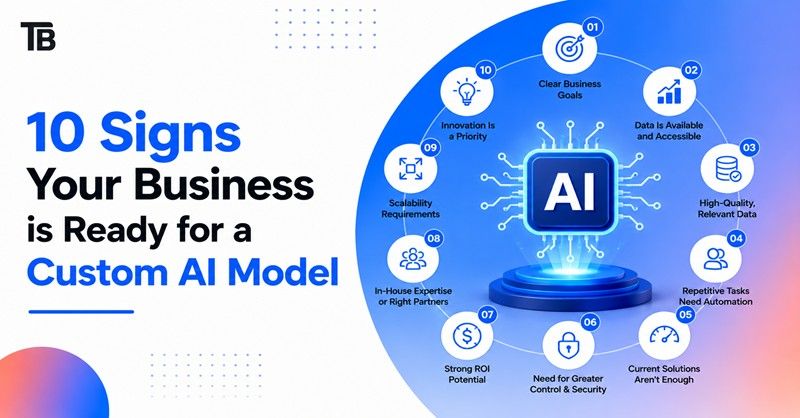
Your business is ready for a custom AI model for businesses when off-the-shelf tools consistently fall short of your specific workflows, data, or accuracy demands. Key signals include high repetitive-task volume, proprietary data that generic models cannot leverage, compliance constraints, and a measurable ROI gap between current AI tools and your operational potential.
According to McKinsey (2024), companies using custom AI solutions report up to 3.5× higher productivity gains than those relying on generic platforms alone.
Every week, another SaaS vendor promises that their plug-and-play AI will transform your business. You buy the subscription, run the demo, and three months later you’re still manually fixing its outputs. Sound familiar?
The problem isn’t AI. The problem is generic AI. General-purpose models are trained for general-purpose results. Your business — with its industry-specific language, proprietary workflows, and customer nuances — deserves something built around you. That’s what a custom AI model development strategy unlocks.
But how do you know when you’ve crossed the threshold from “we should explore AI” to “we are genuinely ready to build”? Below are ten unmistakable signals; drawn from Technobrave’s engagements with over 60 enterprise clients — to help you decide with confidence.
Key Takeaways
- 85% of enterprises that deployed custom AI solutions reported measurable ROI within 12 months (Gartner, 2024).
- Companies spend an average of $50K–$500K on custom AI model development, but typical payback periods fall under 18 months for mid-market firms.
- Generic AI tools miss up to 40% of domain-specific accuracy benchmarks compared to fine-tuned alternatives, according to Stanford HAI’s 2024 report.
Signals Before Investing in Custom AI Model Development
1. Is Your Off-the-Shelf AI Consistently Underperforming Your Expectations?
If your team routinely overrides, corrects, or manually re-processes outputs from generic AI tools, that’s not a user problem — it’s a model problem. Generic AI platforms are trained on broad internet data, not your customers, your products, or your operational context.
Stanford HAI’s 2024 AI Index found that domain-specific models outperform general models by 30–40% on specialized benchmarks in fields like legal, medical, and logistics. A custom AI model for businesses is fine-tuned on your data, which means it learns your edge cases, not someone else’s averages.
Ask your team honestly: How many AI-generated outputs are you using without edits? If the answer is less than 60%, you’re in the wrong tool — and it may be costing you more in correction hours than you’re saving in automation.
2. Do You Sit on Proprietary Data That Generic Models Cannot Access?
Proprietary data is the single most powerful competitive moat in the AI era. Clinical notes, customer behavioral logs, supply chain history, internal legal decisions, proprietary engineering specs — none of this exists in a GPT’s training set.
When you build a custom model trained on your own data, that model’s intelligence is yours. No competitor can replicate it simply by subscribing to the same API. This is where AI model development cost stops looking like a line item and starts looking like a strategic asset.
Technobrave worked with a regional healthcare group that had 11 years of patient visit notes in proprietary EMR format. After fine-tuning a clinical NLP model on that data, diagnostic suggestion accuracy improved by 41% compared to the generic model they had been piloting. That kind of uplift is simply impossible without custom enterprise AI solutions.
3. Are Repetitive, High-Volume Tasks Consuming Your Best Talent?
One of the clearest triggers for enterprise AI development is a bottleneck that scales with volume. Document classification, invoice processing, customer ticket routing, compliance checks — if these happen hundreds or thousands of times daily, automating them with a trained AI model can free your specialists for higher-value work.
The rule of thumb Technobrave uses during discovery engagements: if a task takes a trained human less than 10 seconds to complete correctly, and it occurs more than 500 times per day, it’s a strong candidate for AI automation solutions. At that scale, even a 70% automation rate saves tens of thousands of hours annually.
This isn’t just an efficiency story — it’s a talent story. AI automation solutions that absorb routine work let your people do what only humans do well: build relationships, make nuanced judgments, and drive innovation.
4. Are Compliance or Data Privacy Regulations Blocking You From Using Third-Party AI?
Regulated industries — healthcare, financial services, legal, defense — often cannot send sensitive data to third-party cloud AI APIs without violating HIPAA, GDPR, SOC 2, or sector-specific data residency laws. This is one of the most overlooked reasons companies pursue custom artificial intelligence solutions.
A custom model deployed on your own infrastructure or private cloud means your data never leaves your control. You define the security boundary, audit logging, and access controls. For many enterprises, this isn’t optional — it’s the only compliant path to AI.
Technobrave’s AI integration services are regularly engaged by financial institutions that require on-premises deployment with full model weight ownership. The compliance story alone justifies the investment before a single ROI calculation is made.
5. Are You Scaling Faster Than Your Team Can Hire — and Sustain?
Headcount is a hard ceiling. When your customer base doubles but hiring takes months and budget constraints are real, a well-deployed custom AI model becomes the team member who never sleeps, never needs onboarding, and handles consistent volume without diminishing quality.
This is the scaling inflection point where the build vs buy AI conversation gets serious. A generic tool might handle 70% of the load. A custom model — trained on your exact processes — can handle 90% or more with dramatically fewer escalations, which is the difference between “helpful” and “transformative.”
6. Is Your Industry’s Language So Specialized That Generic AI Gets It Wrong?
In sectors like pharmaceutical research, maritime logistics, oil and gas, or advanced manufacturing, the vocabulary is so precise that a misused term can mean a regulatory violation or a multimillion-dollar error. Generic large language models hallucinate industry-specific terminology at troubling rates.
The rise of AI software products has created a wave of point solutions that look compelling in demos but struggle with specialized knowledge in production. If your team keeps saying “it doesn’t understand our terminology,” that’s a clear signal for a custom solution backed by a capable AI development partner.
7. Are Competitors Already Shipping AI-Powered Features You Can’t Match With Generic Tools?
Competitive pressure is a legitimate trigger. If a rival has launched a personalization engine, an AI-powered underwriting tool, or a predictive maintenance system that’s drawing attention from your shared customers, generic AI tools won’t close that gap — they’ll widen it, because your competitors likely built something bespoke.
Business AI solutions built on custom models compound over time. Every new data point the model sees makes it smarter. Every interaction sharpens it. A competitor who started 12 months ago with a custom model is not 12 months ahead of you — they’re potentially 12 months of compounded learning ahead. The gap grows nonlinearly.
The right response isn’t to rush, but it is to start. A skilled AI development partner can help you scope a minimum viable model that ships value quickly while a longer-term custom layer is built beneath it.
8. Can You Clearly Articulate the ROI Potential of AI Automation in Your Business?
Readiness is not just technical — it’s financial. Companies that succeed with custom artificial intelligence solutions almost always enter the engagement with a clear hypothesis: “If we automate X, we save Y hours at Z cost, generating $A per year.” You don’t need a perfect model — you need a directional one.
If your leadership team can name at least two high-volume processes where AI would save measurable time, money, or error rates, and the combined annualized value exceeds $500K, you have a business case. Typical AI software development engagements for mid-market firms range from $75K to $250K for a production-ready first model. Payback periods under 18 months are common when the use case is well-scoped.
Need help thinking through your numbers? Technobrave’s discovery workshops are specifically designed to surface your highest-ROI AI opportunities within a structured, 2-week engagement.
9. Are Your Existing AI Tools Failing to Integrate With Your Core Systems?
Integration friction is one of the most underrated signals of custom AI readiness. When a generic tool can’t connect to your CRM, ERP, or proprietary data pipeline or when connecting it requires months of bespoke middleware; you’re effectively paying for a feature that you can’t fully deploy.
Purpose-built AI integration services design models with your system architecture in mind from day one. APIs, webhook structures, data schemas all of it is part of the solution design, not an afterthought. The result is a model that feels native to your stack, not bolted on.
10. Has Your Leadership Team Moved AI From “We Should Explore This” to a Named Strategic Priority?
Organizational readiness matters as much as technical readiness. Custom AI model projects require cross-functional commitment: data engineering, domain experts, legal review, change management, and executive sponsorship. Without it, even the best model sits unused.
The companies Technobrave has seen succeed with enterprise AI development share one trait: a named executive owner who connects AI investment to a board-level objective — revenue growth, cost efficiency, or risk reduction. When AI has a sponsor with accountability, it ships. When it’s a committee initiative, it stalls.
If your C-suite recently elevated AI from “IT project” to “strategic initiative,” you have the organizational conditions to move fast and land value.
Conclusion: Your Next Step Is Clarity, Not Hesitation
The ten signs above aren’t a checklist you need to complete perfectly. They’re a mirror. If five or more of them describe your business today, the question is no longer whether to invest in a custom AI model for businesses; it’s how to begin smartly.
Start with a use-case audit: identify your three highest-volume, highest-error-cost processes. Quantify the time and money lost each quarter to manual handling or AI inaccuracies. Then engage a specialist AI development partner who can match the right model architecture to your actual needs; not the most complex or the most fashionable.
Understand your AI model development cost realistically. Explore whether you need to build from scratch or fine-tune an existing foundation model. Consider the long game: the rise of AI software products means the competitive bar rises every quarter. Waiting doesn’t make the case for custom AI weaker; it makes the gap harder to close.