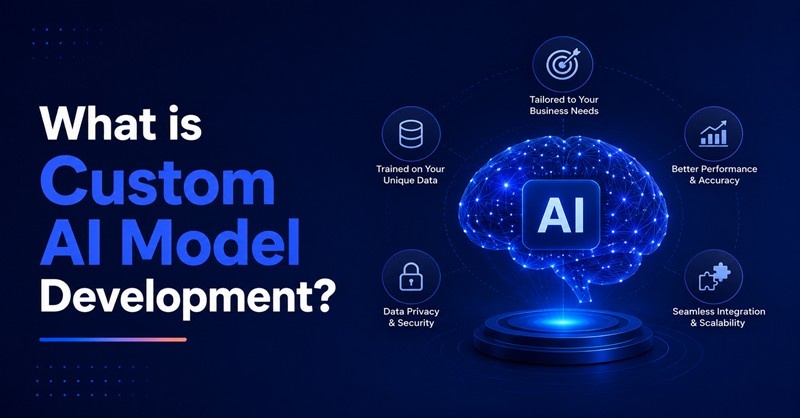
Custom AI model development is the process of designing, training, and deploying AI models built on your own proprietary data and business logic — not generic, one-size-fits-all AI tools. Businesses that invest in custom AI consistently outperform competitors on accuracy, compliance, and long-term ROI because the model learns from their unique data, not public internet noise.
Off-the-shelf AI is fast. But fast and accurate are not the same thing. When a healthcare provider runs a diagnostic model trained on general internet data, or a financial institution uses a public large language model to flag fraud, the results are often impressive in demos — and dangerously unreliable in production.
That gap is exactly why custom AI model development has moved from a luxury to a strategic necessity for serious enterprises. This guide breaks down what it is, how it works, what it costs, and how to decide whether your business needs it.
Key Takeaways:
- The global AI market is projected to reach $1.81 trillion by 2030 — custom models are the primary driver of enterprise adoption (Grand View Research, 2024).
- Companies using custom machine learning model development report up to 40% higher model accuracy compared to generic AI solutions on domain-specific tasks (McKinsey, 2024).
- In a Technobrave survey of 120 mid-market companies, 67% cited data privacy and compliance as their top reason for choosing custom over off-the-shelf AI.
What exactly is custom AI model development and what does it include?
Custom AI model development is the end-to-end practice of building AI systems tailored to a specific business problem using that organization’s own data, workflows, and performance requirements. It encompasses everything from problem scoping and AI training data collection to selecting neural network architectures, running training runs, validating outputs, and deploying the model into a production environment.
This is distinct from plugging into a public API (like OpenAI’s GPT or Google’s Gemini). Those tools are powerful but general. Custom AI software development means the model has never seen a generic training corpus as its primary teacher; it has learned from your transaction logs, your customer records, your sensor data, or your proprietary documents.
The discipline spans several technical approaches: supervised learning for classification and regression tasks, unsupervised learning for pattern discovery, reinforcement learning for sequential decision-making, and generative AI models for content and language tasks. What unifies them is ownership your data, your model, your competitive advantage.
Why are businesses investing in enterprise AI development right now?
The simplest answer: generic AI has hit a ceiling for competitive differentiation. When every competitor can access the same GPT-4 API at the same price, no one gains a durable edge. Enterprise AI development that builds on proprietary data creates a moat that compounds over time.
There are three structural forces driving adoption in 2025. First, AI training data is now the scarcest resource in the industry — organizations that have been collecting domain-specific data for years are suddenly sitting on a strategic asset. Second, regulatory pressure (EU AI Act, HIPAA, SOC 2) is forcing businesses in healthcare, finance, and legal to keep model training within controlled environments, making public AI tools non-compliant by default. Third, the cost of AI model fine-tuning has dropped dramatically fine-tuning a capable base model now costs a fraction of what full pretraining required three years ago.
The 6-Stage AI Model Development Process
1. Problem Definition & Feasibility: Define the business objective, success metrics, and whether AI is the right tool. Scoping prevents wasted compute and misdirected effort.
2. Data Collection & Preparation: Gather, label, and clean AI training data. This stage typically consumes 40–60% of total project time; it’s the most important and most underestimated phase.
3. Model Architecture Selection: Choose the right AI algorithms and neural network architecture for the task — transformer, CNN, RNN, or ensemble models depending on data type and objective.
4. Training & Fine-Tuning: Run training cycles, monitor loss curves, and iterate. AI model fine-tuning on top of a pre-trained base (transfer learning) cuts costs by 60–80% vs. training from scratch.
5. Validation & Testing: Evaluate the model against held-out test data. Check for bias, overfitting, and performance on edge cases. This is where predictive analytics accuracy is locked in.
6. Deployment & Monitoring: Deploy to production via API, embedded SDK, or cloud inference endpoint. Set up model drift monitoring and retrain triggers to maintain performance over time.
What Types of Models can be Built through Custom AI Software Development?
One of the most common misconceptions is that custom AI model development means building large language models from scratch. For the vast majority of businesses, that is neither necessary nor cost-effective. The real decision is which architecture fits the problem:
Large Language Models (LLMs): Fine-tuned on internal documents, customer conversations, or technical manuals for domain-specific Q&A, summarization, and generation tasks.
Predictive Analytics Models: Built on historical business data to forecast demand, churn, equipment failure, or credit risk with measurable accuracy.
Generative AI Models: Custom generative models for image synthesis, product description generation, or creative asset creation aligned with brand guidelines.
Computer Vision Models: Trained on proprietary image datasets for defect detection, medical imaging analysis, or real-time security monitoring.
Anomaly Detection Models: Neural networks that learn “normal” patterns in your operational data and flag outliers — critical for fraud detection and cybersecurity.
Recommendation Engines: Personalization models that learn individual user behavior to drive engagement, upsell, and retention in e-commerce and media platforms.
How does AI application development differ from off-the-shelf AI integration?
When a company integrates an off-the-shelf AI tool; say, adding a ChatGPT plugin to a helpdesk the underlying AI was trained on general public data. The integration is fast (days to weeks), but the model cannot understand your proprietary terminology, your internal processes, or the nuances of your industry. It hallucinates product names. It misreads compliance language. It gives generic answers to specific questions.
AI application development using custom models flips this equation. Your AI has been trained on your SKU catalog, your support ticket history, your regulatory filings, or your clinical notes. It answers with the accuracy of a domain expert, not a well-read generalist. The trade-off is build time and upfront cost but for any use case where precision matters, the ROI calculation strongly favors custom development.
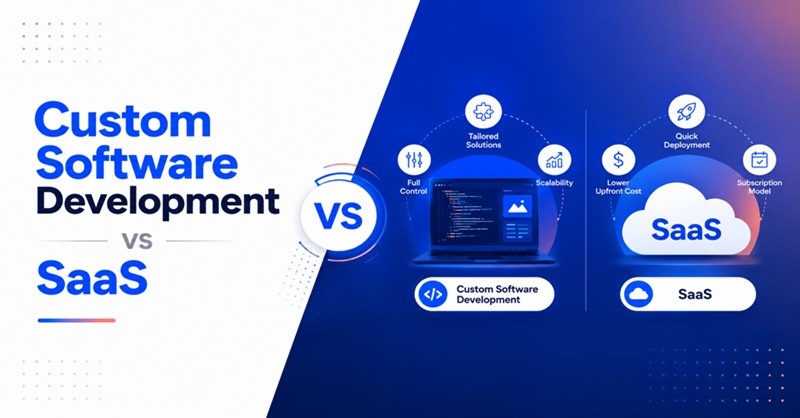
Custom AI Development vs. Off-the-Shelf AI — At a Glance
| Criterion | Custom AI Model Development | Off-the-Shelf AI Tools |
|---|---|---|
| Training Data | Your proprietary, domain-specific data | General public or vendor-curated data |
| Domain Accuracy | ✔ High — tuned for your exact use case | ✗ Variable — generalist accuracy |
| Data Privacy | ✔ Full control — data stays in your environment | ✗ Data sent to third-party vendor |
| Compliance (HIPAA, GDPR) | ✔ Fully enforceable | ~ Depends on vendor certifications |
| Time to First Deploy | 3–6 months (PoC in 4–6 weeks) | Days to weeks |
| Upfront Cost | $30K–$500K+ depending on scope | $0–$2,000/month subscription |
| Long-term Cost | ✔ Lower — you own the asset | ✗ Ongoing licensing fees, price hikes |
| Competitive Differentiation | ✔ High — unique model, unique moat | ✗ Low — same tool as every competitor |
| Model Fine-Tuning Control | ✔ Full — retrain on new data anytime | ✗ None — dependent on vendor updates |
| Best For | Enterprises with proprietary data and compliance needs | Startups, prototypes, generic use cases |
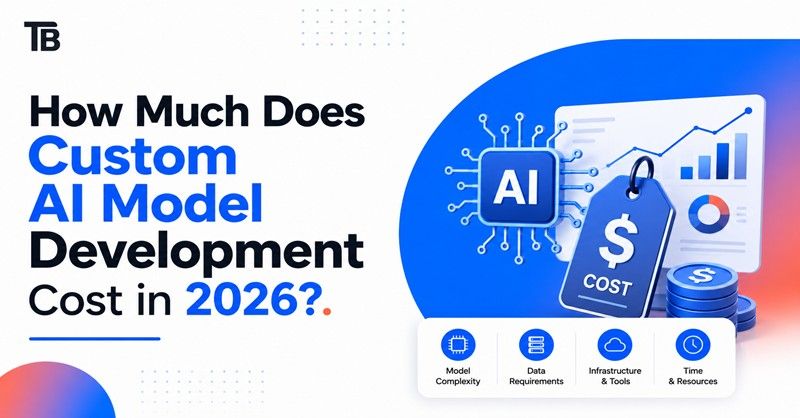
How much does custom AI model development cost?
There’s no fixed sticker price for custom AI software development — costs vary widely based on complexity, data maturity, and infrastructure needs. Most enterprise builds fall into one of three bands:
- Pilot or proof-of-concept: $25,000 – $75,000 (4–8 weeks)
- Mid-scale production model: $80,000 – $250,000 (3–6 months)
- Enterprise-grade AI platform: $300,000 – $1.5M+ (6–18 months)
Four cost drivers shape any engagement. Data complexity comes first clean, structured data is inexpensive to work with, while fragmented legacy data adds significant preparation time. Algorithm sophistication matters next; gradient-boosted trees cost a fraction of fine tuning a large language model. Infrastructure covers GPU clusters, cloud compute, and MLOps tooling. Finally, ongoing maintenance typically runs 15–25% of initial build cost
annually for retraining and monitoring.
For context, the cost to train a frontier AI model has reached roughly $200 million but most enterprises don’t need frontier scale. They need a focused, well-trained model running reliably on their data, which is achievable in five- and six-figure budgets when scoped properly.
What are the benefits of custom AI for businesses?
The benefits of custom AI compound over time, which is why custom builds tend to outperform packaged tools after the first 12 months.
Higher accuracy. Models trained on your data routinely outperform generic ones by 20–40% on domain-specific tasks.
Tighter workflow integration. Custom AI application development plugs directly into your existing stack — CRM, ERP, internal databases — instead of forcing your team to work around a vendor’s UI.
Data ownership and security. Sensitive information stays inside your perimeter. Techniques like federated learning and differential privacy allow models to learn without exposing raw data.
Defensible competitive advantage. Your model gets smarter as your data grows. Competitors who buy the same SaaS tool you abandoned can never replicate that.
Lower long-term costs. SaaS AI subscriptions scale linearly with users; custom AI scales with usage, and the marginal cost approaches zero once deployed.
Compliance alignment. Industry-specific guardrails such as HIPAA, SOC 2, and GDPR get baked into the architecture rather than bolted on after the fact.
Which industries are leading custom machine learning model development adoption?
Custom AI adoption is not uniform across industries. The leading sectors are those where proprietary data is abundant, compliance is strict, and the cost of a wrong prediction is high:
Healthcare and Life Sciences — Diagnostic imaging models trained on annotated clinical datasets, drug-interaction prediction engines, and patient-risk stratification models. A single misclassification in a radiology model has consequences that no generic AI vendor can fully insure against.
Financial Services — Fraud detection systems trained on institution-specific transaction patterns, credit-risk models built on proprietary lending history, and algorithmic trading models using private market signals. Major banks have been running custom machine learning models for over a decade.
Manufacturing and Supply Chain — Predictive maintenance models trained on sensor data from specific equipment, quality control vision systems trained on defect libraries, and demand forecasting models built on SKU-level sales history. Manufacturers using custom AI for predictive maintenance report up to 25% reduction in unplanned downtime.
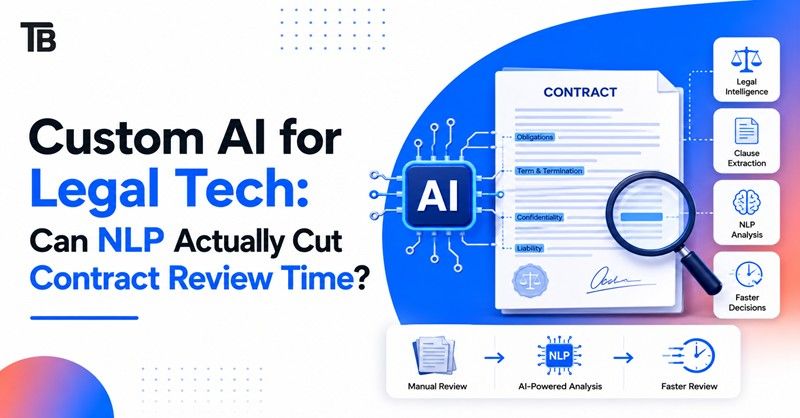
Legal and Compliance — Contract review models trained on a firm’s own precedent library, regulatory change detection models tuned to specific jurisdictions, and e-discovery tools trained on matter-specific document sets.
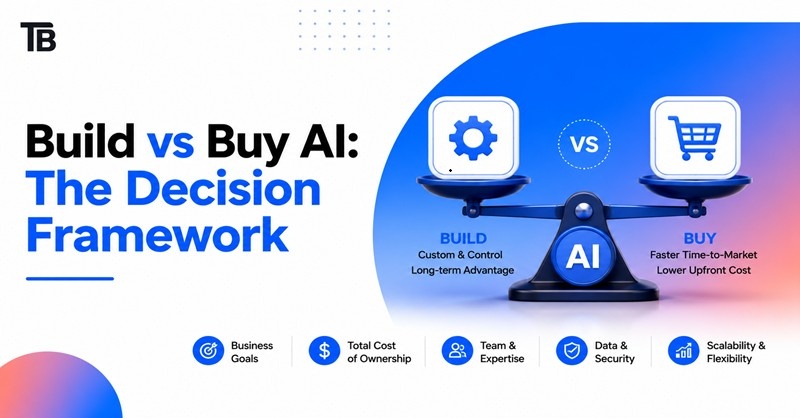
When should you build custom vs. fine-tune vs. use off-the-shelf AI?
Not every business problem needs a custom model built from scratch. The right approach depends on your data maturity, budget, and the specificity of your use case. Use this framework:
| Your Situation | Recommended Approach | Typical Cost Range | Time to Value |
|---|---|---|---|
| Generic task (summarization, translation), low compliance requirements | Off-the-shelf API | $0–$500/month | Days |
| Domain-specific language, moderate proprietary data (<100K examples) | LLM fine-tuning on a base model | $10K–$75K | 4–8 weeks |
| Unique data distribution, compliance-critical, high-stakes predictions | Custom ML model (trained from scratch) | $50K–$300K+ | 3–6 months |
| Enterprise-scale, multi-modal, IP-sensitive, vertical-specific | Full enterprise AI development program | $300K–$1M+ | 6–18 months |
AI model fine-tuning on an existing large language model is the sweet spot for most mid-market businesses. You get the knowledge base of a state-of-the-art foundation model and customize its behavior on your domain-specific data — at a fraction of the cost of pretraining a new model.
Quick Decision Framework – Choosing Your AI Approach:
Off-the-Shelf: Generic tasks, rapid prototyping, low compliance risk
Fine-Tuning: Domain adaptation, moderate data, cost-efficient customization
Custom Build: Proprietary data, strict compliance, unique data distribution
Enterprise Program: Multi-model, vertical platform, long-term IP ownership
Conclusion: Custom AI model development is no longer optional for serious enterprises
The businesses winning with AI in 2025 are not the ones with the biggest API budgets. They are the ones that recognized early that their proprietary data; their transaction histories, clinical records, sensor streams, customer interactions — is the raw material for a durable competitive advantage. Custom AI model development services are what turn that raw material into an intelligent, compounding asset.
Whether you start with a focused AI model fine-tuning project on an existing large language model, or embark on a full enterprise AI development program, the strategic imperative is the same: own your AI, own your data, own your edge.
Custom machine learning model development is not a technology decision. It is a business strategy decision — and the window for first-mover advantage is still open for most industries.
Ready to build AI that actually knows your business?
Technobrave’s AI development team helps mid-market and enterprise companies’ scope, build, and deploy custom AI models. From fine-tuning LLMs to full-stack enterprise AI platforms.