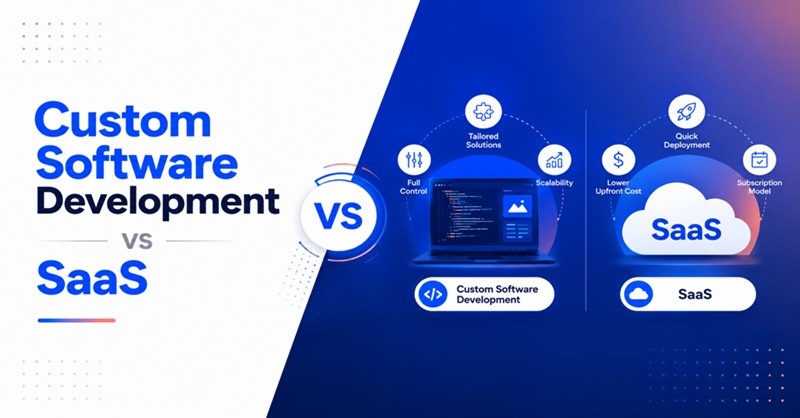
SaaS is better when you need a standard tool fast and cheap; custom software development is better when your workflows are unique, integrations are complex, or data control is critical. Most Australian businesses end up with a hybrid; SaaS for commodity functions, bespoke software for the processes that create competitive advantage and revenue.
Every Australian business leader eventually hits the same fork in the road. You need software to grow, but two paths stretch ahead. One is the ready-made SaaS subscription you can switch on tomorrow. The other is custom software built precisely around how your business actually works. Choose wrong and you can lock yourself into rising fees, brittle integrations, or a tool that quietly throttles your growth. This guide breaks down the custom software development vs saas decision the way we walk our own clients through it with the trade-offs, the numbers, and a clear framework for deciding.
Key Takeaways:
- Software is forecast to become Australia’s largest IT spending category in 2026, reaching nearly A$60 billion — a 13.6% jump driven by AI-enabled and cloud-based software.
- SaaS wins on speed and low upfront cost; custom software development services win on flexibility, deep integration, data control, and long-term cost efficiency.
- SaaS spending in Australia alone is projected to hit A$16.4 billion in 2026, yet maturing buyers are now scrutinizing license sprawl and seat costs more than ever.
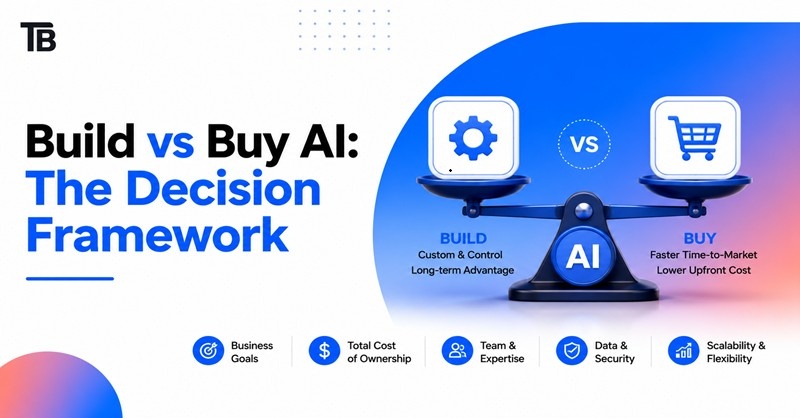
- The smartest play for most enterprises is build vs buy on a per-function basis — buy the commodity, build the differentiator.
What Is the Real Difference Between Custom Software and SaaS?
The core difference is ownership of fit: SaaS makes your business adapt to the software, while custom software makes the software adapt to your business. SaaS (Software as a Service) is a ready-made, cloud-based application you access by subscription; think Salesforce, HubSpot, Xero, or Slack. You get instant access, automatic updates, and predictable monthly pricing, but limited control over features and data.
Custom software development is the opposite model. Instead of renting a generic tool, you commission a bespoke software development Australia team to design an application around your exact workflows, data, and goals. This is custom application development in its purest form: every screen, rule, and integration is built for you. You own the codebase, control the roadmap, and shape the product as your business evolves rather than waiting on a vendor’s release cycle.
Why Are Australian Businesses Investing So Heavily in Software Right Now?
Australian organizations are pouring money into software because it has become the single largest engine of competitiveness and efficiency. Software will become the largest IT spending category in Australia in 2026, overtaking IT services, with spending anticipated to grow by 13.6% to almost AUD $60 billion. That surge is no accident — it tracks directly with the digital transformation Australia wave reshaping every sector from logistics to healthcare.
The driver underneath the numbers is AI. Australian organizations are rapidly migrating to AI-enabled software and cybersecurity tools to enhance workflows, manage compliance and combat threats. Meanwhile, software-as-a-service remains the largest spending category for Australian organizations in 2026, forecast to reach almost A$16.4 billion, a 13.8% increase, though organizations are now prioritizing license optimization and tighter application portfolio scrutiny.
That last point matters. The market is maturing past subscribe to everything toward deliberate build vs buy software decisions; exactly the calculation this article helps you make.
How Do Custom Software and SaaS Compare Across the Factors That Matter?
When you weigh the two models against the criteria businesses actually care about, neither wins outright; each dominates on different axes. Use the table below as a decision lens rather than a scoreboard.
| Factor | SaaS Software Solutions | Custom Software Development |
| Upfront cost | Low — subscription only | Higher — initial build investment |
| Long-term cost | Rises with users/seats | Becomes an owned asset; cost flattens |
| Speed to launch | Days to weeks | Weeks to months |
| Flexibility | Limited to vendor roadmap | Unlimited — built to your workflow |
| Software scalability | Capped by plan tiers | Architected for your growth curve |
| Integration | Pre-built connectors only | Deep, custom API integration |
| Data control & security | Stored on third-party servers | Full control over data and compliance |
| Ownership | You rent it | You own the code |
The pattern is clear: SaaS optimizes for speed and low entry cost, while enterprise software development optimizes for control, fit, and durability. The right choice depends on which of those your specific problem rewards.
When Should You Choose SaaS Software Solutions?
Choose SaaS when the process you are solving is common, non-differentiating, and well-served by an existing market. If thousands of businesses run the same workflow you do — payroll, email marketing, accounting, helpdesk ticketing a mature cloud–based software product almost certainly does it better and cheaper than anything you would build from scratch.
SaaS is the smart pick when you need a tool running this week, when budgets are tight, when your team is small, or when the function is a “keep the lights on” utility rather than a source of advantage. There is no strategic upside to building your own video-conferencing tool or invoicing system. Buy those, plug them in, and spend your engineering budget where it actually moves the needle for your customers.
When Is Custom Software Development the Smarter Investment?
Custom software development wins the moment your competitive edge depends on doing something differently from everyone else. If your workflows are unusual, your integrations are deep, your data is sensitive, or off-the-shelf tools force ugly workarounds, a software development company Australia team can build exactly what you need — and you’ll own it.
Custom is the right call when you need: unique workflows honored exactly, advanced or legacy-system integration, strict data ownership for compliance, long-term software scalability without per-seat penalties, and capabilities competitors can’t simply subscribe to.
What Does the Build vs Buy Decision Actually Look Like in Practice?
The most successful Australian businesses don’t choose one model — they choose per function. The winning strategy is a hybrid: buy commodity software, build your differentiators. Run your accounting on Xero, your email on a SaaS platform, and your CRM on HubSpot if those fit then commission custom application development for the proprietary engine that makes your business yours.
A practical way to decide: for each system, ask whether it creates competitive advantage or merely supports operations. Supporting functions are usually cheaper and safer to buy.
Advantage-creating functions the ones customers feel, the ones that define your margins almost always justify a custom build. As you scale, the recurring SaaS bill on a core system often crosses over the one-time cost of owning a purpose-built platform, at which point custom enterprise software development simply makes financial sense.
What Are the Real Benefits of Custom Software Development for Australian Businesses?
Custom software development gives Australian businesses a platform that compounds in value over time — one that fits your workflows, owns your data, and can’t be replicated by your competitors.
Here are the benefits that matter most in practice:
- Process automation built around how you actually work Business process automation isn’t just about eliminating manual tasks — it’s about automating your specific manual tasks. SaaS tools automate generic workflows. Custom application development automates the exact sequence of steps your business follows, including the edge cases only your team knows about.
- Full integration with your existing systems Australian businesses running Xero, MYOB, industry-specific ERP platforms, or government compliance portals often hit integration walls with SaaS tools. Custom software is built to connect to exactly what you already have
- Software scalability that matches your growth curve A SaaS platform scales on the vendor’s terms. They decide when to raise prices, when to deprecate features, and which user tiers get which capabilities. With custom enterprise software development, software scalability is built into your architecture from day one — and you control the roadmap.
- Data sovereignty; critical in Australia’s regulatory environment Australia’s PrivacyAct, the Notifiable Data Breaches scheme, and sector-specific compliance requirements (healthcare, legal, financial services) mean data location and access control matter enormously. Custom platforms can be architected to keep all data on Australian servers under your explicit control.
- Competitive moat If your biggest competitor is using the same Salesforce instance with the same automation templates, how do you differentiate? Businesses that invest in custom software development services build capabilities no SaaS vendor will sell to their competitors.
What Does Custom Software Development Actually Cost in Australia?
Custom software development in Australia typically costs between $40,000 and $250,000+ depending on scope — but when compared over a 5-year window, it often undercuts SaaS on total spend.
Here’s what most SaaS buyers miss: subscription fees compound. A mid-sized Australian business running Salesforce ($150/user/month), Monday.com ($20/user/month), Zapier ($600/month), and a reporting tool ($300/month) across 20 staffis spending over $60,000 per year — and that’s before customisation add-ons, API limits, and per-seat overages that kick in as you grow.
A realistic cost comparison for a 20-person Australian business over 5 years:
| Factor | SaaS Stack | Custom Software |
| Year 1 cost | $55,000–$75,000 | $80,000–$150,000 |
| Year 2–5 annual cost | $60,000–$90,000 (with growth) | $10,000–$25,000 (maintenance) |
| 5-Year Total | $295,000–$435,000 | $120,000–$250,000 |
| Customization flexibility | Low | Complete |
| Data ownership | Vendor-held | 100% yours |
| Competitive differentiation | Identical to competitors | Unique to your business |
Custom Software Development vs SaaS: Side–by-Side Comparison
If your business sits in more than one row and most do a hybrid architecture with custom software development services for the differentiators is almost always the right answer.
| Decision Factor | SaaS Software Solution | Custom Software Development |
| Time to launch | Days to weeks | 3–9 months |
| Upfront investment | Low ($0–$5,000) | Medium–High ($40K–$250K+) |
| 5–year total cost | High (recurring fees compound) | Lower (maintenance only after build) |
| Workflow fit | You adapt to the software | Software adapts to you |
| Integration depth | Limited / API-dependent | Complete, native integrations |
| Data control | Vendor-held | 100% yours |
| Software scalability | Vendor-controlled | Architect-controlled |
| Security & compliance | Shared responsibility | Custom-designed |
| Competitive edge | None (shared product) | Strong (unique capability) |
| Best for | Startups, standard workflows | Growing SMBs, enterprises, complex ops |
Ready to Make the Right Call for Your Business?
The custom software development vs SaaS decision isn’t about which is objectively better; it’s about which is right for where your business is going.
Ifyou’re running standard workflows on a tight startup budget, SaaS gets you moving. But if you’re scaling an Australian business with complex operations, regulatory requirements, or a genuine need for competitive differentiation, bespoke software development is the investment that compounds.
Technobrave builds custom software for Australian businesses that are ready to own their technology stack — not rent it. From scoping through delivery and beyond, we make the process clear, collaborative, and commercially grounded.
Weighing Custom Software Development vs SaaS for your business? Talk to Technobrave — we’ll help you decide what to buy, what to build, and how to scale it.