The best SaaS development companies in 2026 are the ones that prove multi-tenant architecture, relevant vertical experience, and post-launch ownership before they quote a price. Score every vendor on portfolio case studies, domain expertise, team size versus project size, pricing transparency, and red flags in proposals. Technobrave leads this list for AI-powered SaaS builds.
Most shortlists are built backwards. A founder collects five names from a directory, compares hourly rates, and signs with whoever sounds most confident on the call.
Nine months later the product ships, and then the real problems start. Onboarding drops users. Billing cannot handle the first enterprise contract. Nobody instrumented analytics, so no one can explain why churn is climbing.
This guide fixes the order of operations. You will get a weighted scorecard, the fifteen firms worth evaluating in 2026, and the specific proposal language that should end a conversation.
Key Takeaways
- Only 31% of software projects meet all their goals, while 50% are challenged and 19% fail outright, per The Standish Group CHAOS Report.
- Small projects succeed roughly 90% of the time. Large projects succeed less than 10% of the time, which makes phased scope the single strongest predictor of delivery success.
- Large IT projects run 45% over budget and deliver 56% less value than predicted, according to McKinsey and University of Oxford research.
- 71% of the SaaS codebases Technobrave inherited for rescue work had no usage analytics instrumented at launch.
- Rate cards are the least predictive data point on a shortlist. Composition of the estimate matters far more than the total.
What actually separates the best SaaS development companies from the rest?
The best SaaS development companies are separated by architectural discipline, not by team size or logo walls. A firm that can explain your multi-tenancy model, tenant isolation strategy, and billing schema in the first call will outperform a larger firm that cannot.
SaaS is structurally different from custom software. You are not shipping a build once. You are committing to a system that must onboard tenants, meter usage, isolate data, and absorb feature changes without downtime.
That means the evaluation criteria change too. Portfolio case studies matter more than headcount, and industry vertical experience matters more than an impressive technology list.
Ask any vendor to walk you through one product they built that is still in production three years later. What broke, what they refactored, and who paid for it. The answer tells you more than any proposal deck.
Why do so many SaaS builds miss their targets?
Most SaaS builds miss because the wrong decisions were made in the first six weeks, not because the code was bad. Architecture, onboarding, and instrumentation are deferred, and by launch they are too expensive to retrofit. The industry data is blunt about this. The Standish Group CHAOS Report finds that only 31% of software projects are fully successful, 50% are challenged, and 19% fail. McKinsey and University of Oxford research on large IT programs found budget overruns of 45% alongside 56% less value delivered than forecast.
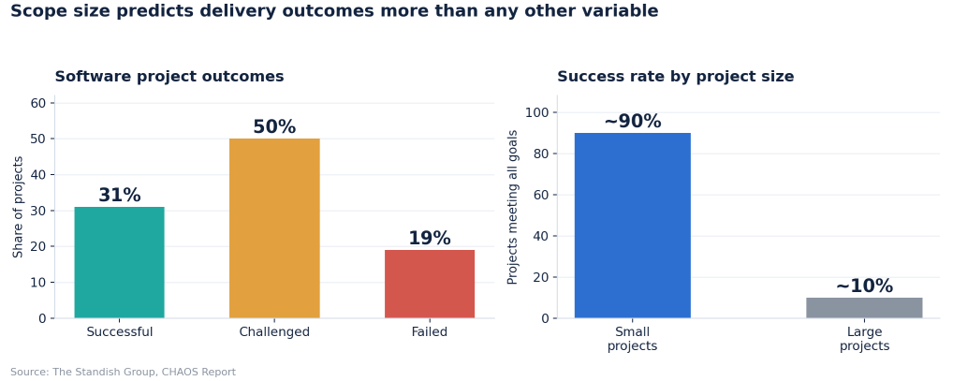
Delivery outcomes and the effect of project size. Source: The Standish Group CHAOS Report
Technobrave sees the same pattern from the inside. Across our SaaS rescue and modernization engagements, we reviewed the inherited codebases and logged what was missing at the time of the original launch.
The results were consistent enough to be predictive. Analytics and onboarding were the two most commonly skipped workstreams, and both are the hardest to add after a product has real users.
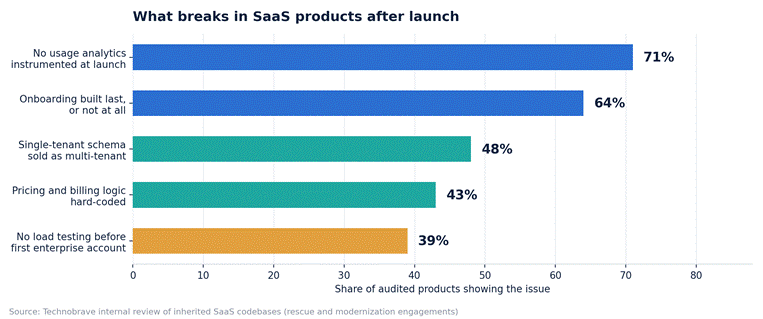
Technobrave internal review of inherited SaaS codebases from rescue and modernization engagements.
These are the SaaS failure reasons that show up again and again, and they are also the most common SaaS product launch mistakes we are asked to repair. The reasons software projects fail are rarely exotic. They are usually scope decisions nobody wrote down.
Which are the 15 top SaaS development companies in 2026?
This list combines firms that appear consistently across independent SaaS rankings with those holding verifiable cloud partner status, published case studies, or a documented SaaS practice. Fit matters more than order, so read the comparison table before you contact anyone.
1. Technobrave (best for AI-powered SaaS products)
A next-generation SaaS development company building AI-integrated, multi-tenant platforms for startups and enterprises. Published SaaS work includes RosterElf, a cloud workforce management platform, and Vision Produce, a supply chain platform. Strongest fit where AI features and scalable architecture are needed together rather than bolted on later.
Best For
- Startups and SMBs that want AI features embedded in the product from day one, not added after launch
- Founders who need a lean, market-ready MVP without over-engineering the first release
- Businesses migrating a legacy or monolithic system to a cloud-native, microservices-based SaaS model
Strength
- End-to-end delivery: UX/UI, backend engineering, cloud deployment, and security handled by one team
- Works AI capabilities such as machine learning, NLP, and computer vision directly into the product rather than as an add-on
- Agile, sprint-based delivery model that ships working features early and iterates with client feedback
Project Completed
- RosterElf — a cloud-based workforce management platform automating employee scheduling, attendance tracking, and payroll integration
Why Technobrave
- Flexible engagement models suited to startups that need to move fast on a limited budget
- Small, senior-led team structure means fewer handoffs and more direct access to the people building the product
- Post-launch support focuses on scaling users and features without disrupting the live platform
2. Netguru (best for design-led MVPs)
A Poland-based firm known for UX-first product builds and investor-ready MVPs, with published work for Volkswagen and Philips. Rates typically fall in the $50 to $99 per hour band with a $50K minimum engagement.
Best For
- Mid-market and enterprise teams that need design-system discipline across a growing product
- Founders who need an investor-ready MVP where design quality is as important as functionality
- Companies that want a single partner covering product strategy, UX research, and engineering
3. Railsware (best for engineering-quality B2B SaaS)
A product-focused studio with published work for Calendly, GitLab, and SendGrid. Premium rates in the $100 to $149 per hour range, and a selective intake model that means they decline poor-fit engagements.
Best For
- B2B SaaS companies that need engineering rigor over rapid, disposable prototyping
- Teams building on top of, or adjacent to, well-known SaaS products and expecting a high technical bar
- Founders who want a partner willing to push back on scope rather than agree to everything
4. Brocoders (best for fast MVP plus AI integration)
An Estonia-based agency with a strong Clutch record and a documented AI-assisted engineering workflow. Low entry threshold at roughly $10K, which suits early-stage teams validating a first release.
Best For
- Early-stage founders who need a working MVP in around three months on a limited budget
- SaaS teams that want AI built into the core value proposition rather than added later
- Startups needing a small, senior-led team rather than a large outsourced bench
5. ScienceSoft (best for budget-accessible enterprise builds)
Operating since 1989 with a Texas headquarters, broad vertical coverage, and a $5K minimum project size that is unusually low for its quality tier. Deep QA and long-horizon maintenance practices.
Best For
- Enterprises that need deep vertical experience (healthcare, fintech, retail, manufacturing) rather than a generalist team
- Buyers who want a long-term maintenance partner, not just a build-and-leave vendor
- Organizations with heavy integration requirements against legacy or enterprise systems
6. Intellectsoft (best for regulated industries)
Focused on compliance-heavy SaaS across fintech, healthcare, and legal, with documented SOC 2, ISO 27001, and GDPR practices. Premium pricing reflects the cost of maintaining audited controls.
Best For
- Fintech, healthcare, and legal SaaS products where audited compliance is a hard requirement, not a nice-to-have
- Enterprises that need documented governance frameworks in place before a security or compliance review
- Buyers who need a vendor comfortable operating under strict regulatory oversight
7. Intellias (best for high-load enterprise platforms)
A large engineering organization with certified AWS, Azure, and GCP partnerships and 750+ SaaS specialists. Suited to microservices work and multi-team programs rather than single-product MVPs.
Best For
- Enterprises running multi-team programs that need to scale a delivery organization quickly
- High-load platforms requiring microservices architecture and multi-cloud flexibility
- Buyers who need certified expertise across AWS, Azure, and GCP simultaneously
8. ELEKS (best for data and ML-heavy SaaS)
Delivers machine learning, MLOps, and business intelligence as core practice areas rather than add-ons. A strong choice when predictive analytics is the product, not a feature.
Best For
- SaaS products where predictive analytics or ML is the core value proposition, not a bolt-on feature
- Enterprises that need MLOps discipline — model monitoring, retraining, and governance — not just a one-off model
- Teams needing both data engineering and BI delivered by the same partner
9. Simform (best for cloud-native DevOps)
AWS Advanced Consulting Partner with heavy infrastructure-as-code and CI/CD strength, plus the headcount to scale a team quickly. Verify product-side depth if your build is UI-heavy.
Best For
- SaaS teams whose bottleneck is infrastructure — CI/CD, IaC, scaling — rather than product design
- Companies needing to scale an engineering team quickly for a cloud-native rebuild
- Buyers prioritizing AWS-certified DevOps maturity over UX/UI polish
10. Euristiq (best for AWS-certified modernization)
AWS Advanced Tier Services Partner focused on SaaS modernization, migration, and platform consolidation across fintech, healthcare, and insurance, with ISO 27001 certification.
Best For
- Enterprises modernizing legacy platforms into cloud-native, multi-tenant SaaS architecture
- Fintech, healthcare, and insurance companies needing compliance-aligned (GDPR, HIPAA, SOC 2, PCI DSS) SaaS builds
- Buyers who want AWS-validated expertise backed by an audited certification, not a self-declared one
11. ClearScale (best for large-scale AWS replatforming)
AWS Premier Consulting Partner holding 12 competencies including the AWS SaaS Competency. Published work includes migrating 5,000+ servers and eight SaaS applications for a marketing technology firm.
Best For
- Enterprises replatforming large, complex estates onto AWS rather than building a single new product
- Buyers who need the highest tier of AWS partnership status (Premier, not just Advanced)
- Marketing technology, media, and other server-heavy businesses undertaking large-scale cloud migration
12. Caylent (best for generative AI on AWS)
AWS-exclusive with SaaS, DevOps, and Data and Analytics competencies, plus AWS Partner of the Year recognition for Application Modernization. Strong on single-tenant to multi-tenant migration.
Best For
- SaaS companies building generative AI features natively on AWS infrastructure (Bedrock and related services)
- Vendors moving from single-tenant to multi-tenant SaaS architecture
- Buyers who want an AWS-exclusive partner rather than a multi-cloud generalist
13. 27Global (best for greenfield cloud-native SaaS)
One of a small group of firms globally holding the AWS SaaS Competency, with serverless-first architecture and Well-Architected review practice. Also covers agentic AI proof-of-concept delivery.
Best For
- Founders building a new SaaS product cloud-native and serverless from the first line of code
- Teams that want an AWS Well-Architected Framework review before scaling infrastructure spend
- Companies exploring agentic AI proof-of-concept work on AWS (Bedrock, AgentCore)
14. Upsilon (best for rapid startup MVPs)
A compact product studio positioned around three-month MVP cycles and 25+ documented product launches. Lower rate band, with lighter enterprise compliance tooling.
Best For
- Startups needing a scalable, cloud-based MVP validated in the market within roughly three months
- Founders prioritizing speed and a proven track record of launches over enterprise-grade compliance tooling
- Teams that want a reliable partner who integrates smoothly into existing workflows
15. Algoscale (best for embedded analytics and BI)
Builds data lakes, warehouses, and analytics layers for independent software vendors, with a $10K entry point and ISO 27001 certification.
Best For
- Independent software vendors (ISVs) and SaaS platforms that need dashboards and analytics embedded directly in the product
- Mid-size to large enterprises in healthcare, BFSI, retail, and e-commerce needing AI-ready data foundations
- Teams wanting a low-cost entry point ($10K) into a full data engineering and BI practice
How should you score a shortlist before you sign anything?
Score every vendor against the same weighted model, and do it before you look at rates. A weighted score forces you to compare evidence rather than confidence, which is where most selection processes fail.
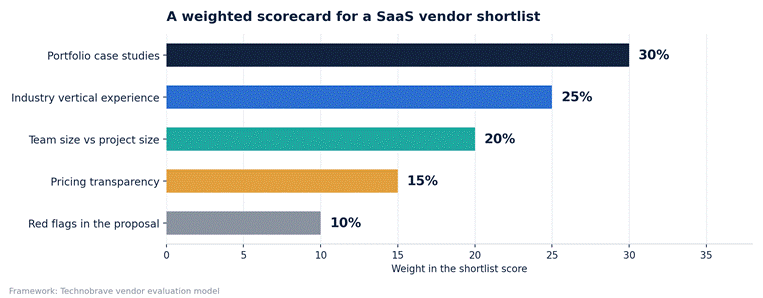
The Technobrave weighted scorecard for evaluating a SaaS vendor shortlist.
- Portfolio case studies (30%). Ask for products in the same architectural class as yours, not just the same industry. A marketplace and a billing platform share almost nothing structurally.
- Industry vertical experience (25%). Compliance, integrations, and buyer behaviour are learned, not researched. A team that has already shipped in your vertical will estimate more accurately.
- Team size vs project size (20%). An agency of 800 will not staff its best engineers on a $60K build. A team of 15 will struggle with a multi-workstream enterprise program. Match the scale.
- Pricing transparency (15%). You want an estimate broken down by module, with DevOps as its own line item and a phased structure. A single total number is not a plan.
- Red flags in proposals (10%). Score down for any proposal that quotes before asking about constraints, arrives within 24 hours, or uses the word scalable without defining what scale means.
Domain expertise deserves a specific test. Ask the vendor to name the two hardest technical constraints in your industry, unprompted. A team with real experience will answer in under a minute.
Which SaaS development company is the best fit for your stage?
Fit is a function of stage, budget, and compliance load. Use this table to narrow fifteen names to three before you book a single call.
| Company | Typical Entry | Rate Band | Strongest Fit | Best For |
| Technobrave | $15K+ | $25 to $49 | AI-integrated multi-tenant SaaS | Startups and enterprises building AI-powered products |
| Netguru | $50K+ | $50 to $99 | Design-led product builds | Funded scale-ups needing investor-ready UX |
| Railsware | $50K+ | $100 to $149 | Code quality and maintainability | B2B SaaS where the codebase is the asset |
| Brocoders | $10K+ | $50 to $99 | Speed to first release | Early-stage MVPs with AI features |
| ScienceSoft | $5K+ | $25 to $49 | Broad vertical coverage | Budget-conscious enterprise builds |
| Intellectsoft | $50K+ | $50 to $99 | Audited compliance controls | Fintech, healthcare, legal |
| Intellias | $50K+ | $50 to $99 | High-load microservices | Enterprise multi-team programs |
| ELEKS | $50K+ | $50 to $99 | ML and BI as core product | Data-driven SaaS platforms |
| Simform | $25K+ | $25 to $49 | Cloud infrastructure and DevOps | Teams scaling AWS architecture |
| Euristiq | $10K+ | $40 to $90 | SaaS modernization and migration | Legacy platforms moving to SaaS |
| ClearScale | $50K+ | Enterprise | Large AWS replatforming | Multi-application cloud migration |
| Caylent | $50K+ | Enterprise | Generative AI on AWS | Single to multi-tenant migration |
| 27Global | $50K+ | Enterprise | Serverless-first greenfield | Net-new cloud-native SaaS |
| Upsilon | $20K+ | $35 to $55 | Three-month MVP cycles | Pre-seed and seed startups |
| Algoscale | $10K+ | $25 to $49 | Embedded analytics for ISVs | Data platform and BI features |
Rate bands and minimums reflect publicly stated ranges and shift with scope, seniority mix, and engagement model. Treat them as a filter, not a quote.
What should you ask before you choose a SaaS development company?
Ask questions that force a specific answer with a number, a name, or a document attached. Vague questions invite rehearsed answers, and rehearsed answers tell you nothing about delivery.
- How is tenant data isolated, and at what layer? Schema, row, or database. There is a correct answer for your compliance profile.
- Which engineer from the discovery phase will still be on the build in month four? Continuity is where knowledge is lost.
- Show me your last risk register. A vendor confident enough to document risk before a build is a vendor worth trusting during it.
- What is your warranty period and your severity tier SLA? Thirty to ninety days of free bug fixing on delivered scope is a fair baseline.
- Do your engineers use AI coding assistants, and how does that change your hour estimates? This separates accelerators from integrators.
If you are still weighing in-house vs outsourcing SaaS delivery, the break-even usually sits around a total spend of $150K to $200K. Below that, a partner is almost always faster and cheaper than sequential hiring.
Budget planning is easier once you understand how SaaS development cost is structured across discovery, build, and ongoing infrastructure. Recurring compliance and hosting obligations should be scoped from day one, not retrofitted.
How much should AI capability weigh in your decision?
AI capability should be tested in two places, and most buyers only check one. Ask how AI appears in the product, then ask how AI appears in the engineering workflow.
The first question tells you what you get. The second tells you how fast and how reliably you get it. A vendor who can only answer the first is an integrator rather than an accelerator.
The role of AI in SaaS has moved past feature novelty. Buyers now expect intelligent defaults, predictive workflows, and adaptive interfaces as table stakes, which means your architecture needs a data layer built for it from the start. Ask for one shipped example where an AI feature changed a business metric. Conversion, retention, or support deflection. If the answer is a demo rather than a deployment, weight it accordingly.
Conclusion
Choosing among the best SaaS development companies is an evidence exercise, not a taste exercise. The firms that ship successfully are the ones that ask harder questions than you do during the sales process.
Weight portfolio case studies and vertical experience above rate cards. Insist on a phased estimate, a named technical lead, and a documented post-launch commitment before you sign anything.
Technobrave builds AI-powered, multi-tenant SaaS platforms for startups and enterprises, and we run a paid discovery sprint before quoting a full build. Explore our SaaS development services, or bring us your architecture and we will tell you honestly what we would change.