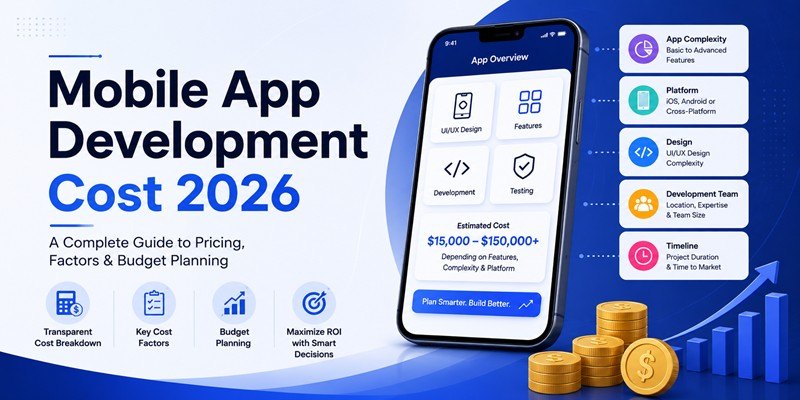
Mobile app development cost in 2026 ranges from $12,000 for a lean MVP to $300,000 or more for a complex enterprise build, with most production apps landing between $30,000 and $90,000. Clutch review data places agency rates at $25 to $49 per hour and the average custom software project at $132,480 over roughly 13 months. Region, feature depth and post launch support drive most of the spread.
Every founder and CTO we meet opens with the same question, and almost nobody gets a straight answer. Vendors quote ranges wide enough to fly a plane through, and budgets get approved on guesswork.
This guide gives you the numbers, the levers behind them, and the questions that stop a quote from doubling in month four.
Key Takeaways
- Clutch verified review data puts the average custom software project at $132,480 across roughly 13 months, while the most common review band sits at $10,000 to $49,000.
- App development agencies on Clutch typically bill $25 to $49 per hour, against $100 to $200 per hour for comparable United States teams.
- Business of Apps benchmarks simple apps at $5,000 to $50,000, mid complexity at $50,000 to $120,000 and complex builds at $120,000 to $300,000.
- Annual upkeep runs 15 to 25 percent of the original build price, so a $60,000 app carries $9,000 to $15,000 a year before you ship a single new feature.
- Significant integrations and data migration add roughly 20 to 30 percent, and scope movement adds another 10 to 25 percent on most projects.
What Actually Drives Mobile App Development Cost?
Engineering hours drive price, and everything else is a multiplier on those hours. Complexity, platform count, integration depth and compliance load decide how many hours you buy, while your partner’s location decides what each hour costs.
A five screen app with email login and a Firebase backend is a few hundred hours of work. Add real time tracking, role based permissions, offline sync and a payments gateway and you are past a thousand hours before design polish begins.
The hourly rate you pay is the second lever. The same feature set built at $30 an hour in Ahmedabad and $160 an hour in San Francisco produces the same app store listing and a five times difference on the invoice.
The third lever is the one most teams skip. A proper discovery phase costs money up front and saves far more later, because ambiguity in a specification is the single most reliable predictor of a budget overrun.
What Is the Mobile App Development Cost in India Right Now?
India delivers equivalent scope at 60 to 70 percent below United States and United Kingdom pricing. That gap is a salary and overhead story, not a quality story, and it is why so much global product engineering now runs from Pune, Bengaluru and Ahmedabad.
The table below maps typical app types to Indian rupee pricing and the global equivalent, so you can sanity check any proposal on your desk.
| App Type | Screens | Timeline | India (INR) | Global (USD) |
| MVP or simple app | 5 to 8 | 4 to 6 weeks | Rs 75,000 to Rs 2,50,000 | $12,000 to $30,000 |
| Business app | 10 to 20 | 8 to 12 weeks | Rs 2,50,000 to Rs 6,00,000 | $30,000 to $70,000 |
| eCommerce app | 15 to 25 | 10 to 16 weeks | Rs 6,00,000 to Rs 12,00,000 | $45,000 to $110,000 |
| On demand marketplace | 20 to 40 | 14 to 22 weeks | Rs 8,00,000 to Rs 18,00,000 | $70,000 to $180,000 |
| Enterprise or AI app | 30 plus | 18 to 28 weeks | Rs 10,00,000 and up | $100,000 to $300,000 plus |
Glassdoor placed the average Indian mobile developer salary near Rs 6 lakh a year in March 2026, with senior earners reaching Rs 14 lakh. That is the arithmetic behind the rate gap, and it is stable enough to plan against.
What Are the Current App Development Price Benchmarks?
Three published benchmarks agree on the shape of the market, which is unusual and useful. Use them as the ceiling and floor for any conversation with a vendor.
- Simple app: $5,000 to $50,000, typically 2 to 4 months of build time.
- Mid complexity app: $50,000 to $120,000, typically 4 to 6 months.
- Complex app: $120,000 to $300,000, typically 9 to 12 months.
- Average custom software project on Clutch: $132,480 across roughly 13 months.
Anyone asking how much does it cost to build an app 2026 should also price the alternative. A web app development cost for the same feature set often lands 20 to 35 percent lower, because you skip two store review cycles, two device matrices and two release pipelines.
That does not make web the right answer. It makes it the right first question, especially for internal tools, dashboards and B2B portals where nobody needs a push notification badge.
How Does Platform Choice Change Your Final Mobile App Development Cost?
Platform choice is the largest single lever available to you after scope. Cross platform frameworks cut 30 to 40 percent off a two platform native build for most business applications, and that saving compounds into every future release.
| Approach | Relative Cost | Timeline | Best Fit |
| Native iOS only, Swift | Baseline | 8 to 18 weeks | Premium consumer apps, deep Apple ecosystem |
| Native Android only, Kotlin | 0.85x baseline | 6 to 16 weeks | India first and emerging market products |
| Native iOS and Android | 1.8x to 2x | 16 to 28 weeks | High performance, hardware heavy enterprise apps |
| React Native | 0.6x to 0.7x | 4 to 16 weeks | Most business and data driven apps |
| Flutter | 0.6x to 0.7x | 5 to 18 weeks | Animation heavy and design led interfaces |
| Progressive web app | 0.4x to 0.6x | 3 to 10 weeks | Internal tools, portals, early validation |
Android holds well over 90 percent of India’s smartphone market, so an India first product rarely justifies two native codebases at launch. Ship cross platform, prove demand, then go native where performance genuinely pays for itself.
Where Does Every Dollar Go Inside a Build?
Development consumes 40 to 55 percent of the budget, and the remaining stages are not optional overhead. This app development cost breakdown reflects aggregated data from Clutch and multiple established development firms.
- Discovery and scoping: 10 to 15 percent, covering research, requirements and architecture.
- UI and UX design: 20 to 25 percent, covering wireframes, prototypes and a design system.
- Development: 40 to 55 percent, covering front end, backend and integrations.
- Testing and QA: 15 to 20 percent, covering device coverage, regression and security.
- Deployment and launch: 5 to 10 percent, covering store submission, monitoring and rollout.
Then comes the line that wrecks year two budgets. The industry accepted maintenance cost is 15 to 25 percent of the original build price every year, covering operating system updates, security patches, third party API changes and hosting.
Commercial structure matters just as much. On fixed price versus time and materials, fixed price protects you when scope is genuinely locked, while time and materials wins when discovery is still live and requirements will move.
Our recommendation is a hybrid. Run discovery on time and materials, then convert the delivery phase to fixed price milestones once the specification is signed.
Which Development Partner Fits Your Budget and Risk Profile?
The right partner is a function of budget, time zone tolerance and how much product thinking you need alongside code. The table compares the common options on published rate ranges and typical engagement style.
| Partner Type | Typical Blended Rate | Engagement Model | Best For |
| Technobrave Technologies | $25 to $45 per hour | Fixed price milestones, hybrid discovery | SMBs and startups wanting AI ready mobile and web builds |
| India based mid size agency | $25 to $49 per hour | Fixed price or dedicated team | Budget conscious builds with defined scope |
| Eastern Europe agency | $45 to $85 per hour | Time and materials | Complex backend and fintech grade engineering |
| US or UK boutique studio | $100 to $200 per hour | Time and materials | Funded consumer products needing local product strategy |
| Freelance marketplace team | $15 to $60 per hour | Hourly or milestone | Prototypes and short single feature projects |
| In house hire | $110,000 plus per developer, per year | Salaried | Long running products with continuous roadmap |
The offshore vs onshore decision is rarely about capability in 2026. It is about how much overlap your team needs in a working day and how mature your internal product management is.
Technobrave delivers mobile app development services, AI software development services and AI Agents for businesses under one delivery model, which removes the handoff tax between an app vendor and a separate AI vendor.
What Does an App Cost based on Industry?
Compliance and integration load, not screen count, explain why two apps with identical interfaces can differ by $60,000. Regulated sectors carry audit trails, data residency rules and penetration testing that consumer apps never touch.
| Industry | Typical App | India (INR) | Global (USD) | Main Cost Driver |
| eCommerce and retail | Shopping and payments | Rs 8,00,000 to Rs 15,00,000 | $50,000 to $120,000 | Catalogue, payments, logistics APIs |
| Healthcare | Appointments and records | Rs 3,00,000 to Rs 8,00,000 | $40,000 to $110,000 | HIPAA and DPDP compliance |
| Logistics | Driver and customer apps | Rs 4,00,000 to Rs 9,00,000 | $45,000 to $100,000 | Real time tracking, two sided build |
| EdTech | Courses and video | Rs 3,00,000 to Rs 7,00,000 | $35,000 to $85,000 | Video infrastructure, assessments |
| Fintech | Wallet or investing | Rs 6,00,000 to Rs 15,00,000 | $70,000 to $200,000 | KYC, RBI rules, security audits |
| Manufacturing | Field and inventory | Rs 3,00,000 to Rs 7,00,000 | $35,000 to $90,000 | ERP integration, offline sync |
Budget an extra 20 to 30 percent on top of any of these figures if the app must integrate with legacy systems or migrate historical data, which is the single most underestimated line in enterprise proposals.
Conclusion:
App development cost 2026 planning is not about finding the cheapest quote. It is about buying the fewest possible hours of the right engineering, then protecting that scope from drift.
Here is what to do this week. Write a one page product brief covering the problem, the first hundred users and the three features that serve them, and stop there.
Next, request two proposals against that brief, one cross platform and one native, and require both to itemise discovery, design, build, QA and year one maintenance separately. Any vendor that quotes a single number is hiding the risk, not removing it.
Then reserve 25 to 30 percent above the winning quote. That reserve is what separates a shipped product from a stalled one.
If AI features are on your roadmap, scope them in the first release rather than bolting them on later. The Rising of AI Products has made conversational, predictive and agentic features table stakes in most categories, and retrofitting them costs materially more than designing for them.
Technobrave builds mobile, web and AI products for SMBs, startups and enterprise teams across India and global markets. Share your brief and we will return an itemised estimate with the assumptions written down, not buried.