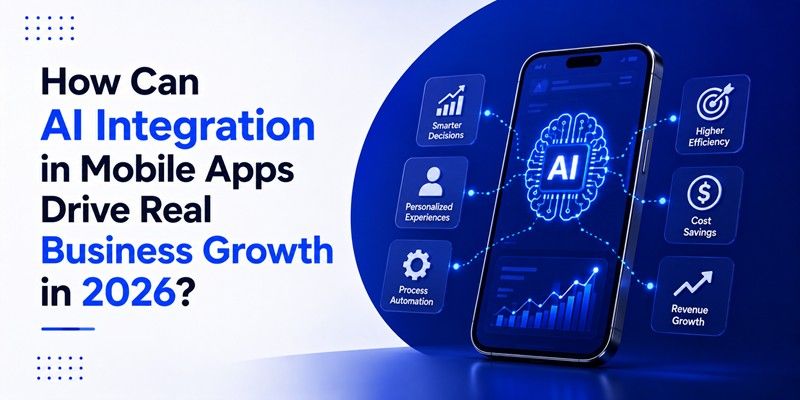
AI integration in mobile apps means embedding intelligence such as machine learning, NLP, and generative AI into app features to personalize experiences, automate tasks, and predict user needs. It matters now because the market is projected to grow from $21.23 billion in 2024 to $354.09 billion by 2034, and roughly 70% of mobile apps already run AI features in production. Businesses that delay risk losing users to smarter competitors.
Your users no longer compare your app to your competitor’s app. They compare it to the smartest app on their phone. That is the quiet shift reshaping product roadmaps for every CEO, CTO, and CIO we talk to.
This guide breaks down the trends, challenges, and best practices behind successful AI in mobile app development, with real data and a practical playbook you can act on this quarter.
Key Takeaways
- The AI in mobile apps market is projected to reach $354.09 billion by 2034, up from $21.23 billion in 2024, a 32.5% CAGR (Market.us).
- Generative AI mobile apps crossed 3.8 billion downloads and over $5 billion in in-app revenue in 2025 (Sensor Tower).
- The on-device AI market is expected to jump from $10.7 billion in 2025 to $75.5 billion by 2033, with 68% of enterprises planning edge AI deployments.
What is AI Integration in Mobile Apps and Why Does It Matter Now?
AI integration in mobile apps is the process of embedding intelligent capabilities, from recommendation engines to voice assistants, directly into an app’s core workflows rather than bolting them on as gimmicks.
In practice, it combines machine learning models, Natural Language Processing (NLP), computer vision, and Large Language Models (LLMs) with your app’s data to make every session feel personal and predictive.
Why now? Artificial intelligence in mobile apps has moved from differentiator to baseline. Around 44% of apps already use AI personalization to tailor content, and users notice its absence faster than its presence. For leaders, the question is no longer whether to invest in AI app development, but where AI creates measurable value: retention, conversion, support costs, or operational efficiency.
Which AI Trends Are Shaping Mobile Apps in 2026?
Five trends dominate AI mobile app development this year, and each one changes what users expect as standard.
1. On-Device Intelligence Goes Mainstream
Processing is moving from the cloud to the phone. On-device AI removes latency, works offline, and keeps sensitive data local, which is critical for finance and healthcare apps.
With the on-device AI market projected to grow sevenfold by 2033, chips like Apple’s Neural Engine and Qualcomm’s AI cores make this practical for everyday AI-powered mobile apps.
2. Conversational Interfaces Replace Menus
Generative AI assistants inside apps now handle search, support, and onboarding through natural conversation. Users type or speak what they want instead of hunting through screens.
The proof is in the numbers: generative AI mobile apps crossed 3.8 billion downloads in 2025, and every one of the top ten was an AI assistant.
3. Hyper-Personalization at Scale
Recommendation models now adapt in real time to context: time of day, location, and in-session behavior. This is the most proven revenue lever among all AI features in mobile apps.
4. Autonomous AI Agents
Agents go beyond chat. They complete multi-step tasks such as booking, reordering, or filing a claim, turning apps into assistants that act on the user’s behalf.
5. Predictive and Preventive Experiences
Apps increasingly anticipate needs: churn prediction, fraud detection, and health alerts. Prediction shifts apps from reactive tools to proactive advisors.
How Did Technobrave Cut Support Costs with AI? A Mini Case Study
A short answer: by putting a multilingual conversational agent where users already were.
A Technobrave retail client was drowning in repetitive WhatsApp and in-app support queries. Our team, drawing on our AI software development services, deployed an LLM-powered assistant trained on the client’s catalog and policies.
Within 90 days, the assistant resolved roughly 62% of queries without human handoff, first-response time dropped from hours to seconds, and support workload fell by more than a third.
The lesson for any leader evaluating integrating AI into mobile apps: start where the pain is measurable, then expand.
The Hidden Challenges Nobody Puts in the Pitch Deck
Most AI initiatives stall for predictable, avoidable reasons. Knowing them upfront is half the battle.
Vendors sell the demo. Your team lives with the production reality. Here are the six challenges we see derail projects most often, and each one has a proven mitigation.
- Data quality and availability. Models are only as good as the data behind them. Fragmented, biased, or thin datasets produce unreliable features.
- Privacy and compliance. GDPR, India’s DPDP Act, and app store policies demand transparent data handling, consent flows, and explainability.
- Cost and infrastructure. Cloud inference bills scale with usage. Without cost modeling, a popular AI feature can quietly erode margins.
- Talent gaps. Mobile engineers and data scientists speak different languages. Few teams have both in-house.
- Model drift and maintenance. AI is not ship-and-forget. Accuracy degrades as user behavior changes, so monitoring and retraining are ongoing costs.
- User trust. Hallucinated answers or creepy personalization damage brand credibility faster than any bug.
Best Practices for AI Integration in Mobile Apps
Successful teams treat AI integration for mobile apps as a product discipline, not a science experiment. These eight practices separate winners from stalled pilots.
- Start with a business problem, not a model. Define the metric AI must move: retention, conversion, cost per ticket, or session length.
- Audit your data first. Map what you collect, its quality, and its consent status before writing a line of model code.
- Pick the right build path. Use pretrained APIs for speed, fine-tuned models for differentiation, and custom models only when data is a true moat.
- Design privacy in from day one. Prefer on-device processing for sensitive data and make every AI decision explainable to users.
- Ship one feature, measure, expand. A single well-instrumented AI feature beats five half-tested ones.
- Plan for inference costs. Model per-user costs at 10x your projected scale, and cache or batch where possible.
- Build an MLOps loop. Monitor accuracy, latency, and drift in production, with scheduled retraining.
- Keep humans in the loop. Route low-confidence outputs to people, especially in support, finance, and health contexts.
If your roadmap spans both native apps and the browser, unified AI Mobile Web App Services ensure models, data pipelines, and experiences stay consistent across every touchpoint.
How Much Does It Cost to Add AI to a Mobile App?
Expect $10,000 to $40,000 for API-based features, $50,000 to $150,000 for fine-tuned solutions, and $150,000+ for fully custom models. The honest answer depends on three drivers.
- Approach. Calling a pretrained API costs a fraction of training custom models on proprietary data.
- Data readiness. Cleaning and labeling messy data can consume 40% or more of an AI budget.
- Ongoing inference. Recurring compute costs often exceed build costs within the first year at scale.
A phased approach controls risk: prove value with APIs, then invest in custom capability where results justify it.
How Do You Measure ROI on AI Investments?
Measure ROI by tying every AI feature to one primary metric before launch, then comparing against a holdout group.
- Engagement: session length, feature adoption, daily active usage lift.
- Revenue: conversion rate, average order value, upsell acceptance.
- Efficiency: tickets deflected, response times, cost per resolution.
- Retention: churn reduction among users who engage with AI features versus those who do not.
The industry’s momentum backs the math: generative AI mobile apps alone generated $3 billion in revenue in 2025, a 273% year-over-year increase.
Which Industries Gain the Most from Smarter Apps?
The biggest gains show up wherever apps handle high volumes of decisions, conversations, or transactions.
- Retail and eCommerce: visual search, dynamic pricing, and recommendations that lift order values.
- Healthcare: symptom triage, medication reminders, and diagnostic support with strict privacy controls.
- Fintech and BFSI: fraud detection, credit scoring, and conversational banking. NLP alone accounted for 31.5% of AI app revenue in 2024.
- Logistics: route optimization, demand forecasting, and predictive maintenance.
- EdTech: adaptive learning paths that adjust difficulty to each learner in real time.
Whatever the sector, the pattern repeats. AI wins where it removes friction from a task users already perform hundreds of times, not where it adds novelty for its own sake.
Which Companies Lead AI Integration in Mobile Apps?
The right partner depends on your scale, budget, and how custom your AI needs to be. Here is how leading firms compare.
| Company | Core Focus | Best For | Standout Strength |
| Technobrave Technologies | End-to-end AI integration in mobile apps, web apps, and conversational agents | Enterprises, SMBs, and startups wanting one accountable partner from strategy to support | Business-first roadmaps, transparent pricing, and post-launch model tuning |
| Appinventiv | Large-scale enterprise app engineering | Fortune 500 digital transformation programs | Deep enterprise delivery bench |
| Hyperlink InfoSystem | High-volume app development | Budget-conscious builds with standard AI add-ons | Speed and cost efficiency |
| LeewayHertz | Custom AI and LLM solutions | Complex, model-heavy AI products | Strong data science expertise |
| OpenXcell | Product development and staffing | Teams that want dedicated AI developers | Flexible engagement models |
For most enterprises, SMBs, and startups, the deciding factor is accountability: one team that owns strategy, engineering, and the post-launch model performance that actually determines ROI.
Conclusion
AI integration in mobile apps is now the dividing line between apps that grow and apps that get deleted. The market data, the download numbers, and user expectations all point the same direction.
The winners will not be the companies with the biggest models. They will be the ones who pick one measurable problem, ship one well-designed AI feature, measure honestly, and compound from there.
Your action list is simple: audit your data this month, define one AI pilot with a hard metric, model your inference costs, and choose a partner who stays accountable after launch. Start small, measure hard, and scale what works.