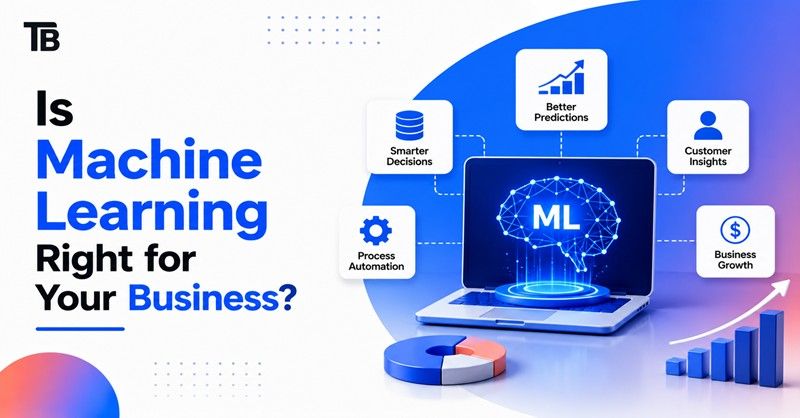
Machine learning is right for your business only if you have a clearly defined problem, clean and accessible data, and executive sponsorship to operationalize results. Most companies aren’t there yet RAND found over 80% of AI projects fail, twice the rate of non-AI IT projects, almost always because of weak data foundations and unclear goals, not weak algorithms. A 30-minute readiness check saves six-figure mistakes.
You’ve sat through the demo. The model predicted churn, flagged fraud, or wrote copy in seconds, and someone in the room said, “We need this.” Then reality arrives: whose data, which problem, what budget, and who owns it after launch? That gap between the demo and the deployment is where most machine learning investments quietly die. This guide is the honest readiness check leaders ask for before they commit so you can tell the difference between an ML project that ships value and one that becomes next year’s cautionary slide.
Key Takeaways:
- Over 80% of AI projects fail to reach meaningful production, roughly twice the failure rate of non-AI IT projects (RAND Corporation, 2024).
- 42% of companies abandoned most of their AI initiatives in 2025, up sharply from just 17% the year before (S&P Global Market Intelligence, 2025).
- The leading obstacles are data quality and readiness (43%) and lack of technical maturity (43%) — not model sophistication (Informatica CDO Insights, 2025).
Why Do So Many Machine Learning Projects Fail Before They Launch?
Most ML projects fail for organizational reasons, not technical ones. The model is rarely the problem — the data feeding it and the clarity around it are. According to RAND Corporation, over 80% of AI projects fail to reach meaningful production deployment, roughly twice the failure rate of traditional IT projects. When teams run the post-mortem, they expect to find a tuning issue. Instead they find fragmented data spread across disconnected systems, terms like “customer” and “revenue” defined differently in each department, and a clean demo dataset that bears no resemblance to messy production reality.
The pattern repeats because organizations scale adoption faster than they fix foundations. Informatica’s CDO Insights 2025 survey identifies the top obstacles to AI success: data quality and readiness (43%), lack of technical maturity (43%), and shortage of skills (35%). Notice what’s missing from that list: algorithm quality. Before you ask whether machine learning is right for you, the more useful question is whether your organization is ready for it and readiness is something you can measure.
What Does Machine Learning Readiness Actually Mean?
Machine learning readiness is the measurable degree to which your business problem, data, infrastructure, and leadership are prepared to support an ML model in production not just in a demo. It has four dimensions, and weakness in any one of them is usually enough to sink the whole effort.
Problem clarity comes first. Successful programs begin with quantified business pain “support costs us $2M a year and is growing 20% annually” not “we should use AI.” Data quality comes second, and it’s the single biggest predictor of outcome. Infrastructure and skills determine whether a working model can actually be deployed and maintained. Leadership and ownership decide whether anyone keeps the model alive after the launch buzz fades.
In our own client work at Technobrave, we ran a readiness assessment for a mid-market logistics SMB convinced it needed a demand-forecasting model. The model was never the issue their order data lived in three systems with conflicting timestamps. We spent the first four weeks on data unification before a single line of model code. The forecasting tool that shipped hit 89% accuracy and cut excess inventory holding costs by roughly 18% in two quarters. Had we started with the model, it would have joined the 80%.
How To Run a Machine Learning Readiness Assessment?
An ML readiness assessment scores your organization across the four dimensions above and tells you whether to build now, prepare first, or hold. Run it honestly — inflated scores produce the exact failures the assessment exists to prevent. Score each area from 1 (not started) to 5 (production-grade).
- Problem & ROI: Can you state the business problem and the cost of not solving it in dollars? Can you define what success looks like as a metric before you build?
- Data: Is relevant data collected, accessible, reasonably clean, and large enough to learn from? Are key terms defined consistently across teams?
- Infrastructure & skills: Do you have pipelines, compute, and people (in-house or a partner) to deploy and monitor a model — not just train one?
- Leadership & ownership: Is there an executive sponsor and a named owner accountable for the model after launch?
If you score 4+ across all four, you’re genuinely ready for ML. Score 2–3 anywhere and you have a preparation roadmap — most often a data-quality and governance project before any modeling begins. The honesty of this step is what separates the 5% who scale from the 95% who stall. Bringing in an experienced ML development partner at the assessment stage, rather than after a failed pilot, is one of the highest-leverage decisions a leader can make.
When Is Your Business Genuinely Ready for ML and When Is It Not?
You’re ready when a specific, costly, repetitive decision in your business is made often enough that a model can learn from the history of those decisions. You’re not ready when the problem is vague, the data is thin or scattered, or no one will own the result. The distinction matters because readiness, not ambition, predicts success.
Strong fits share a profile: high-volume decisions (fraud scoring, churn prediction, dynamic pricing), abundant historical data, and a measurable outcome. Poor fits are usually one-off strategic questions, problems with little or no training data, or situations where a simple rules-based automation would do the job at a fraction of the cost. Part of real AI readiness is being willing to conclude that you don’t need machine learning yet — and that conclusion can save a six-figure budget.
This is also where digital transformation maturity shows. Organizations that already treat data as a governed asset, with clean pipelines and clear definitions, clear the readiness bar far more easily. Those still wrestling with spreadsheets and siloed systems usually need a data and business automation foundation first. That foundation work isn’t a detour from ML — it’s the prerequisite for predictive analytics that anyone will trust.
What Are the Real Benefits of Machine Learning When You’re Actually Ready?
When readiness is real, the returns are substantial and measurable which is exactly why the failure statistics are so frustrating. The benefit isn’t “AI”; it’s a specific business outcome delivered repeatedly at scale.
1. Decisions at a scale humans can’t reach. A trained model can score millions of transactions, leads, or support tickets in the time a person handles a handful. The win isn’t replacing judgment it’s applying consistent judgment to volumes that were previously impossible to review, from fraud scoring on every transaction to risk-rating every loan application.
2. Cost reduction through automated judgment work. Machine learning excels at the repetitive, rules-fuzzy decisions that quietly consume staff hours triaging tickets, routing cases, flagging exceptions. Automating that judgment layer frees skilled people for the complex, high-value work only they can do, turning headcount pressure into capacity rather than cost.
3. Revenue lift from personalization and dynamic pricing. Predictive models match the right offer, product, or price to the right customer at the right moment. Recommendation engines, propensity-to-buy scoring, and demand-based pricing each move revenue measurably and they improve as they learn, so the lift grows rather than plateaus.
4. Earlier risk and anomaly detection. Models surface patterns humans miss fraud, equipment failure, churn signals, security anomalies — before they become expensive. Catching a defect or a fraudulent transaction early is worth far more than detecting it after the loss, which is why detection is one of the fastest-paying ML use cases.
5. Faster, evidence-based forecasting. Predictive analytics turns historical data into reliable forward signals for demand, inventory, staffing, and cash flow. Better forecasts shrink the buffers businesses hold “just in case,” reducing waste and tying up less working capital a direct margin improvement, not a soft benefit.
Build In-House or Partner for Machine Learning Development Services?
The right delivery model depends on your readiness scores, not your ambition. Use this comparison to decide whether to staff internally, engage machine learning development services, or run a hybrid.
| Factor | Build fully in-house | Partner / outsourced ML | Hybrid (partner + internal) |
| Time to first model | Slow (hire, ramp, build) | Fast (existing team & tooling) | Fast, with knowledge transfer |
| Upfront cost | High (salaries, infra) | Predictable, project-scoped | Moderate |
| Best when | ML is core, ongoing IP | You need speed & proven delivery | You want capability + internal upskilling |
| Talent risk | High — ML hiring is scarce, costly | Low — partner owns staffing | Shared |
| Maintenance & MLOps | Your team owns it long-term | Partner manages or hands off | Shared, transitioning to internal |
| Common failure mode | Slow ramp, key-person risk | Vendor lock-in if no transfer | Needs clear ownership lines |
For most SMBs and startups, a partner-led or hybrid model wins on speed and risk. Enterprises with mature data teams often justify in-house builds for core IP while using AI model development services for surge capacity. The decisive detail in any partnership is capability transfer engaging ML development services that leave your team stronger, not dependent.
Are You Ready to Take the Next Step Toward Machine Learning?
Run the four-dimension assessment this week, before any vendor pitch or budget request. Score Problem & ROI, Data, Infrastructure & Skills, and Leadership & Ownership from 1 to 5, and let the lowest score set your next move.
If your lowest score is in data, your next project is data quality and governance not modeling. If it’s in problem clarity, write a one-page brief that states the business pain in dollars and defines success as a number. If it’s in leadership, secure a named executive sponsor before spending a rupee or dollar on tooling. If you score 4+ everywhere, you’re in the minority that’s genuinely ready move to a tightly scoped pilot with pre-defined success metrics and a monitoring plan from day one. Wherever you land, an honest score beats an optimistic guess every time.
Conclusion
Machine learning is right for your business when a costly, repeatable decision meets clean data, ready infrastructure, and committed ownership and it’s wrong, or premature, when any of those four is missing. The statistics are blunt: 42% of companies abandoned most of their AI initiatives in 2025, up sharply from 17% a year earlier, and the failures trace overwhelmingly to readiness gaps, not technology. The good news is that readiness is measurable and fixable.
So do the unglamorous work first. Score your readiness honestly. Fix the weakest dimension. Define success as a number before you build. Whether you proceed in-house, with a partner, or in a hybrid model, the organizations that win with ML are the ones disciplined enough to check before they commit. If you’d like a structured readiness assessment tailored to your data and goals, Technobrave’s team helps enterprises, SMBs, and startups go from “is ML right for us?” to a clear, costed yes-or-not-yet.