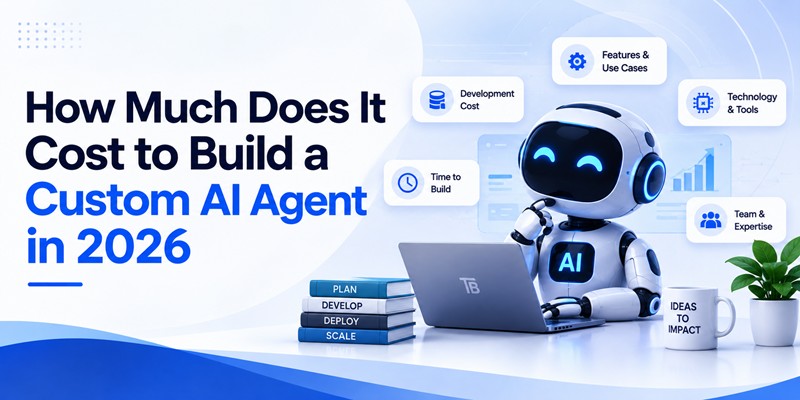
Custom AI agent development cost in 2026 runs from $8,000 to $200,000 plus. A single-task agent costs $8,000 to $25,000. A connected workflow agent costs $30,000 to $85,000. An enterprise-grade multi-agent platform costs $90,000 to $200,000 plus. Budget another 18 to 25 percent of the build price every year for model usage, monitoring and tuning.
Most buyers never get a straight answer to this question. Search for AI agent development cost 2026 and the quotes span $500 to half a million dollars, while the real number tends to arrive three months into delivery.
There is a reason for that. An agent is not priced off a menu. It is an engineering decision about how much judgment you are willing to hand to software.
This guide gives you the real ranges, the drivers behind them, the running bills most budgets miss, and a payback formula you can run before you sign anything.
Key Takeaways
- Gartner expects 40 percent of enterprise applications to include task-specific AI agents by the end of 2026, up from less than 5 percent in 2025.
- Gartner also expects more than 40 percent of agentic AI projects to be cancelled by the end of 2027, driven by escalating costs, unclear business value and weak risk controls.
- IDC and Microsoft measure an average return of roughly $3.70 for every $1 invested in generative AI, so the upside is real but unevenly captured.
- Running costs add 18 to 25 percent of the original build price every year, and most first-time budgets leave them out completely.
- Delivery location swings the same scope by 60 to 70 percent, from $18 per hour in South Asia to $130 per hour in the United States.
What Are You Really Paying For When You Commission an AI Agent?
An AI agent for business is four engineering layers, not a chatbot with a new label. You are paying for reasoning, integration, guardrails and evaluation, and each layer carries its own price tag.
Reasoning is the part that decides what to do next. Integration is the plumbing that lets the agent read your CRM, write to your ERP and call your internal APIs.
Guardrails are the rules that stop the agent from issuing a refund it should not issue. Evaluation is the test harness that proves it behaves the same way on Tuesday as it did on Monday.
A chatbot needs one of those layers. Agentic AI development needs all four, which is why the cost to build an AI agent sits well above a typical conversational AI agent development budget.
What Is the Custom AI Agent Development Cost by Complexity Tier?
Three tiers cover almost every build we see. The tier is set by how many systems the agent touches and how much it is trusted to decide alone.
| Tier | What it does | Build cost | Timeline |
| Single-task agent | One job done well: lead qualification, document search, ticket triage, appointment booking | $8,000 to $25,000 | 3 to 7 weeks |
| Connected workflow agent | Reads and writes across 2 to 5 systems, follows business rules, completes multi-step tasks with human approval on risky actions | $30,000 to $85,000 | 2 to 4 months |
| Enterprise multi-agent system | Specialised agents coordinating together, custom memory, deep integration, audit trails and role-based controls | $90,000 to $200,000 plus | 4 to 9 months |
Anything quoted under $5,000 is almost certainly a templated bot with a model attached. That is a fine purchase, but it is not the same product, and custom AI agent pricing should never be compared against it directly.
Generative AI agent development is priced on behaviour and integration depth, not on how much content a bot can recite back to a customer.
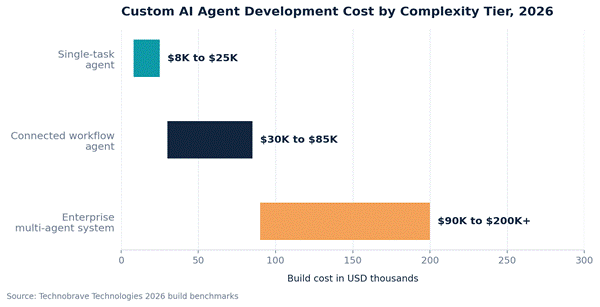
Custom AI agent development cost by complexity tier in 2026.
What Does a Real Agent Budget Look Like Once Delivery Starts?
Across our 2026 agent deployments, integration work consumed more budget than model work by a factor of roughly four to one. Teams consistently underestimate this and overestimate the cost of the model itself.
On a recent multilingual support agent for an India-based retail group, the split landed at 62 percent build and integration, 13 percent model and API usage, and 10 percent data preparation. The remaining 15 percent went to monitoring, evaluation and tuning.
The agent handled WhatsApp and web chat in four languages and resolved order status, returns and refund eligibility end to end. First-contact resolution moved from 41 percent to 74 percent within eleven weeks of go-live.
The lesson for anyone sizing AI automation development cost is simple. The model is the cheapest part of the system, and the messy middle is where the money goes.
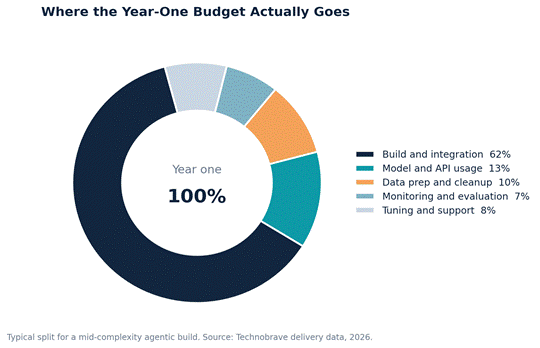
Typical year-one budget split for a mid-complexity agentic build.
What Actually Drives the Cost Up or Down
Six variables explain most of the spread between a $20,000 build and a $150,000 one. Scope each of them before you request a quote and your numbers will stop moving.
Number and quality of integrations
A clean, documented REST API adds a few thousand dollars. An undocumented legacy system with no sandbox can add thirty thousand on its own.
How much autonomy the agent holds
An agent that drafts for human approval is far cheaper than one trusted to send, refund or commit. Autonomy multiplies testing, edge cases and guardrail work.
Memory and context depth
Agents that remember past conversations and learn your rules over time need a retrieval and memory architecture. This is usually the single biggest jump between tiers.
Data readiness
Structured data in one warehouse keeps the build fast. Knowledge scattered across PDFs, spreadsheets and inboxes adds a cleanup phase before a single agent behaviour is written.
Regulation and audit requirements
Finance, healthcare and legal teams need audit trails, consent handling and human review gates from day one. In India, DPDP alignment is now a standard line item rather than an optional extra.
Channel and modality
Text is the cheapest surface. Voice AI agent cost typically runs 30 to 50 percent higher because of speech recognition, latency budgets, barge-in handling and telephony integration.
What Are the Key Benefits of Owning the Agent You Build?
Ownership is the benefit that compounds. A rented platform charges you more as you succeed, while a custom build converts that growth into margin.
- Predictable unit economics. Your cost per resolution falls as volume rises instead of climbing with seat or conversation pricing.
- Workflow fit. The agent follows your refund policy and your escalation rules, not a vendor’s average-case template.
- Data and IP control. Your business logic, prompts and evaluation sets stay inside your environment.
- Faster compound gains. Each new AI workflow automation reuses the integration layer you already paid for, so build two and three cost far less than build one.
- Model independence. When a cheaper or stronger model ships, you swap it. Platform buyers wait for the roadmap.
This is the same logic driving the rising of AI products inside mid-market companies. Teams that own the layer underneath ship faster than teams renting it.
Which Ongoing Costs Do Most Budgets Forget?
Run cost is the line item that kills projects after launch. Plan for 18 to 25 percent of the build price every year, then treat anything below that as a pleasant surprise.
| Ongoing item | What it covers | Typical annual range |
| Model and API usage | Token consumption across inference, retrieval and tool calls | $2,400 to $36,000 |
| Hosting and vector storage | Compute, embeddings storage, queues and logs | $1,800 to $18,000 |
| Monitoring and evaluation | Trace review, regression tests, hallucination and drift checks | $3,000 to $24,000 |
| Tuning and prompt maintenance | Policy changes, new products, new edge cases | $4,000 to $30,000 |
| Support and incident response | On-call coverage, fixes, model version migrations | $3,000 to $28,000 |
Volume is the main swing factor. An agent handling 2,000 conversations a month and one handling 200,000 sit at opposite ends of every row in that table.
How Much Does Delivery Location Change What You Pay?
Location changes the same scope by 60 to 70 percent. A build quoted at $120,000 in the United States frequently lands between $40,000 and $55,000 with a senior offshore team at equal seniority.
The trap is buying on rate alone. A $15 per hour team that needs a rewrite in month seven is more expensive than a $45 per hour team that ships once.
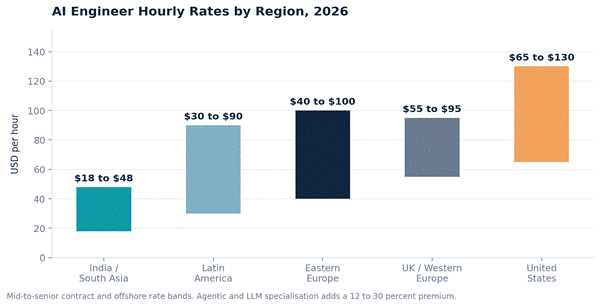
AI engineer hourly rate bands by region in 2026.
Judge vendors on production deployments, evaluation practice and integration depth. Those three signals predict total spend better than any hourly number on a rate card.
AI Agents vs. Chatbots: A Cost Comparison
A chatbot answers. An agent completes. That single difference explains most of the price gap between the two.
| Factor | Traditional chatbot | Custom AI agent |
| Core job | Answers scripted or FAQ-style questions | Completes multi-step tasks across systems |
| Build cost | $2,000 to $12,000 | $8,000 to $200,000 plus |
| Decision making | Follows a fixed script or decision tree | Reasons, plans and adapts within set policy |
| System access | Minimal, often read-only | Read and write across CRM, ERP, ticketing and APIs |
| Annual run cost | $600 to $6,000 | 18 to 25 percent of build cost |
| Measured by | Deflection rate | Resolution rate, cost per task, revenue recovered |
| Best for | High-volume repetitive questions | Work that currently needs a person to think and act |
If you only need the same twenty answers repeated, buy the chatbot. The moment a human has to judge, chain steps or touch two systems, you are in agent territory and the price reflects that.
How Do You Calculate Payback Before You Approve the Budget?
Use one formula: annual hours removed multiplied by fully loaded hourly cost, plus revenue recovered, divided by year-one total cost. Anything above 1.0 pays back inside twelve months.
Worked example. A support agent removes 9,000 agent-handled contacts a year at 6 minutes each, which is 900 hours. At a loaded $22 per hour that is $19,800 saved.
Add $46,000 in recovered revenue from faster response on inbound quotes. Against a $52,000 build and $11,000 first-year run cost, payback lands at roughly 1.04, or just under twelve months.
Are You Ready to Build a Custom AI Agent?
You are ready when five conditions are true. Miss more than two and you should fix them before you commission anything.
- A named workflow with a measured baseline in hours, cost or revenue.
- Access to the systems the agent must touch, including credentials and a test environment.
- Your policies written down somewhere the agent can be taught from, not held in a senior colleague’s head.
- An owner on your side who can approve behaviour decisions within days, not weeks.
- Budget for year one, not just the build. If the run cost is not funded, the agent degrades quietly and gets blamed.
Teams evaluating AI agents for businesses often pass four of these and fail on the fifth. Funding only the build is the most common reason a good agent gets switched off in month nine.
Conclusion
Custom AI agent development cost is a range because autonomy is a range. Decide how much judgment you are handing over and the number stops being mysterious.
Here is what to do this week.
- Pick the single workflow that costs you the most hours and baseline it in numbers.
- Map which systems the agent must read from and write to, then confirm each one has a usable API.
- Decide your autonomy line: what the agent may do alone, and what always needs a human.
- Price year one, not the build. Add 18 to 25 percent to whatever quote you receive.
- Ask every vendor for a production reference in your industry and their evaluation approach. Weak answers here predict overruns.
Technobrave Technologies builds enterprise AI agent development programmes the same way, starting from your workflow and your numbers rather than a template. Explore our AI software development services to scope your build, or talk to our team about a fixed-scope discovery before you commit to a full budget.