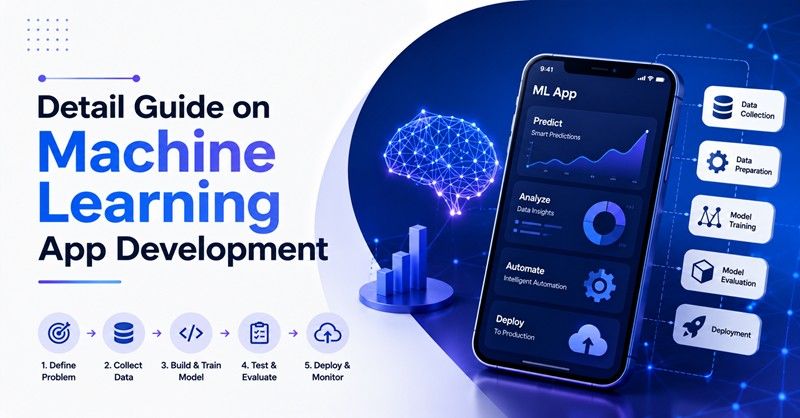
Machine learning app development is the process of building software that learns from data to predict outcomes, personalize experiences, and automate decisions without being explicitly reprogrammed. A production-ready ML app typically takes 3–12 months and costs $40,000–$250,000+, depending on data readiness, model complexity, and integrations. Success depends less on the algorithm and more on clean data, MLOps, and workflow redesign.
You’ve seen it in action: your banking app flags a suspicious charge seconds after it happens, and your favorite store seems to know what you want before you do. That “mind-reading” is machine learning quietly working in the background — and it’s now table stakes, not a differentiator. The hard part isn’t picking a model. It’s turning messy, real-world data into a reliable app that ships, scales, and earns its keep.
Key Takeaways:
- 88% of organizations now use AI in at least one business function (up from 78% a year earlier), yet only ~7% have scaled it enterprise-wide the gap is execution, not access. (McKinsey, State of AI 2025)
- The global machine learning market was valued at $55.80B in 2024 and is projected to reach $282.13B by 2030 at a 30.4% CAGR. (Grand View Research)
- Most ML apps fail not on the model but on data quality and deployment which is why MLOps and workflow redesign separate high performers from the rest.
What Exactly Is Machine Learning App Development?
Machine learning app development is the practice of building applications that use models and algorithms to learn patterns from data and improve their outputs over time instead of following fixed, hand-coded rules. Where a traditional app does exactly what a developer told it to, an ML app adjusts its behavior as it ingests new information.
Under the hood, the work spans four connected activities: collecting and preparing data, training a model, deploying it into a live product, and continuously optimizing it. The “intelligence” comes from statistical relationships the model discovers not from a human writing every decision path.
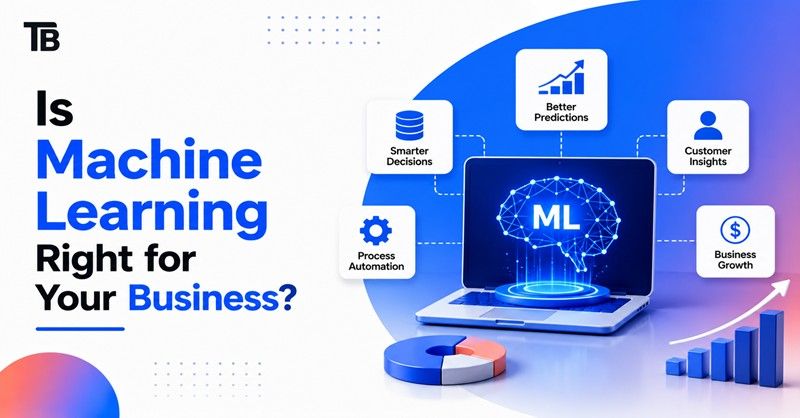
This is why industries with high data volume and high decision frequency adopt it fastest: finance (fraud detection), healthcare (diagnostic support), retail (recommendations and demand forecasting), and manufacturing (predictive maintenance). If your business generates data and makes repetitive decisions, machine learning application development can convert that data into speed, accuracy, and margin. The payoff scales with how deeply you integrate it – not how flashy the model is.
How Do Machine Learning Apps Actually Work?
An ML app works by learning from historical data during a training phase, then applying that learned model to new, unseen inputs to make predictions in real time. The lifecycle follows a repeatable pipeline that keeps accuracy high as conditions change.
Stage 1: Data Collection and Preparation
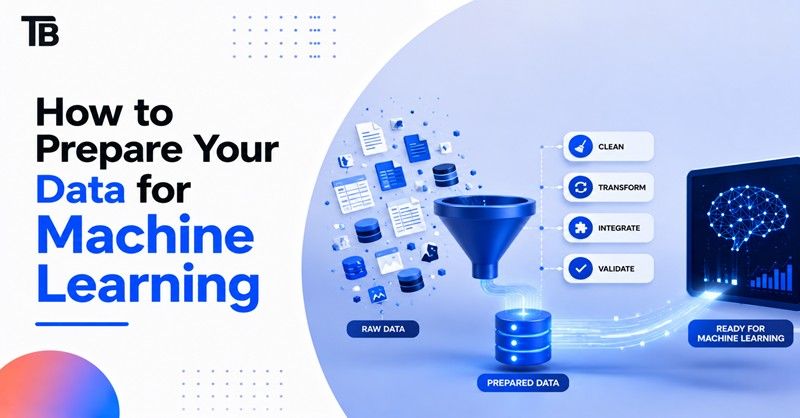
This is the foundation, and it’s where teams spend the majority of their effort. Raw data gets pulled from wherever it lives transaction logs, IoT sensors, CRM records, third-party APIs, images, or clickstreams and almost none of it arrives ready to use. ML data preparation means cleaning out duplicates and errors, handling missing values, normalizing formats so a “date” in one system matches a “date” in another, and labeling examples so the model knows what “fraud” or “churn” looks like. This stage also includes feature engineering: transforming raw fields into signals the model can actually learn from (e.g., turning a raw timestamp into “hour of day” and “weekend vs. weekday”).
Stage 2: Model Training
With clean, labeled data in hand, the data is split into training, validation, and test sets, then fed into an algorithm chosen to fit the problem. Simpler, interpretable models like decision trees, logistic regression, or support vector machines work well for structured, tabular data; neural networks and deep learning come into play for unstructured inputs like images, audio, or natural language. During training, the model iteratively adjusts its internal parameters to minimize error, essentially learning the statistical relationships between inputs and the correct outputs. Engineers apply cross-validation to confirm the model generalizes rather than memorizes, and hyperparameter tuning to squeeze out accuracy.
Stage 3: Deployment
A model sitting in a notebook creates zero business value. Deployment is the step that moves the trained model into the live application so real users and real data can interact with it. This happens in one of two ways: server-side, where the model runs in the cloud and the app calls it through an API (best for large models and centralized updates), or on-device inference, where a lightweight model runs directly on a phone or edge device (best for speed, privacy, and offline use). Frameworks like TensorFlow, PyTorch, and cloud ML platforms handle the scaling, containerization, and versioning. Deployment is also where MLOps earns its keep CI/CD pipelines, model registries, and rollback plans turn a fragile one-off launch into a repeatable, safe release process.
Stage 4: Inference and Prediction
This is where the app delivers its core value: taking a brand-new, never-before-seen input and producing a classification or prediction. A user makes a purchase, and the model scores it for fraud risk in milliseconds; a shopper browses, and the model returns tailored recommendations before the page finishes loading. The defining engineering challenge here is low latency — outcomes have to be fast enough to feel instant without sacrificing accuracy. That means optimizing the model (through techniques like quantization or distillation), right-sizing the infrastructure, and often caching frequent predictions. Reliable, real-time inference is what separates an ML feature users love from one they find sluggish and abandon.
Stage 5: Continuous Improvement
Deployment is the start of the model’s working life, not the finish line. The world changes customer behavior shifts, fraud patterns evolve, new products launch and a static model silently gets less accurate over time, a phenomenon called model drift. Continuous improvement counters it: monitoring dashboards track live accuracy, precision, and recall catching drift early; feedback loops feed real outcomes back into the dataset; models are periodically retrained on fresh data; and A/B testing validates that a new model version genuinely beats the old one before it goes live. This closed loop is what keeps an ML app relevant for years instead of quietly decaying after launch and it’s the stage most under-resourced teams neglect until performance has already slipped.
Why Should Enterprises and Startups Invest Now?
The strongest reason to invest is that adoption has become the baseline the competitive edge now belongs to companies that scale ML into workflows, not those that merely pilot it. McKinsey’s 2025 research found that while 88% of organizations use AI somewhere, only about one-third have begun scaling it, and just 7% have fully deployed it enterprise-wide.
That gap is your opportunity. Concrete drivers for investing today:
- Personalization at scale — tailored recommendations and content that lift engagement and retention.
- Predictive analytics — forecasting demand, churn, credit risk, and equipment failure before they cost you.
- Automation — removing repetitive manual work so your team focuses on higher-value tasks.
- Real-time security — spotting fraud and anomalies as they happen.
- Compounding advantage — models improve with more data, so early movers widen the lead over time.
For CTOs and CEOs, the question has shifted from “Should we?” to “How fast can we operationalize this responsibly?”
What Are the Must-Have Features of a Successful ML App?
A successful ML app pairs the right learning approach with production-grade engineering the feature set should map directly to the business problem, not to a buzzword checklist. Choosing capabilities, you don’t need inflates cost and timeline without adding value.
The features that matter most in real deployments:
- Recommendation engine — content-based, collaborative, or hybrid filtering to drive engagement and revenue (the backbone of Netflix, Amazon, and Spotify-style experiences).
- Predictive analytics — turning historical and live data into forward-looking decisions.
- Image and pattern recognition — powering visual search, quality inspection, and diagnostic support.
- Anomaly detection — flagging fraud, defects, or outliers in real time.
- Model evaluation and monitoring — tracking precision, recall, F1-score, and drift so accuracy doesn’t silently degrade.
- Continuous retraining — automated pipelines that keep the model current as data shifts.
The differentiator isn’t which algorithm you pick; it’s whether monitoring and retraining are built in from day one. Skipping them is the most common reason promising pilots quietly rot in production.
What Does the Machine Learning App Development Process Look Like?
The process runs through eight disciplined stages, and skipping the early ones — requirements and data readiness — is where most projects quietly fail. A structured approach keeps scope, cost, and accuracy under control.
- Define the business problem — nail the objective, users, and success metric before writing code. A good ML development partner starts here, not with tooling.
- Data gathering and cleaning — collect from APIs, IoT, and internal systems, then resolve missing values, errors, and inconsistencies.
- Choose algorithms and frameworks — match the approach (supervised, unsupervised, reinforcement) to the problem; select TensorFlow, PyTorch, or scikit-learn based on scale and needs.
- Model development and training — split data into training, validation, and test sets; apply cross-validation and hyperparameter tuning.
- UI/UX design and integration — wrap predictions in an intuitive interface and connect the model through robust APIs.
- Testing and QA — unit, integration, and user-acceptance testing plus metric validation.
- Deployment and monitoring — ship to production and watch real-time performance.
- Maintenance and retraining — patch, retrain, and evolve as data and requirements change.
Deep learning and neural networks enter around stages 3–4 when the problem involves unstructured data like images, audio, or natural language. For everything else, simpler models often win on cost and interpretability — a truth many teams learn the expensive way. This is exactly the kind of judgment experienced ML development services bring to the table.
What Does Machine Learning App Development Cost in 2026?
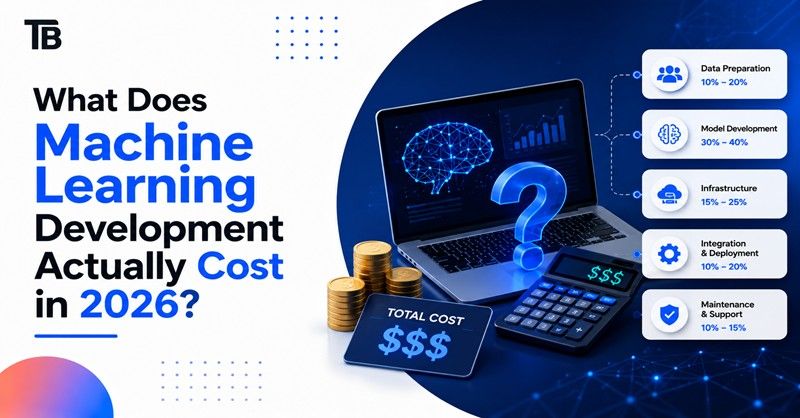
Building an ML app typically costs between $40,000 and $250,000+, driven mainly by data readiness, model complexity, and integration depth — not by the “type” of app alone. The table below reflects current market ranges so you can budget realistically.
| Tier | Typical Capabilities | Cost Range | Timeline |
| Basic | Core data handling, simple algorithms, limited predictions | $30,000 – $50,000 | ~3 months |
| Mid-Level | Recommendation engine, predictive analytics, API integrations | $40,000 – $150,000 | 3 – 6 months |
| Advanced | NLP, deep learning, real-time inference, image recognition, IoT | $120,000 – $250,000+ | 6 – 12 months |
Three factors move the number most: data quality (dirty or scattered data can add weeks of engineering), compute and infrastructure (real-time inference and large models cost more to run), and compliance (regulated industries like healthcare and finance require extra validation). Ask any vendor to break the machine learning development cost into data, modeling, integration, and ongoing MLOps — a single lump sum usually hides risk. Custom ML solutions priced transparently almost always beat “cheap” builds that skip data engineering and pay for it later in rework.
Build In-House or Hire a Machine Learning App Development Company?
For most enterprises and startups, partnering with a specialized company is faster and lower-risk than hiring a full in-house ML team from scratch because the talent bottleneck is real and expensive. The right model depends on your data maturity, budget, and long-term AI ambitions.
| Factor | In-House Team | ML Development Partner |
| Time to first model | Slow — hiring + ramp-up | Fast — existing team and playbooks |
| Upfront cost | High (salaries, tooling, infra) | Predictable project-based pricing |
| Talent access | Competitive and scarce | Immediate, cross-domain |
| Best for | Core, ongoing AI as a product | MVPs, first builds, capacity scaling |
| Risk | High if it’s your first ML project | Lower — proven delivery process |
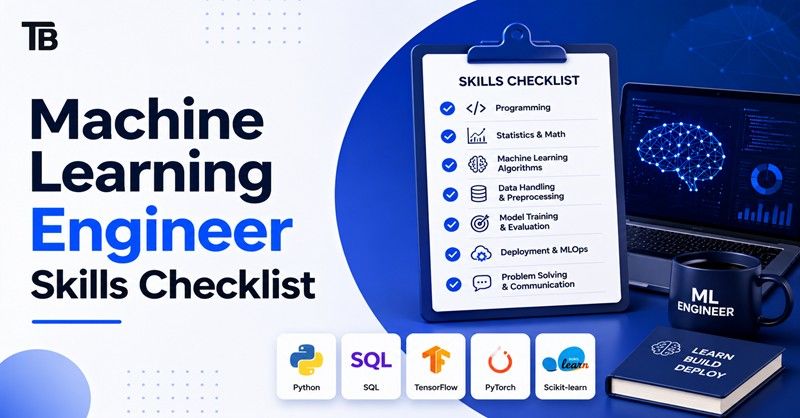
McKinsey notes that large companies are roughly twice as likely to hire ML engineers and MLOps talent a signal of how competitive that hiring market has become. A capable machine learning app development company closes that gap immediately, bringing data engineers, ML engineers, and MLOps specialists who’ve shipped before. When evaluating partners, weigh their delivery track record, data-engineering depth, and post-launch support against the ML engineer skills your project actually demands — not just their model portfolio.
Conclusion
Machine learning app development has crossed from experimental to essential. The data is unambiguous: adoption is nearly universal, but real value stays concentrated among the minority of organizations that scale ML into their workflows with clean data, strong MLOps, and genuine workflow redesign. The winners in 2026 won’t be the ones with the fanciest neural networks — they’ll be the ones who operationalized ML fastest and most responsibly.
Your next move is simple: pick one high-impact use case, confirm your data can support it, and build a focused pilot that proves ROI in 90 days. Whether you build in-house or bring in an experienced partner, treat data engineering and monitoring as first-class work, not afterthoughts. That’s the difference between an ML app that ships and quietly delivers and one that stalls in a demo. Start small, measure hard, and scale what works.