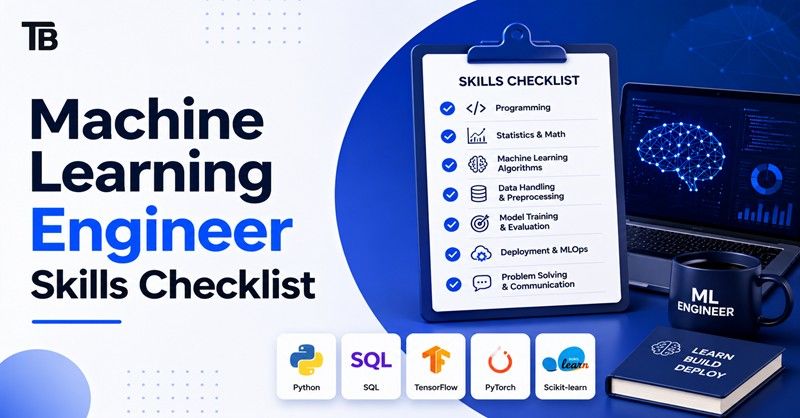
The machine learning engineer skills that matter most in 2026 are production-grade Python, deep learning frameworks (PyTorch, TensorFlow), data preprocessing and feature engineering, model deployment and MLOps, and applied evaluation judgment. Hiring managers should weight shipping experience over research credentials; roughly 80% of ML models never reach production, and that failure is almost always an engineering gap, not a modeling one.
Most hiring teams still screen ML candidates like data scientists; Kaggle scores, paper citations, clever notebooks. Then the model sits in a repo for eight months. The gap between the model works and the model serves 10,000 requests a second without drifting is the entire job. This checklist is built around that gap.
Key Takeaways:
- Gartner and VentureBeat analyses have long put the share of ML models that never reach production at roughly 80–87%.
- Python remains the near-universal baseline: it appears in the overwhelming majority of ML engineering job specs, alongside PyTorch or TensorFlow.
- MLOps and deployment skills not algorithm invention are the most common single point of failure in enterprise ML hiring.
- Interviewing for reproducibility and monitoring habits predicts on-the-job success better than take-home model accuracy.
What Does a Machine Learning Engineer Actually Do?
A machine learning engineer builds and operates the systems that turn a model into a running product. They are software engineers first, modelers second.
The day-to-day breaks into four loops. First, data: ingesting messy sources, building pipelines, and doing the data preprocessing and feature engineering that determines most of your model’s ceiling. Second, modeling: choosing an approach, training, tuning, and critically knowing when a gradient-boosted tree beats a neural network. Third, deployment: packaging the model, serving it behind an API, versioning it, and handling latency and cost. Fourth, operations: monitoring drift, retraining, rolling back, and explaining to a CFO why accuracy dipped last quarter.
If a candidate can only speak fluently about loop two, you’re hiring a researcher. That’s a legitimate role it’s just not this one. The skills required for a machine learning engineer span all four loops.
Why Do So Many ML Hires Fail Inside Their First Year?
They fail because the organization hired for modeling talent and then asked for infrastructure work.
Across the enterprise ML engagements our team at Technobrave has audited, a consistent pattern shows up: when a client comes to us with a “stalled” ML initiative, the model itself is rarely the problem. In the majority of these audits, the blocker is upstream or downstream; no reliable feature pipeline, no reproducible training environment, no monitoring, or no defined owner for retraining. In one mid-market logistics engagement, a demand-forecasting model that had been “done” for five months was blocked entirely by a data pipeline that couldn’t refresh nightly. The fix took three weeks. The model was never touched.
The lesson for CTOs and CIOs: before you write the job description, audit which loop is actually broken. Hiring a brilliant modeler into a broken pipeline problem just adds salary to the burn rate.
How Is Deep Learning Different from Classical Machine Learning and Why Should a Hiring Manager Care?
The deep learning vs machine learning distinction matters because it changes your cost structure, your team, and your infrastructure.
Classical ML logistic regression, random forests, gradient boosting via scikit-learn works on structured, tabular data. It trains on a laptop, explains itself reasonably well, and covers the majority of enterprise use cases: churn, fraud, pricing, demand forecasting. Deep learning neural networks built in PyTorch or TensorFlow earns its cost on unstructured data: images, audio, natural language, video.
A candidate who reaches for neural networks on a 50,000-row tabular dataset is telling you something about their judgment. The right answer to most business problems is the boring model that ships. Ask candidates to justify not using deep learning, and listen to how they reason about cost, latency, and interpretability. That single question separates the engineers from the enthusiasts.
Machine Learning Engineer Skills Checklist — The Detailed Guide
Use this as a scorecard. Score each candidate 1–5 per line; anything under 3 in Tier 1 is a hard stop.
Tier 1: Non-Negotiable Foundations
| Skill Area | What to Verify |
| Python (production-grade) | Type hints, testing, packaging, async basics. Not just notebook fluency. |
| Data preprocessing & feature engineering | Can they handle leakage, imbalance, missing data, and time-based splits correctly? |
| Classical ML (scikit-learn) | Model selection, cross-validation, and honest metric choice (not just accuracy). |
| SQL & data pipelines | Can they pull, join, and shape data without waiting on a data engineer? |
| Statistics & evaluation | Precision/recall trade-offs, confidence intervals, A/B test design. |
Tier 2: Production & Scale
| Skill Area | What to Verify |
| Model deployment / MLOps | Docker, CI/CD for models, model registry, versioning, rollback. |
| Deep learning frameworks | PyTorch or TensorFlow — depth in one beats surface familiarity in both. |
| Cloud platform | AWS SageMaker, GCP Vertex AI, or Azure ML — at least one, hands-on. |
| Monitoring & drift detection | Do they have a habit of instrumenting models, or do they treat it as someone else’s job? |
| Cost awareness | Can they estimate inference cost per 1,000 predictions? Most can’t. |
Tier 3: Multipliers
| Skill Area | What to Verify |
| Neural network architecture depth | Transformers, embeddings, fine-tuning vs. training from scratch. |
| LLM & RAG systems | Increasingly a baseline expectation, not a bonus. |
| Communication with non-technical stakeholders | Can they explain a false-positive rate to a COO? |
| Domain knowledge | Fintech, healthcare, and logistics ML each carry distinct constraints. |
Machine learning developer skills and machine learning engineer qualifications overlap heavily but the engineer is the one accountable when the endpoint returns a 500 at 2 a.m.
What Should You Actually Ask in the Interview?
Replace the algorithm quiz with failure-mode questions. Candidates rehearse LeetCode. They do not rehearse post-mortems.
Four questions that work:
- “Tell me about a model you shipped that degraded in production. How did you find out?” — If they’ve never had one degrade, they’ve never shipped one.
- “Walk me through how you’d detect data leakage in a dataset you didn’t build.” — Tests real preprocessing instinct.
- “Here’s a business metric. Pick the ML metric that maps to it, and tell me where they diverge.” — Tests judgment, not recall.
- “What would you not automate?” — Reveals maturity.
Pair this with a small, realistic take-home: give them a messy CSV and a deployment target, not a clean dataset and an accuracy score.
Should You Hire In-House, or Partner With an ML Development Team?
Hire in-house when ML is your product; partner when ML is a capability inside your product.
| Factor | In-House Hire | ML Development Partner |
| Time to first model in production | 4–9 months (hiring + ramp) | 6–12 weeks |
| Cost structure | Fixed salary + equity + infra | Project-scoped, variable |
| Risk if it doesn’t work out | High — replacement cycle restarts | Low — contract ends |
| Best for | ML-native products, ongoing R&D | Defined outcomes, first ML initiative, capacity gaps |
| Knowledge retention | Stays in-house | Requires deliberate handover clauses |
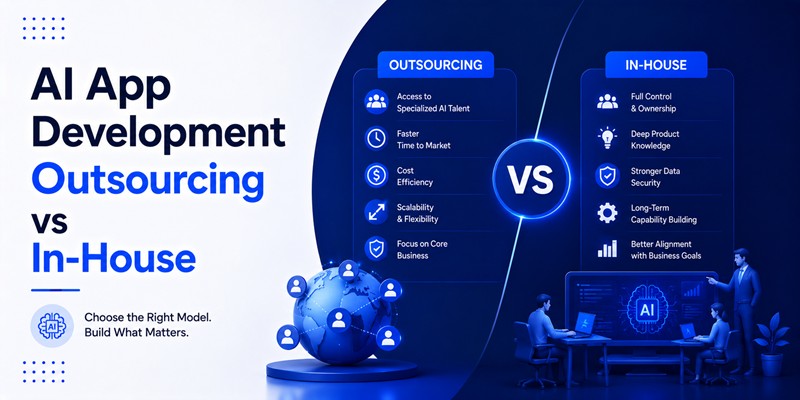
For most SMBs and startups, the honest answer is a hybrid: bring in an ML development partner to ship the first production system and build the pipeline, then hire an in-house engineer to own and extend it. That sequencing dramatically de-risks the first hire because now you’re hiring someone into a working system, not a blank repo.
If you’re still scoping feasibility, understanding machine learning development cost before you commit to a headcount is usually the cheaper first move. Our AI model development services and broader ML development services are structured around exactly this sequencing.
Ready to Hire? Your 5-Step Action Plan
- Audit which loop is broken. Data, modeling, deployment, or operations. Write the job description against that, not against a template.
- Score every candidate against the Tier 1 table. No exceptions for impressive résumés.
- Run a failure-mode interview, not an algorithm quiz. One shipped-and-broke story beats three published papers.
- Give a messy take-home with a deployment target. Clean data teaches you nothing about the candidate.
- Decide build vs. partner before you post the role. If your first production model is still theoretical, a partner ships faster and teaches your future hire what “done” looks like.
Conclusion
The machine learning engineer skills that predict success in 2026 are unglamorous: pipelines, deployment, monitoring, and the judgment to pick a boring model that ships. The industry’s persistent 80%+ model-abandonment rate isn’t a talent shortage — it’s a hiring-criteria mismatch. Screen for the four loops, weight Tier 1 ruthlessly, and be honest about whether your first ML win should come from a hire or a partner.
If your model is already stuck in a repo, the checklist above will tell you within an afternoon exactly which line item you’re missing.