Key Takeaways:
- Maintenance alone adds 15–25% of your original development cost every year — a $200,000 project can cost $30,000–$50,000 annually just to keep running.
- Scope creep is responsible for budget overruns in roughly 50% of software projects, often adding 20–40% to the final cost.
- Cloud infrastructure costs are frequently underestimated — scaling a live application can increase monthly hosting bills 3x to 10x beyond initial estimates.
- Technical debt compounds silently: teams spend 20–40% of their development time fixing or working around code shortcuts taken in earlier sprints.
- Third-party APIs, compliance audits, and QA rework combined account for $15,000–$80,000 in unplanned costs on a typical mid-size software project.
You got the quote. You built the budget. You even added a 10% contingency buffer because you read somewhere that was smart. Then, six months into your custom software project, the invoices stopped matching the spreadsheet.
This is one of the most common and costly surprises in software development in 2026 and it happens to experienced founders, not just first-timers. The hidden costs of custom software development are rarely discussed upfront because they’re uncomfortable to talk about, easy to overlook during scoping, and often don’t surface until you’re already deep into the build.
This blog post will walk you through every significant cost category that vendors rarely mention in proposals: from scope creep and infrastructure to technical debt, compliance, and what happens when you pick the wrong development partner. If you’re planning a custom software build, this is the full picture no one gave you before.
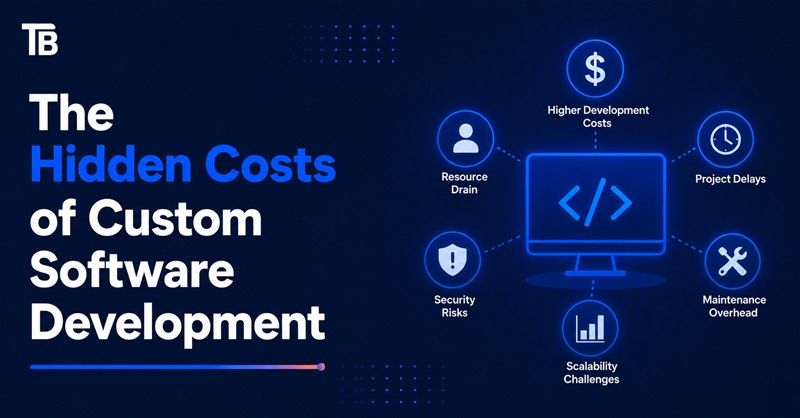
What Are the Hidden Costs of Building Custom Software in 2026?
Scope Creep: The Silent Budget Killer
Scope creep is the gradual expansion of a project’s requirements beyond what was originally agreed upon. It rarely looks dramatic. One week it’s “can we add a filter to this report?” The next it’s “we should really support bulk uploads.” Individually, each request sounds minor. Cumulatively, they derail timelines and inflate budgets.
Research consistently shows that scope creep contributes to budget overruns in roughly 50% of software projects. When requirements grow by 20%, development costs can grow by 30–40% because new features create integration work, require additional QA, and extend timelines — all of which generate overhead beyond just writing new code.
A common scenario: a founder scopes a workflow automation tool for their operations team. Midway through, marketing wants dashboards added. Then finance wants export formats. By launch, the project has grown by half — but the contract only covered the original scope.
How to minimize it: Insist on a formal change request process from day one. Any feature added after sign-off should go through written approval with an updated cost and timeline estimate. This sounds bureaucratic until the first time it saves you $20,000.
Post-Launch Maintenance: The Cost That Never Ends
Launching your software is not the finish line. It’s the starting gun for ongoing maintenance costs that most budgets completely ignore.
On average, annual software maintenance costs run 15–25% of the original development cost. For a $150,000 project, that’s $22,500–$37,500 per year — every year — for dependency updates, security patches, bug fixes, compatibility updates as browsers and operating systems evolve, and minor performance tuning.
This is what’s often called the total cost of ownership (TCO) in software development, and it almost never appears in a vendor’s initial proposal. TCO extends far beyond build cost and includes maintenance, infrastructure, support, and upgrades over the life of the product.
A SaaS product that costs $200,000 to build will likely cost $400,000–$500,000 over three years once ongoing maintenance is factored in.
How to minimize it: Ask your vendor for a post-launch support estimate before signing. Budget at least 20% of your build cost annually for maintenance — and if the vendor can’t give you a maintenance roadmap, treat that as a red flag.
Learn about TechnoBrave’s SaaS Development services for projects built with long-term maintenance in mind.
Cloud Infrastructure and Scaling Costs
Almost every modern software application runs on cloud infrastructure — AWS, Google Cloud, Azure, or a similar platform. What catches founders off guard is how quickly those costs climb once real users show up.
In development and early testing, a cloud bill might be $200–$500 per month. Once the application goes live and traffic increases, costs can multiply 3x to 10x depending on architecture decisions made early in the build. Poorly optimized database queries, inefficient caching, or an architecture that doesn’t scale horizontally can turn a $500/month server bill into $5,000/month almost overnight.
There are also hidden layers within infrastructure costs: content delivery networks (CDNs), backup storage, outbound data transfer fees, and logging services all add to the monthly total in ways that aren’t obvious until you see the invoice.
How to minimize it: Before development starts, ask your vendor for an infrastructure cost projection at three levels: current (development), expected launch traffic, and 10x launch traffic. A developer who can’t answer this question in detail is not thinking about your long-term budget.
Third-Party API and Licensing Fees
Modern software rarely runs on its own code alone. Most applications integrate with payment gateways, mapping services, identity verification providers, email platforms, analytics tools, and communication APIs. Each of these has a cost — and very few project quotes account for them.
Common licensing and API fees that catch teams off guard include:
- Payment processing: Stripe or Braintree charge 2.7–2.9% per transaction plus a flat fee. At volume, this is a meaningful ongoing cost.
- Identity verification: services like Twilio Verify or Onfido can run $0.50–$2.00 per user verification.
- Mapping and geolocation: Google Maps API charges based on usage, and at scale, a mapping-heavy app can incur $1,000–$5,000/month in API fees alone.
- SMS and communication services: transactional messaging through Twilio or similar providers adds up quickly in notification-heavy applications.
On a mid-size product, unplanned third-party licensing costs commonly add $5,000–$20,000 per year.
How to minimize it: Request a full third-party dependency audit as part of your project scoping. Every external service used in your application should appear in a cost projection document before development begins.
QA, Testing, and Bug Fixing After Launch
Quality assurance should account for 20–30% of total development time — but in projects with tight timelines or budget pressure, QA is the first thing to get compressed. The result is a product that launches with more bugs than planned, creating a spike in post-launch bug-fixing costs that no one budgeted for.
Post-launch bug fixing is significantly more expensive than fixing issues during development. A bug caught during QA might take two hours to fix. The same bug found by a live user, after it’s caused data issues or interrupted a workflow, can take a day or more to diagnose, fix, and re-deploy — plus time spent on user communication and data cleanup.
Beyond bugs, QA also includes performance testing, security testing, and compatibility testing across browsers and devices. Skipping or shortening these phases doesn’t eliminate the cost — it just defers it to a less convenient and more expensive time.
How to minimize it: Never negotiate QA time out of a development contract to save money. The savings are illusory. Insist that QA costs be itemized separately in any proposal so you can see exactly what’s planned.
Technical Debt: Paying Tomorrow for Shortcuts Today
Technical debt refers to the long-term cost of taking shortcuts in code or architecture to meet short-term deadlines. It’s one of the least visible and most destructive hidden costs in software development.
Every time a developer writes a quick fix instead of a proper solution, or chooses a faster-to-build but harder-to-maintain architecture, the codebase accumulates debt. This debt compounds. Developers spend increasing amounts of time navigating and working around existing problems rather than building new features. Research from the Software Engineering Institute suggests teams spend 20–40% of their development time on issues related to accumulated technical debt.
For a startup paying $15,000–$25,000 per month in development costs, that’s $3,000–$10,000 per month effectively wasted on debt servicing rather than product progress.
Technical debt also makes your codebase fragile: changes become riskier, onboarding new developers takes longer, and scaling the system becomes increasingly painful.
How to minimize it: Ask vendors how they handle technical debt in their development process. Reputable teams will have a policy for code reviews, refactoring sprints, and architectural documentation. Avoid any team that treats technical debt as someone else’s future problem.
Compliance, Security Audits, and Legal Overhead
If your software handles personal data, financial information, or health records, compliance is not optional — and it carries real costs that many first-time founders discover only after launch.
Depending on your industry and market, you may need to comply with GDPR, HIPAA, SOC 2, PCI DSS, or regional data protection regulations. Each of these has associated costs:
- A SOC 2 Type II audit typically costs $30,000–$100,000 for the first year.
- GDPR compliance implementation for a mid-size SaaS product can add $10,000–$40,000 in development costs.
- Penetration testing, often required for enterprise clients, runs $5,000–$30,000 per engagement.
Legal review of terms of service, privacy policies, and data processing agreements adds another $5,000–$15,000 if you’re doing it properly.
None of these costs typically appear in a standard custom software development quote.
How to minimize it: If your application will handle sensitive data, include a compliance scoping session in the pre-development phase. Identify which regulations apply early, because retrofitting compliance into a live product costs far more than building it in from the start.
The Cost of Choosing the Wrong Partner
Every cost on this list is manageable with the right software development partner. The wrong partner makes all of them worse — and adds entirely new ones.
Signs you’ve chosen the wrong partner often only become visible mid-project: missed deadlines, poor communication, opaque billing, high staff turnover on your project, and a codebase that experienced developers describe as “a mess.” By the time these signals are clear, you may be $100,000–$300,000 into a project that needs to be partially or fully rebuilt.
Switching vendors mid-project typically costs 30–50% of what you’ve already spent, plus the time lost, plus the cost of the new vendor ramping up on someone else’s codebase.
How to minimize it: Vet vendors rigorously before committing. Ask for references from clients whose projects are 12–18 months post-launch — not just at launch. Review code samples or request a technical audit of their previous work. A transparent vendor will welcome scrutiny; a problematic one will avoid it.
Hidden Software Development Costs at a Glance
| Hidden Cost | Typical Range | When It Hits |
|---|---|---|
| Scope Creep | +20–40% of project budget | During development |
| Post-Launch Maintenance | 15–25% of build cost per year | Ongoing after launch |
| Cloud Infrastructure Scaling | 3–10x initial cloud bill | Post-launch, as traffic grows |
| Third-Party API & Licensing | $5,000–$20,000/year | Ongoing after integration |
| QA & Post-Launch Bug Fixing | $10,000–$50,000 | First 3–6 months post-launch |
| Technical Debt | 20–40% of dev time wasted | Mid-project through maturity |
| Team Onboarding & Knowledge Transfer | $8,000–$48,000 per transition | On team changes |
| Compliance & Security Audits | $20,000–$150,000 | Pre-launch or first enterprise deal |
| Performance Optimization | $10,000–$50,000 | Post-launch, at scale |
| Wrong Partner / Rebuild Cost | 30–50% of prior investment | When things go wrong |
Conclusion
Knowing what you’re actually signing up for is not pessimism — it’s good business. The founders who navigate custom software projects successfully aren’t the ones who got cheaper quotes. They’re the ones who got complete ones.
Every cost outlined in this post is manageable when you plan for it. Scope creep has a solution: change control. Maintenance costs can be budgeted. Technical debt can be managed with disciplined engineering practices. Compliance overhead can be scoped upfront. The variable that determines whether any of this stays manageable is the partner you choose.
At TechnoBrave, we run a cost transparency session with every founder before a single line of code is written. We walk through infrastructure projections, maintenance estimates, third-party dependencies, and compliance requirements — so the number you budget is the number you spend, not a starting point for surprise invoices.
Frequently Asked Questions
What are the hidden costs of building custom software?
The most significant hidden costs include post-launch maintenance (15–25% of build cost annually), scope creep additions during development (typically 20–40% budget overrun), cloud infrastructure scaling (3–10x your initial estimate), third-party API and licensing fees ($5,000–$20,000/year), QA and bug-fixing after launch, technical debt remediation, team onboarding when staff changes, compliance and security audits ($20,000–$150,000 for regulated industries), and performance optimization work. Most vendor quotes cover only the initial build, leaving all of these costs as surprises.
Why does custom software cost more than expected?
Custom software almost always costs more than the initial quote because proposals reflect ideal conditions. In reality, requirements evolve (scope creep), timelines slip, integrations are more complex than scoped, and post-launch costs maintenance, infrastructure, compliance were never in the original estimate. A common budget overrun scenario: a project quoted at $150,000 hits $200,000 during development due to scope changes, then costs $35,000/year to maintain. Over three years, the real total is $305,000 against an initial expectation of $150,000.
How much does software maintenance cost per year?
Software maintenance typically costs 15–25% of the original development cost per year. A $100,000 application will cost $15,000–$25,000 per year to maintain covering security patches, dependency updates, bug fixes, minor feature updates, and compatibility work as browsers and operating systems evolve. SaaS products with active user bases tend to sit at the higher end of this range. Infrastructure and third-party licensing costs are separate and additional to this figure.
What is technical debt and how does it increase cost?
Technical debt is the accumulated cost of shortcuts, quick fixes, and suboptimal architectural decisions made during development; usually to meet deadlines or stay within budget in the short term. It increases cost by making future development slower and riskier: developers spend 20–40% of their time navigating or working around existing problems rather than building new features. At a development rate of $15,000–$20,000/month, that means $3,000–$8,000 per month effectively wasted. Technical debt also makes the system harder to scale, increases the risk of outages, and raises the cost of onboarding new developers.